




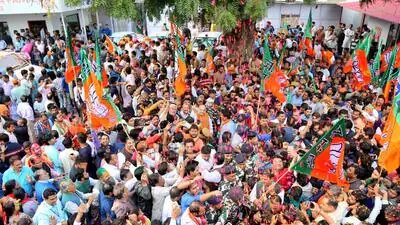
Kolkata: As the Bharatiya Janata Party (BJP) inched closer to a landslide victory in West Bengal, celebrations started outside the BJP’s office both in Kolkata and Salt Lake. Besides sweets, BJP supporters and workers were seen sharing jhalmuri (spicy puffed rice). The popular Bengali snack had hit the headlines after Prime Minister Narendra Modi was seen enjoying it at a roadside stall during his election campaign ahead of the second phase. “I ate jhalmuri, but TMC felt the jhal (hot and spicy),” Modi had said.

BJP supporters played holi with saffron colour and shouted Joy Shree Ram slogans.
At the BJP’s office in Salt Lake cooks could be seen preparing fish curry along with rice, vegetable and dal for the lunch.
The BJP, which has often been accused to be a proponent of vegetarianism, started projecting fish in its campaign in the run up to the assembly polls. Fish is part of the daily platter in most homes in Bengal.
The TMC relentlessly campaigned to tag BJP as a “party of outsiders” that is against Bengal’s culture.
In contrast, the Trinamool office in Kolkata was deserted with only a handful party workers present inside.
On April 2 while addressing a rally in Bhabanipur in South Kolkata, Union home minister Amit Shah had said that there was a shortcut to bring a change in West Bengal – defeat Mamata Banerjee, the sitting chief minister, in Bhabanipur her own constituency.
“The responsibility of bringing a change in West Bengal lies in the hands of the voters of Bhabanipur. To bring change we will have to win one seat after another to reach the target of 170. But I have a shortcut. If the voters of Bhabanipur ensure this one seat only, change will come on its own,” Shah had said in an election meeting in Bhabanipur on April 2.
On Monday, more than a month later, Banerjee was defeated by BJP’s heavyweight candidate Suvendu Adhikari in Bhabanipur by 15,114 votes.
“It was very important to defeat Mamata. Her political sanyas has started. The Muslims of Bhabanipur didn’t vote for me. They voted whole-heartedly in her favour. I got the blessings of the Hindus, Sikhs, Jains and other communities,” Adhikari told reporters after receiving the winner’s certificate from the poll panel.
BJP not just clinched Bhabanipur, but bagged five of the 11 seats in Kolkata. These seats – Rashbehari in South Kolkata and Jorasanko, Shyampukur, Maniktala and Kashipur–Belgachia in North Kolkata were considered the strongholds of the TMC.
The BJP won five seats including Kolkata Port, Ballygunge, Chowranghee, Entally and Beleghata.
In 2021 the TMC won all 11 seats in Kolkata region.
After Mamata Banerjee was defeated at Nandigram in Purba Mednipur by her former protégé Suvendu Adhikari, she returned to Bhabanipur and won the seat by defeating BJP’s Priyanka Tibrewal with a margin of 58,832 votes.
This time Kolkata recorded a huge turnout. While in 2021 the city (North Kolkata and South Kolkata) registered a 62.3% turnout, this year 88.59% polling was recorded in the areas.
Political analysts said that while on one hand it was because of the SIR that people came out in large numbers to vote, the anti-incumbency factory played a major role in pushing up the voter-turnout in the cities and other urban conglomerates including Kolkata.
“Unlike the rural areas, majority of the voters in large cities like Kolkata are not dependent on the government’s schemes. Anti-incumbency and the SIR-effect played a key role here,” said Biswanath Chakraborty, political analyst, told the media.