





Despite escalating tensions near the Strait of Hormuz, US-Iran ceasefire remains intact, according to Pentagon Chief Pete Hegseth.
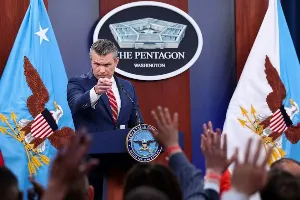
The ceasefire between the United States and Iran remains operational despite recent military activities occurring around the strategically important Strait of Hormuz, as stated by Pentagon Chief Pete Hegseth during a press briefing. On Tuesday, he indicated that President Donald Trump will make the determination regarding the truce’s future, suggesting a possibility that the US may endure some Iranian provocations as efforts continue to ease restrictions on vessel traffic in Hormuz.
Hegseth underscored that the initiative aimed at reopening the vital waterway, referred to as ‘Project Freedom,’ is distinct from the broader US-Israeli campaign against Iran, known as ‘Epic Fury.’ “The ceasefire is not over. Ultimately, this is a separate and distinct project, and we expected there would be some churn at the beginning, which happened,” Hegseth remarked.
Conflict escalated on Monday, marking the highest level of hostilities since the ceasefire commenced on April 8. Iranian forces reportedly targeted US Navy vessels, while the US responded by neutralising seven Iranian boats. Additionally, Iran launched missile and drone strikes against various targets in the United Arab Emirates, resulting in casualties.
Three individuals sustained injuries in an Iranian missile attack on the Fujairah Petroleum Industries Zone in the UAE. Furthermore, Iranian authorities claimed that a US offensive on a civilian vessel in the Gulf resulted in five fatalities.
Following the outbreak of US operations aimed at disrupting the Iranian blockade in Hormuz, traffic within the strait has largely ground to a halt, as ship tracking data illustrates. Hegseth maintained that the US has fortified security along the waterway, asserting that American naval forces, including destroyers and numerous aircraft, are providing continuous surveillance to ensure safe passage for commercial vessels. He stated, “We have established a powerful red, white and blue dome over the strait.”
While facilitating safe navigation for commercial shipping, Hegseth affirmed that Iranian vessels would be barred from transiting the waterway, confirming that the US blockade on Iranian ports remains active. However, details regarding the actual number of vessels being escorted by US forces have not been disclosed by officials.
In response to queries regarding the specifics of vessel traffic through the strait, top US General Dan Caine referred to the US Central Command for further information, indicating a division of responsibilities. He stated, “I’ll let CENTCOM talk to the number of ships they’re going to take through because they’re the nearest ones to talking to the commercial shippers.”
Meanwhile, Iranian officials have dismissed US assertions regarding control over the shipping lanes. Prior to the conflict, more than 20 percent of the world’s oil and natural gas shipments passed through the Strait of Hormuz. Despite this, Iran has been making claims of sovereignty over parts of the waterway, which had previously been treated as international territory.
Iranian Parliament Speaker Mohammad Bagher Ghalibaf contended that the US and its allies have jeopardised shipping and energy transit security, claiming, “The continuation of the status quo is intolerable for America.”
The ongoing conflict has led to a dramatic rise in oil prices globally, contributing to inflationary pressures in the US. The American Automobile Association reported an uptick in petrol prices, with the average cost reaching $4.48 per gallon, significantly higher than the levels before the outbreak of war.
Despite the increasing economic fallout, President Trump suggested that the price surge would be a minor cost to eliminate perceived nuclear threats from Iran. Later statements from Trump indicated that he expected the economic consequences of the conflict to deepen.
Following the Iranian blockade, it is estimated that approximately 1,550 vessels are currently stranded within the Strait of Hormuz. However, Hegseth claimed that the US has successfully navigated two American-flagged ships through the strait, emphasising that US measures are temporarily stabilising the situation, with plans to transfer responsibility to allied nations in the future. “We’re stabilising the situation so commerce can flow again, but we expect the world to step up at the appropriate time, and soon we will hand responsibility back to you,” Hegseth concluded.