







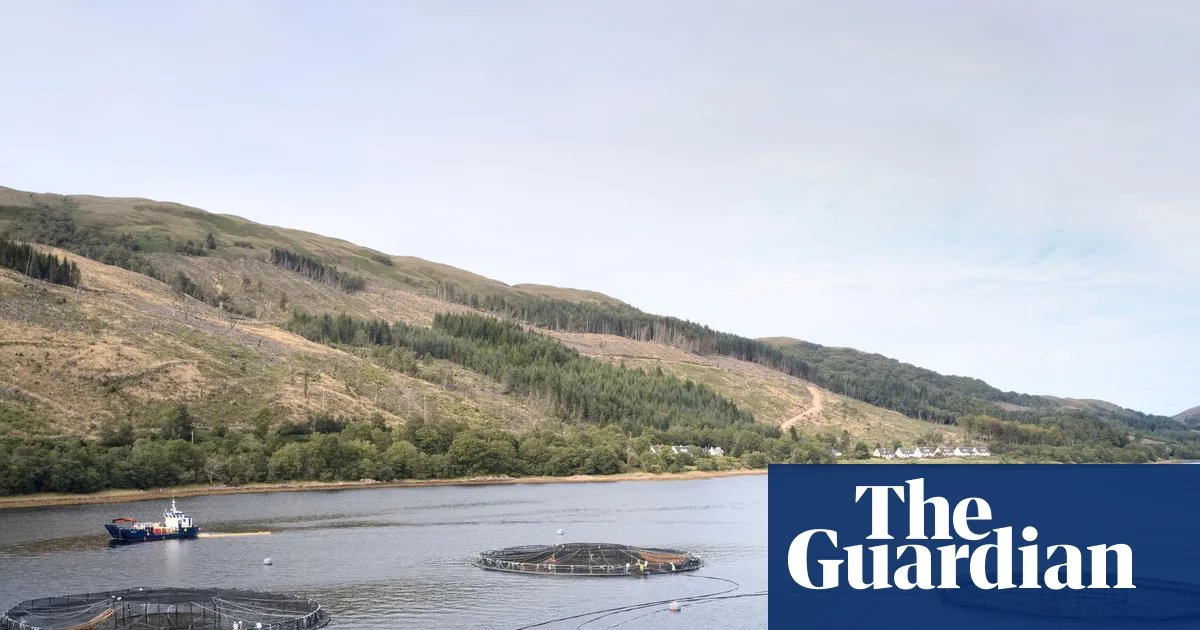
Your report (Norwegian fish farms polluting fjords with waste likened to ‘raw sewage of millions of people’, 4 May) is welcome, but the framing risks implying that this is a distinctly Norwegian problem. The biological and chemical processes generating that pollution are universal to open-net salmon farming, and they operate with equal force in Scottish waters.
Each tonne of salmon produced generates as much waste as 80 humans, discharged unfiltered directly into surrounding waters. Scotland had 215 open-net sea cage farms in 2025. A proposed expansion at Yell Sound in Shetland alone was calculated to produce effluent equivalent to 20 times the entire population of Shetland. An expansion of the farm in Loch Long, situated within a national park, was projected to produce effluent exceeding the sewage output of the entire population of Edinburgh. These are routine consequences of the industrial model, and there is nothing uniquely Norwegian about them.
The chemistry your report describes, nitrogen and phosphorus triggering eutrophication and oxygen depletion, applies equally to Scottish sea lochs and English river systems. It has been established that approximately 70% of nitrogen and 80% of phosphorus inputs to a salmon farm are lost to the environment. Fish farms currently enjoy a grandfathered exclusion from nitrate vulnerable zone legislation, just like they are exempt from meeting many animal welfare laws, and food chain information laws. This pollution is a core part of their business model: the industry would struggle to remain profitable if they were regulated to the same level as terrestrial farming systems.
It is worth noting that, despite a tentative call by the Scottish parliament’s rural affairs and islands committee for a moratorium on new farms if conditions don’t improve within a year, new permissions continue to be granted for ever-larger salmon farms, many of which are commissioned without an environmental impact assessment.
Norway’s pollution load is larger because Norway’s industry is larger. The underlying problem belongs to the whole of industrial salmon farming, and readers in Britain should understand that our own waters are not exempt.
Dr Mark Borthwick
Articora