








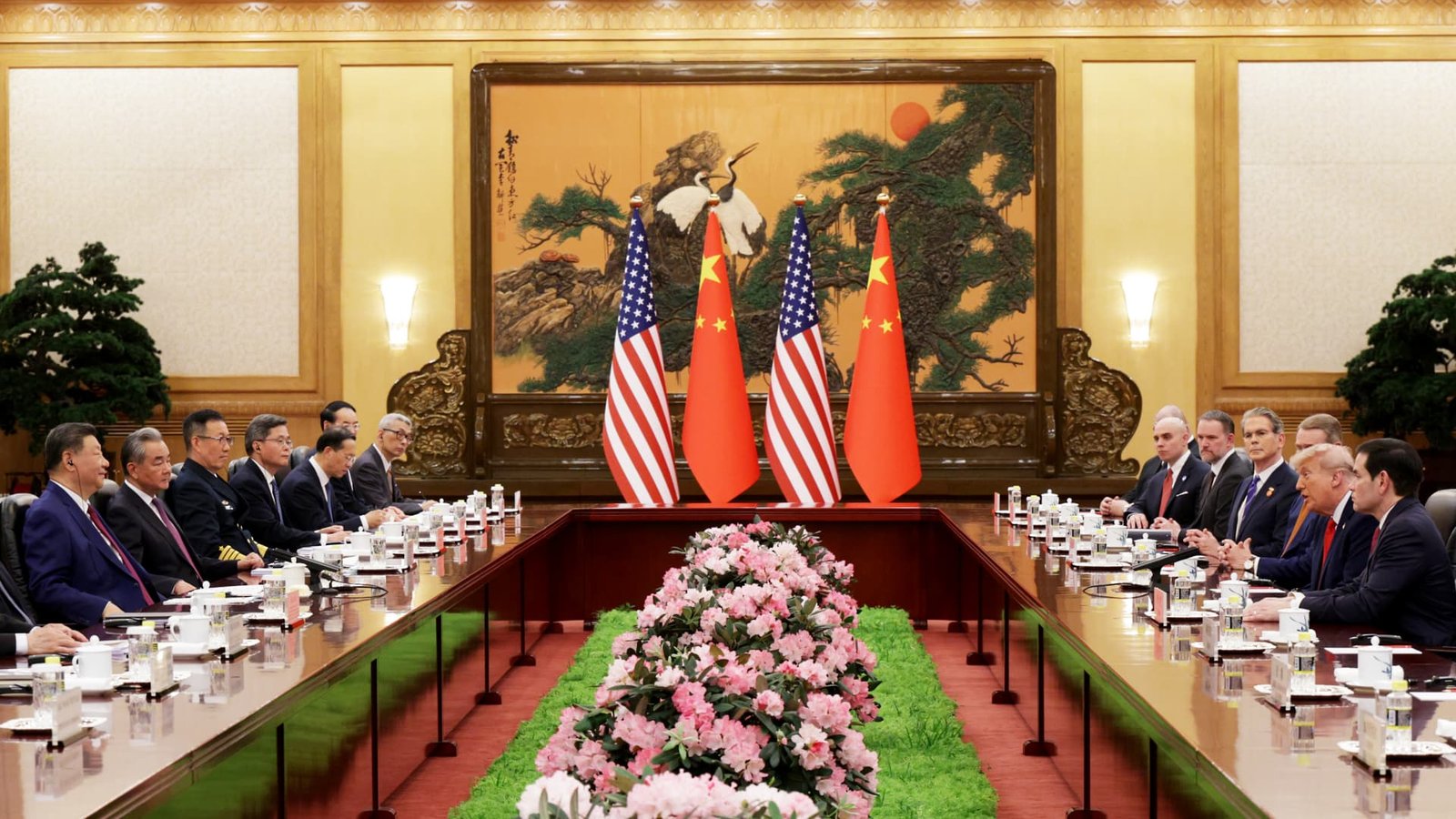
U.S. President Donald Trump and Chinese President Xi Jinping attend a bilateral meeting at the Great Hall of the People on May 14, 2026 in Beijing, China.
Alex Wong | Getty Images News | Getty Images
The U.S. and China agreed to forge more cooperative ties at their summit in Beijing on Thursday, in a high-stakes meeting full of friendly gestures between two countries that have been battling for years on issues ranging from intellectual property and human rights to technology and trade.
Here are five key points, based on the meeting’s readouts from the Chinese government and a White House official.
1. New positioning
Chinese President Xi Jinping and U.S. President Donald Trump agreed to develop a “constructive China-U.S. relationship of strategic stability,” according to Beijing’s official English readout of the summit. Beijing will treat this as the guiding framework for the next three years and beyond, he said.
The strategic positioning would be led by cooperation and “measured competition” with manageable differences, Xi said, according to the readout, while stressing that the framework must be translated into concrete actions.
“It signals a period of ‘managed stability’ that will hold for some time,” said Tianchen Xu, senior economist at Economist Intelligence Unit. While frictions are due to persist, “there will be a guardrail, and things won’t spiral out of the two sides’ control as they nearly did in 2025.”
2. Pre-summit meeting: ‘balanced and positive’
The two countries’ trade envoys reached “overall balanced and positive outcomes” at the preparatory summit in South Korea on Wednesday, according to Xi. That delegation was led by U.S. Treasury Secretary Scott Bessent and Chinese Vice Premier He Lifeng.
“Both sides should work together to preserve this hard-won positive momentum,” Xi said. Beijing welcomes deeper commercial engagement from the U.S., he said, and “China’s door to opening up will only open wider.”
The comments came as a dozen business leaders from some of the biggest American companies joined Trump’s visit, including Tesla’s Elon Musk and Nvidia’s Jensen Huang.
3. Deepening cooperation
Both sides should make better use of diplomatic and military communication channels, Xi said. He also called for deeper cooperation in economic and trade issues, agriculture and tourism.
Trump, Xi and their teams discussed ways to enhance economic cooperation, including expanding market access for U.S. businesses into China and increasing Chinese investment into American industries, according to a White House official.
Trump also called for continued efforts from Beijing to curb the fentanyl flows into the U.S. and ramp up purchases of American agricultural goods, according to the U.S. official.
4. Strait of Hormuz, oil purchase
The two sides also discussed the Middle East conflict, the crisis in Ukraine and the Korean Peninsula, according to the Chinese readout, which did not offer more details.
Trump and Xi agreed that the Strait of Hormuz must remain open to restore energy flows through the critical waterway, according to the White House official.
Xi reiterated Beijing’s opposition to the “militarization” of the energy artery and “any effort to charge a toll for its use,” the official said. China also expressed interest in purchasing more U.S. oil to wean off its reliance on Middle Eastern crude.
Both countries agreed that Iran can never have a nuclear weapon, the official said.
5. Taiwan: ‘most important issue’
Xi reserved his sharpest language for Taiwan, calling it “the most important issue in U.S.-China relations.”
The stakes, he said, could not be higher: “handle it well, the relationship holds; handle it badly, the two countries risk collision or conflict.”