





Date published:
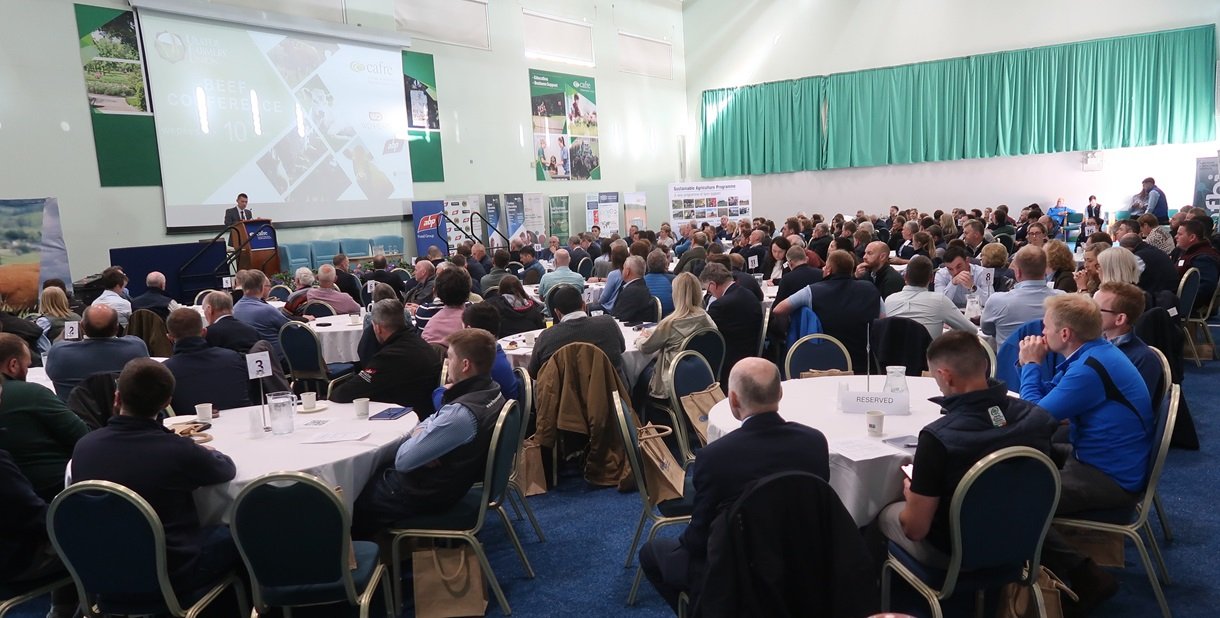
A Driving Productivity, Delivering Sustainability Beef Conference, delivered in partnership by the College of Agriculture, Food and Rural Enterprise (CAFRE) and the Ulster Farmers’ Union (UFU) was hosted at Greenmount Campus, Antrim.
Mark Scott, Head of College Support Services at CAFRE, opened the conference welcoming a full room of 200 delegates. Mark highlighted the focus of the conference was to look intentionally at the clear link between productivity and sustainability, emphasising that: “sustainability refers to economic, social and environmental factors.” Mark also explained that this is the focus at the CAFRE beef and sheep enterprises, with practical activities applied to achieve sustainability being demonstrated during the afternoon’s farm visit.
Beef markets
Colin Smith, Chief Executive Officer at the Livestock and Meat Commission (LMC) delivered a comprehensive overview of the global meat industry covering, production, consumption, supply, import and exports trends and price on a global, EU, UK and local scale. On a positive note, Colin highlighted that the demand for meat and protein is good: “We need to ensure customers choose local beef and, in a climate, where reliance on imports could grow, how can we differentiate our produce and retain that market share.” Colin also stressed the need to support local farm business to be resilient.
Meeting customer demand
“Delivering for the consumer is a vital aspect of the industry”, commented Peter Kennedy, Head of Agriculture and Fisheries at Marks and Spencer (M&S). Peter gave an insight into consumer behaviours and priorities which have shifted due to financial pressures, telling the audience that: “Overall, shoppers are being more intentional in how they spend, focusing on getting the best product at a fair price.”
There is a demand for high quality products on the shelves, this can be filled by local produce and can be delivered through focused integrated supply chains which ensure consistent supply, consistent quality and an ability to deliver against sustainability targets.
Business agility to improve resilience
An overview of the beef finishing systems at Trevor Sommerville’s County Tyrone farm highlighted the importance of maximising performance from all the resources within the business. Trevor encouraged others: “To drive efficiency within their beef finishing enterprises and to be fully aware of all options such integrated schemes to enhance the resilience of your business.”
Trevor’s dairy beef, rose veal and Wagyu systems ensure year-round cash flow and reduced risk within his business, enabling him to meet specific targets for production and current schemes within the Beef Sustainability Package.
Beef sustainability in its entirety
Professor Michael Lee, Vice Chancellor at Harper Adams University, delivered a thought-provoking overview of environmental sustainability and challenged how it’s perceived, measured and commented on what it does, and can deliver. Livestock based food production should be managed at every opportunity to reduce the environmental impact. However, animal protein, in this case beef, should be measured on the nutritional quality it delivers to the consumer, and the circular nature of grazing livestock needs to be better accounted for within environmental metrics.
Driving efficiency to deliver complete sustainability
“Economic and environmental sustainability are interdependent,” commented Dr Paul Crosson, Head of Beef Enterprise at Teagasc Grange. Paul discussed how improving productivity through greater efficiencies such as age at first calving, calving interval, days to slaughter and performance from pasture is the focus to improve profitability within Irish beef systems. This will also deliver against environmental targets through improved resource utilisation and greater returns on inputs.
“There are still many challenges to deliver this (economic and environmental sustainability) which can be achieved through research, and knowledge extension” commented Dr Crossan.
Focusing on delivering the complete system
Declan Rafferty another local farmer from County Tryone highlighted the clear focus he has on driving productivity within his suckler and beef systems. Declan’s spring and autumn calving herds maximise performance from the range of forages and habitats on the farm. Meeting efficiency targets relating to fertility, age at first calving, calving interval and daily live weight gains are key to maximising productivity and driving profitability.
Bull beef systems from both herds alongside a dairy beef system delivers year-round cash flow and strengthens the resilience of the business. This focus is complementary and ultimately delivers against the environmental targets for Declan’s enterprise.
During the farm visit to the CAFRE Beef and Sheep Centre, delegates saw firsthand how economic and environmental sustainability targets are inextricably linked. From breeding and genetics, animal health and welfare, targeted nutrition driven by forage-based systems all of which help to achieve productions targets and align with DAERA’s Sustainable Agriculture Programme.
CAFRE’s role in demonstrating how a focus on efficiency will drive productivity and improve profitability while delivering against environmental targets and social factors was clearly demonstrated during the stops along the visit.
For further information and to view the presentations delivered at the beef conference, please visit the CAFRE website.