








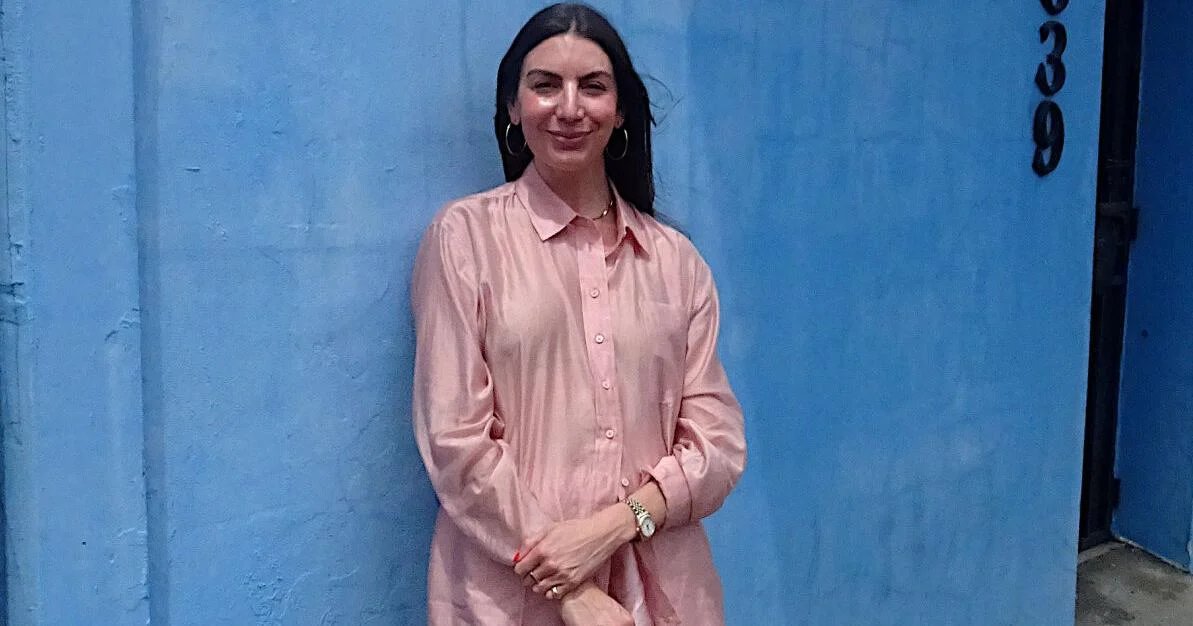
Behind the growing cluster of national retailers hanging their shingles at the center of Magazine Street’s Uptown commercial corridor is a Tennessee native who fell in love with New Orleans while attending grad school — and who has continued to market the city after moving to New York.
Retail adviser Carly Ibach started her career in Dallas at the corporate buying office for Neiman Marcus after majoring in public relations. Seeing the writing on the wall for the department store business, she pivoted to pursue an MBA from Tulane’s Freeman School of Business. That led to an internship at the local firm SVN Urban Properties, bolstering her understanding of the nexus between brand identity and store location.
In 2024, Ibach moved to New York to join Capricorn Retail Advisors as a director, but she’s remained involved in the New Orleans retail scene — where her focus has been on pitching locations on Magazine Street to national brands, earning her the nickname “Queen of Magazine” from the founder of her new firm.
Ibach has closed about 16 deals on the street, both before and after her move, including Reformation, Le Labo and Tecovas, where she also brokered the sale of the buildings. Most recently, she leased the same storefront for the second time, bringing Hill House Home to the former location of Stoney Clover Lane.
The following interview has been edited for length and clarity
What’re currently the big trends in the retail market?
A lot of the direct-to-consumer brands are really hot. You’re seeing the stuff that emerged on Instagram now finding physical spaces, and they’re usually starting in neighborhoods like Bleecker Street and Nolita in New York, Abbot Kinney in L.A., then becoming more mainstream and coming to smaller markets. It’s a buzzword that’s used a lot, but the ‘experiential’ part of shopping really is a thing. If they’re going to spend money, people want to feel like it was a special experience, and that can be achieved in a multitude of ways. Reformation is really cool because in the fitting room, they have a screen, and you can tap a shirt that you want and they’ll bring it to you, so it combines the online shopping that a lot of people love to do with going into a physical store.
How does that trend affect store designs and which locations are most appealing?
From one point of view, if you’re going to offer that much more inventory, you need to have larger stock rooms. Every brand kind of has its own ideal footprint, and that’s a sliding scale depending on the market and how much rents are. New Orleans rents are a lot less than they are in New York or Dallas, so a lot of brands can afford a larger space, even if they don’t necessarily need it. But pretty much every brand kind of has it down, like ‘We operate best out of 1,000 to 1,250 square feet.’ So when I’m working with a brand I go into it having a number in mind.

Pedestrians pass the Reformation store in the 3900 block of Magazine Street in New Orleans, Tuesday, Dec. 30, 2025. (Photo by Sophia Germer, The Times-Picayune)
Is New Orleans already on the radar of brands thinking about choosing their next spot to expand?
I’m definitely putting it on their radar. I’m getting in a lot of brands’ ears that probably weren’t necessarily thinking about New Orleans. The deal that I’m working on right now, that I’m down here for, they have stores in Nashville and Charleston and New York. To me, it seemed like they understood the southeastern consumer, so why not ask them? People also have an emotional attachment to the city, and if they’ve had good times here, when I pitch them on the city, they’re like, ‘I love New Orleans.’ It pulls at the heartstrings for so many people. A lot of brands wouldn’t look at it otherwise, but if they relate it to a fun time they had, they’re like, ‘Yeah, actually, let me look at it.’ I don’t think the same thing happens in Cincinnati.
Is there anything about pitching sites here that makes it especially challenging or appealing?
Weather is something for a lot of people, especially people from far away looking in. They hear about these hurricanes and they hear that Louisiana is sinking and these alarmist kind of things. And then people do hear about crime. People also hear that it’s a party city. Maybe some of it’s accurate, but for someone who doesn’t live it it might be a harder sell. On the flip side, the tourism is so strong here. The culture is amazing. Architecturally, it’s unique. A lot of the stores that I’m working on, people see them and they think, ‘Wow, I’d love to activate my brand in a unique shell like this’ — a double shotgun, it’s such a cool thing and so unique to the city. So I think you can set your store apart here versus just something more sterile in another city.
Does it ever take convincing? How do you convince them?
I have a lot of hard data related to the deals that I’ve done. Take Reformation, for instance. That store on Magazine Street performs so well compared to other cities — you would be absolutely shocked. Now that I have that data, I can show that to other brands and it gets their attention. It’s a snowball effect. It just takes a few proven concepts to do well here, and then everybody else is like, ‘I’ve got to get on the street too. That’s what our peers are doing.’
From your perspective in New York, what’s the next big thing in retail?
Honestly, the vintage scene is really big — resale, sourcing and things like that. People want to be unique. They don’t want to look like everybody else, so, I think that’s a huge thing.