









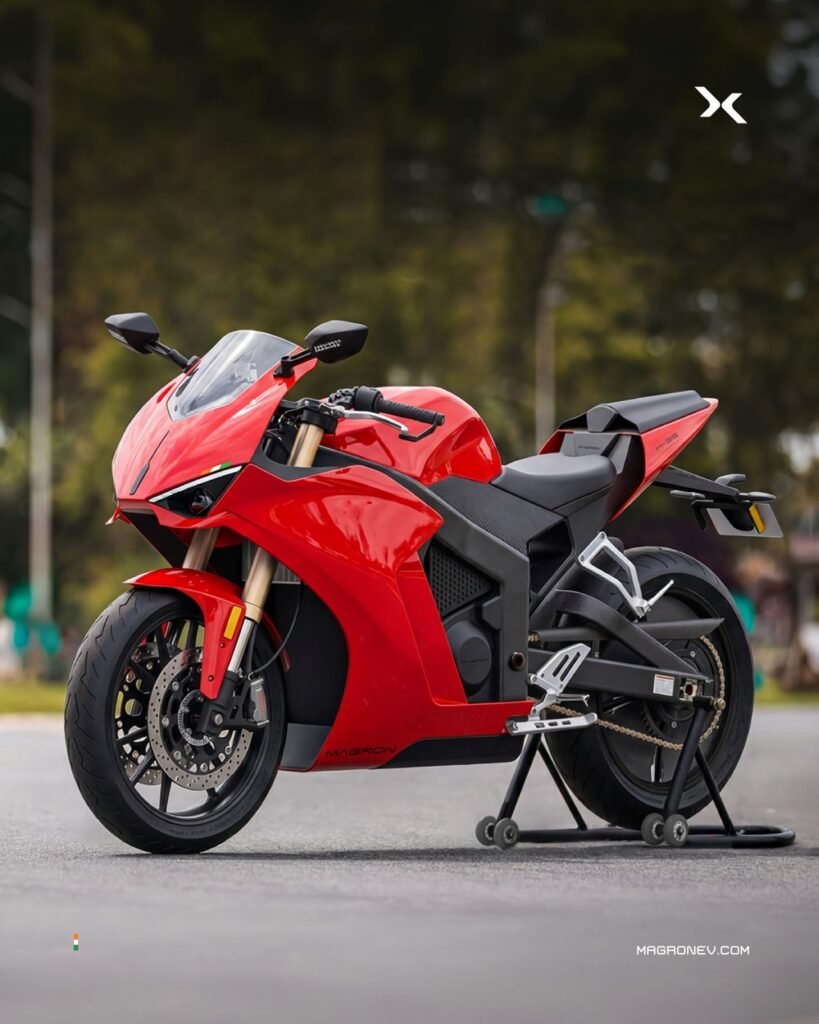
Magron: formally Magron Novus Private Limited, where the name stands for Mobility Architecture Global Research Organisation, is positioning itself not as another affordable commuter brand, but as a technology-led performance manufacturer with global ambitions.
The company’s current lineup consists of two machines: the H-35 and the C-20 Talon. They cover different ends of the market, but share the same underlying software ecosystem and a claimed first-for-India feature: wireless charging.

The H-35 produces 35 kW and 90 Nm of torque from a 12.2 kWh battery pack, with a claimed real-world range of 175–225 km. Magron quotes a 0–100 km/h time of 5.5 seconds and a top speed of 170 km/h: numbers that position it firmly in the performance segment. Charging time via the 6.6 kW fast charger is listed at 1 hour 50 minutes, while the 3.3 kW wireless charger offers a cable-free alternative. A limited-edition variant called the H-35 Carbon – badged ‘The Night Fury’ – is also listed on the site.

The C-20 Talon targets a broader audience. With 22.5 kW and 60 Nm, it offers a claimed range of 200–250 km depending on battery choice (8 or 10 kWh), a 0–100 km/h time of 6.5 seconds, and a top speed of 125 km/h. Both fast and wireless charging are carried over from the H-35. The pitch is accessible performance – described by Magron as a machine without gimmicks or overengineering. A blacked-out version, the C-20 Stealth, is also offered.

What distinguishes Magron from much of the Indian electric two-wheeler market is the software layer it has built around its hardware. The company’s Techverse ecosystem includes three components: Novus (the vehicle operating system), Shift (an AI-powered vehicle dynamics platform), and MIVA, the Magron Intelligent Virtual Assistant. MIVA handles voice commands, real-time ride data, battery and range updates, and what Magron describes as predictive assistance – learning ride patterns to suggest charging stops, flag maintenance needs, and optimise routes proactively. A companion connectivity platform called Novus Connect ties it all together.

The company’s technology partners listed on the site include Google and AWS, alongside several others. Academic partnerships with IIM Bangalore and IIM Lucknow suggest an effort to embed business and research credibility from India’s top management institutions early in the company’s development.

Magron describes its competitive position plainly: “We combine aspirational design with cost-efficient engineering, creating electric vehicles that can be copied in part, but never in full“. It is a bold claim for a brand that has yet to make it to market – both models are currently at the pre-order or subscription stage rather than in production. Whether the technology stack and the performance numbers hold up under real-world scrutiny remains to be seen.

That said, Magron is making moves in a segment where most Indian EV brands have focused on the mass-market commuter. A focus on intelligence, wireless energy transfer, and performance specs that rival established global players makes Magron one of the more interesting startups to watch in the Indian electric motorcycle scene right now.
Note: Magron’s products are not yet in production. No independent test data is available at the time of writing. All performance and range figures are brand-stated.