







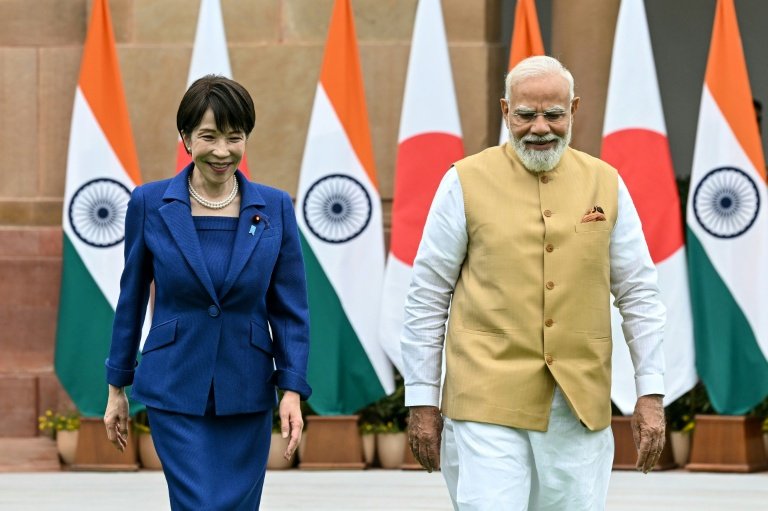
India and Japan will work more closely on critical minerals to boost “resilience” in their supply chains, Prime Minister Narendra Modi said Thursday, as the two huge Asian economies look to cut dependence on top exporter China.
Both India and Japan depend on imports for many such minerals, used in everything from electric vehicles, solar panels and smartphones to jet engines and guided missiles.
They have been seeking new suppliers, including the United States and other countries, as China’s dominance may leave them vulnerable to changes in their ties with Beijing.
“We have agreed to strengthen supply chain resilience in strategic sectors such as semiconductors, quantum technologies, and critical minerals,” India’s Modi said after talks with his Japanese counterpart Sanae Takaichi in New Delhi.
Japan and India are members of the Quad security alliance along with the United States and Australia, a group seen as a counterweight to China’s expanding presence in the Indian Ocean and wider Asia-Pacific region.
Takaichi said both Japan and India were facing challenges such as “weaponisation of the economy and non-market policies and practices”.
“We need to urgently build resilience in our critical minerals supply chains,” she said in her speech.
China on Monday imposed export controls on 20 Japanese companies, adding them to a growing blacklist in a months-long row with Tokyo.
Beijing said that these companies “have participated in enhancing Japan’s military capabilities”.
Tokyo has called the move “unacceptable and deeply regrettable” and demanded its reversal.
A joint statement by India and Japan on Thursday expressed “grave concerns” over non-market actions and warned, “arbitrary export restrictions”, particularly on critical minerals, could disrupt supply chains.
In a sign of camaraderie between the two leaders, Modi referred to Takaichi as his “little sister” and the Japanese premier responded by calling him “elder brother”.
Japanese and Indian businesses concluded investment deals worth $12.3 billion, the two sides said.
They form part of a Japanese pledge to pour $68 billion into India over 10 years.
Modi said the countries had also agreed to co-develop a naval radio antenna project aimed at boosting maritime surveillance.
New Delhi is particularly keen for Tokyo’s greater involvement with its capital and technology to aid its push towards building a domestic military hardware industry.
India’s Foreign Secretary Vikram Misri said that Asia’s second- and third-largest economies identified economic security and energy resilience as key pillars of the bilateral ties.
Earlier, Takaichi received a red-carpet welcome at the presidential palace in Delhi, where troops marched past in an honour guard parade.
Trade between the two nations in 2025–26 topped $27 billion, according to official figures from India.
Tokyo is also backing India’s high-speed railway project with a major loan, and has supported key urban infrastructure and metro rail projects in several cities.
bb/lga