







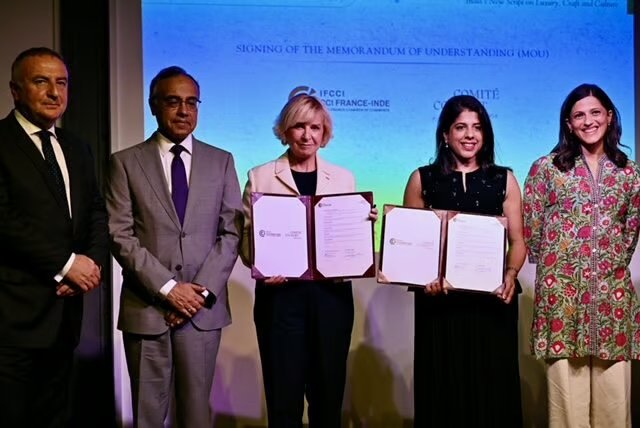
Marc-Antoine Jamet, LVMH’s secretary general, emphasised this on Wednesday, while speaking at the Swami Vivekananda Cultural Center in Paris’s 7th arrondissement: “I am here to confirm, as our chairman, Mr. Bernard Arnault, has asked me to tell you, that LVMH wants to do more in India, do more with India, and do more for India.”

In the presence of the Indian Ambassador to France and an audience of French and Indian luxury industry leaders, the CEO of the world’s leading luxury group took part in the signing ceremony for a memorandum of understanding (MOU) between the Comité Colbert and the Franco-Indian Chamber of Commerce and Industry (IFCCI). It is not so much this mutual commitment that will soon enable the global luxury giant to fulfil its ambition, but rather the signing of the free trade agreement between the European Union and India earlier this year.
European companies should soon be able to expand their operations in the world’s most populous country, as Nicolas Dross, trade advisor to the European Commission in France, noted with satisfaction. This represents significant growth potential for luxury companies, as well as opportunities for collaboration with Indian stakeholders and expertise. But while the details of the agreement’s implementation are expected to be clarified and legally finalised by teams of lawyers by early 2027, the opening of these markets will require certain practices to evolve. Hence this MOU between the two entities, even though the potential of this market has only just begun to be tapped.
“This memorandum of understanding is not the beginning of our relationship. It is the continuation of a dialogue, a journey, and a shared conviction,” explained Bénédicte Epinay, executive director of the Comité Colbert. “This partnership is essential because luxury is, above all, about relationships: relationships between designers and customers, between heritage and innovation, between countries and cultures, and perhaps even more so, between people. For French luxury houses, this free-trade agreement creates new opportunities.”
This view is shared by Payal Kanwar, executive director of the IFCCI. “India looks to France, and Indian companies look to France, particularly in this sector. We have many major Indian fashion houses with a presence in Paris. We had Dior’s iconic fashion show at the Gateway of India with the Chanakya School of Craftsmanship. There are tremendous synergies, whether it’s Leena Nair at the helm of Chanel or simply the new partnerships being formed every day. We are the only chamber of commerce to have signed a memorandum of understanding with the Comité Colbert, and I am very proud of that.”
For the female executives who signed their joint commitment in the presence of Éléonore Caroit, minister delegate for the Francophonie, international partnerships, and French citizens abroad, their role will therefore be to foster a favourable environment. During roundtable discussions with Indian entrepreneurs working in France or with French brands, the participants highlighted the administrative hurdles an Indian company faces in expanding its business. Marc-Antoine Jamet noted similar barriers in the Indian market.
“As many stores as in the United States”
“India is truly the place to be. And the good news is that we’re already there. The number of our top brands present in India will increase, as you’ll see very soon in Mumbai, Delhi, Bangalore, or Hyderabad. However, to take things further, we must also be honest about what remains to be done. We’re still too small and not visible enough. I dream of an India where we could have as many stores as we do in the United States, China, or Brazil. Importing our products into the Indian market isn’t always easy. Fortunately, that should soon be a thing of the past. In January 2026, the European Union and India signed a free trade agreement. We hope it will be signed this year and implemented as early as next year, in 2027. We also hope this agreement will pave the way for faster access, less red tape, and greater efficiency. We’ve heard representatives of the Indian government mention initiatives such as one-stop-shop procedures for imports. That’s exactly what we wanted.”
Such procedures could help India become one of the European Union’s major economic partners and strengthen trade relations between the two countries. As Pascal Morand, executive president of the Federation of Haute Couture and Fashion, emphasised during a second roundtable discussion in a conversation with designer Gaurav Gupta– who presented his collection earlier this year during Couture Week- Indian designers have long maintained a strong relationship with the Parisian fashion scene. For this season, which begins on July 6, Rahul Mishra will be joined by Manish Malhotra as a representative of Indian design. For these designers, the agreement also represents an opportunity.
“Lower customs tariffs and easier market access should benefit several sectors that are strongly represented within the Comité Colbert. But trade agreements alone do not create markets,” notes Bénédicte Epinay. “For more than 20 years, I have been traveling regularly to India, both professionally and personally, and each visit reinforces the same conviction: India is not simply a large market. India is becoming one of the countries that will define the 21st century. Its economic growth is impressive, its entrepreneurial energy is remarkable, its democratic strength is unique, and, perhaps most importantly, its confidence in the future is contagious. These are precisely the values that French luxury has cultivated for centuries within the Comité Colbert. We often say that luxury is the oldest industry of the future. Thus, in many ways, our two countries speak a similar language- the language of culture, creativity, and excellence.”
This shared language should enable French brands to find their place in a market of more than 1.5 billion people—a market experiencing annual growth of 5% to 8% and, above all, a middle class that now comprises 400 million people.
Copyright © 2026 FashionNetwork.com All rights reserved.