








CHICAGO — Consumers show interest in naturally sourced colors, according to a survey from the National Food Colors Association, Inc. (NATCOL). They also want to know more about those colors, and that knowledge is needed, especially for naturally sourced colors that recently received positive rulings from the US Food and Drug Administration.
NATCOL, an American trade association representing manufacturers and users of food coloring derived from natural sources, commissioned an online study that contacted 1,004 US adults of the ages 18 to 65 in November and December of last year. When asked what they considered to be natural sources of color, the top five answers were beet at 77%, vegetable juice at 76%, paprika at 74%, elderberry at 73% and turmeric at 72%.
“It starts to go down as people don’t understand what some of the words might mean, such as spirulina or gardenia,” said William McMorran, vice president and general manager of California Natural Color and president of NATCOL.
Consumers may confuse the lesser-known raw materials with synthetic colors, he added when speaking at a July 13 session in Chicago at IFT FIRST, the Institute of Food Technologists’ annual meeting and food exposition.
Coming in below 40% were spirulina at 37%, carmine at 32%, annatto at 32%, gardenia blue at 30% and galdieria blue at 24%. The FDA in May 2025 approved galdieria extract blue for use in a variety of applications and in July 2025 approved gardenia (genipin) blue color for use in certain foods and beverages.
Consumers in the survey were aware of artificial colors, with 79% saying Red No. 40 was artificial, which was followed by Yellow No. 5 at 77%, Red No. 3 at 77%, Yellow No. 6 lake at 75% and Blue No. 1 at 74%.
When asked how willing they were to accept additives in foods and beverages, 66% said naturally sourced colors, which compared with 28% for artificial colors.

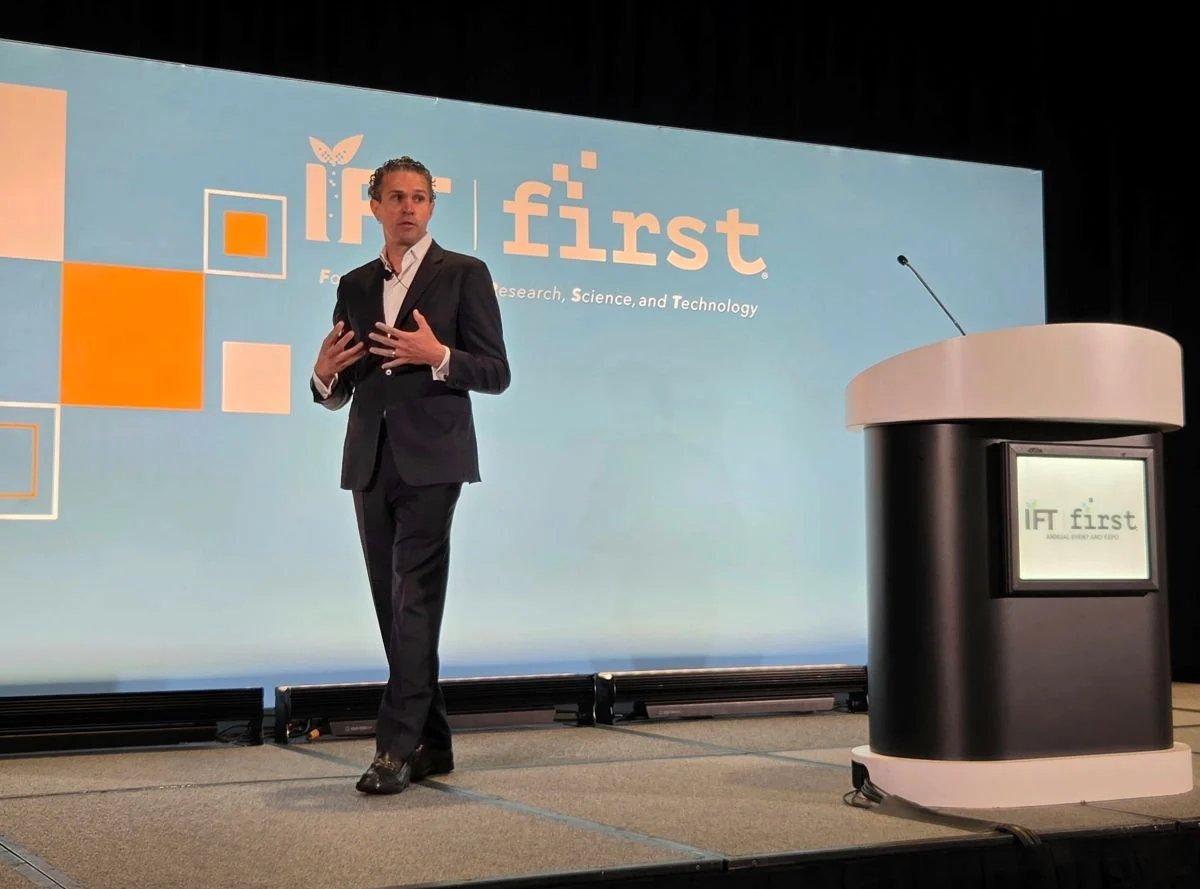
William McMorran, vice president and general manager of California Natural Color, speaks July 13 at IFT FIRST in Chicago.
| Source: Sosland Publishing Co.The consumers were more likely to understand and accept naturally sourced colors once they knew what they were. Before receiving an explanation, 66% said they accepted naturally sourced colors. After being told the colors are derived from plants, animals, minerals or other natural sources, 81% said they accepted them. In the survey, 68% said they would like to receive education about naturally sourced colors in foods and beverages.
When asked if colors impacted their purchasing behavior, 47% said they bought less food and beverages with artificial colors, 49% said their purchasing behavior had not changed, and 5% said they bought more food and beverages with artificial colors.
Food and beverage manufacturers soon will have to eliminate Red No. 3 from their ingredient lists. The FDA has banned that food dye, with effective dates of Jan. 15, 2027, or Jan. 18, 2028. State laws, especially those focusing on school meals, target artificial colors as well. When the consumers in the study were asked if they had heard about state or federal decisions on phasing out artificial colors in foods and beverages, 48% said yes, 41% said no, and 11% said they were not sure.
McMorran said the news media have focused on Red No. 3 and No. 40 and that many products contain red or orange artificial colors.
“Those I think have been in the consumers’ heads,” he said, adding awareness of other artificial colors, like Blue No. 1 and No. 2 and Yellow No. 5 and No. 6, is increasing.
“The biggest challenge is to create a natural blue in a liquid,” McMorran said. “That’s the one that is very, very difficult.”