









Introduction
The government has published guidance about national infrastructure planning which applicants, members of the public and other parties should read. See the National Infrastructure Planning Guidance Portal. The guidance should be read alongside the Planning Act 2008 (PA2008).
This advice is non-statutory. However, the Planning Inspectorate’s advice about running the infrastructure planning regime and matters of process is drawn from good practice and applicants and others should follow our recommendations. It is intended to complement the legislation, regulations and guidance issued by government.
This advice should be read together with government guidance on the Planning Act process.
Legislation
The main legislation for making and deciding NSIP applications is the PA2008. The process of EIA for NSIPs is governed by The Infrastructure Planning (Environmental Impact Assessment) Regulations 2017 (the EIA Regulations).
The EIA Regulations came into force in England and Wales on 16 May 2017. The EIA Regulations require major development projects to be assessed for their impact on the environment as part of the consenting process.
All references to regulations are to The Infrastructure Planning (Environmental Impact Assessment) Regulations 2017 unless otherwise stated.
The purpose of Environmental Impact Assessment (EIA)
The EIA process is defined in regulation 5(1) of the EIA Regulations as comprising the preparation of an Environmental Statement (ES) by an applicant, relevant consultation and notification as required by the EIA Regulations, and consideration of whether development consent should be granted by the Secretary of State.
It is a systematic and iterative process carried out to:
- Inform the design of projects from the early stages of the planning and design process, allowing for the timely identification of environmental effects and the appropriate application of the mitigation hierarchy to avoid or reduce adverse effects and, where feasible, to deliver positive environmental outcomes
- Ensure that the relevant competent authority for a project makes its decision in the full knowledge of any likely significant effects on the environment
The EIA process includes public participation as an essential component. Applicants are strongly encouraged to invest time and effort in EIA consultation exercises. This should include allowing time to consider and address comments.
EIA in the Nationally Significant Infrastructure Project (NSIP) Process
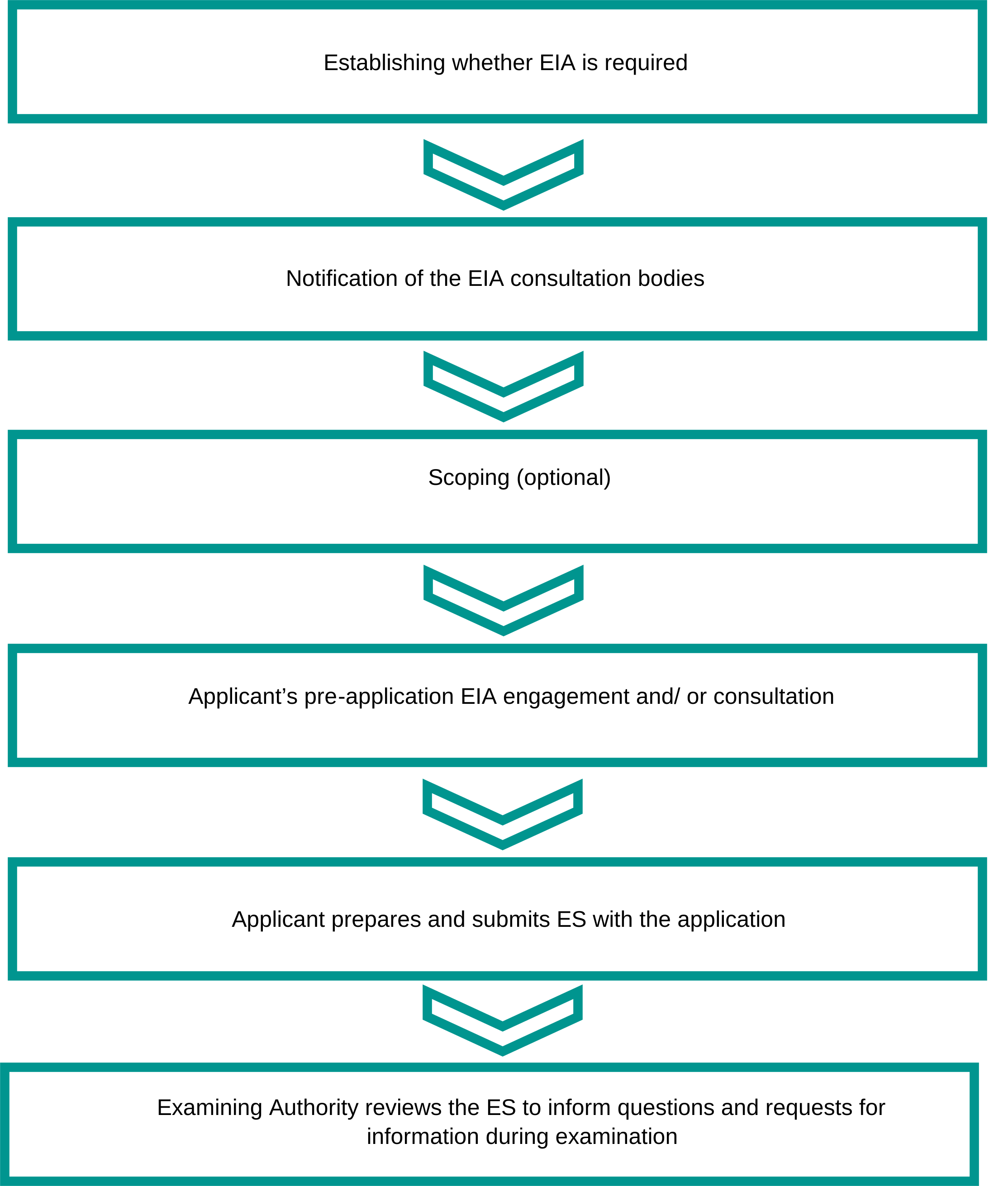
The figure below summarises EIA in the NSIP process, assuming that EIA is required.
Establishing whether EIA is required (regulation 8)
Not all NSIPs require an EIA. The EIA Regulations define EIA development as development which is either:
- listed in Schedule 1 of the EIA regulations, or
- listed in Schedule 2 of the EIA regulations and likely to have significant effects on the environment due to its nature, size or location
A Development Consent Order (DCO) application for EIA development must be accompanied by an ES.
An applicant can either:
- elect its application to be EIA development and notify the Secretary of State in writing that it proposes to provide an ES in respect of the proposed development, or
- seek a screening opinion from the Secretary of State as to whether the proposed development is EIA development
An applicant must complete one of these activities prior to publicising the proposed application under section 48 of the Planning Act 2008. The Inspectorate encourages applicants to complete activity (i) or (ii) above as early as possible in the pre-application programme.
Where an applicant is intending to request a screening or scoping opinion, the Planning Inspectorate should be contacted for an inception meeting at the earliest opportunity to discuss the details of the proposed development and the request.
Applicants must submit a GIS shapefile of the proposed development at least 10 working days in advance of submission of a request for a screening or scoping opinion. Further detail about the GIS shapefile requirements is set out below.
EIA notification
Where an applicant concludes that the proposed development constitutes EIA development and decides not to request a screening opinion, it must notify the Secretary of State that it proposes to submit an ES (regulation 8(1)(b)) to accompany the application for development consent. The inspectorate advises this notification is provided at the point of submission of a request for a scoping opinion.
Notifications under regulation 8(1)(b) must include enough information to enable the Planning Inspectorate to carry out the procedures required under regulation 11 on behalf of the Secretary of State. Applicants must therefore include the information specified in regulation 8(3)(a) and (b) with the notification to be considered valid. The notification should specify whether the proposed development is Schedule 1 or 2 development.
EIA screening
Under regulation 8(1)(a), an applicant can make a request for a screening opinion from the Secretary of State for a development listed in Schedule 2 of the EIA Regulations.
Applicants are advised to consider the following questions in respect of the proposed development before making a screening request:
- Is there sufficient detail and certainty regarding the location and characteristics of the proposed development?
- Is there reasonable confidence that there will not be substantial changes to the information above which may affect any outcome in consideration of likely significant effects?
- Is the absence of likely significant adverse effects dependent upon proposed measures envisaged to avoid or prevent such effects, and are these measures capable of being appropriately defined in order to demonstrate their efficacy?
- Is there a clear route to deliver the measures on which reliance is being placed e.g. planning requirement or other legally binding method?
When making a screening request, applicants must provide the information set out in regulation 8(3), which includes:
- a plan sufficient to identify the land
- a description of the physical characteristics of the whole proposed development
- a description of the location and any sensitive areas likely to be affected
- a description of the aspects of the environment likely to be significantly affected
- information on the likely significant effects resulting from residues and emissions and the use of natural resources
An applicant may also provide details of any features of the proposed development and any measures envisaged to avoid or prevent what might otherwise have been a significant adverse effect on the environment, in accordance with regulation 8(5). Applicants should explain these in detail including how such measures would be delivered and secured.
Applicants should ensure the information is set out with reference to the criteria in Schedule 3 to the EIA Regulations.
To aid the screening process, the Planning Inspectorate advises that a plan(s) to identify the land should include:
- the proposed development site boundary (identified by a red line) including any associated development
- any permanent land take required for the proposed development
- any temporary land take required for construction, including construction compounds
- any existing infrastructure which would be retained or upgraded for use as part of the proposed development and any existing infrastructure which would be removed
- relevant features including environmental and planning constraints (eg designated areas on and around the site)
If more than one plan is required, the plans should be at the same scale with an overview plan provided.
Applicants should also ensure that all aspects of the environment likely to be significantly affected by the development are addressed. The Planning Inspectorate refers to ‘aspects as meaning the relevant descriptions of the environment identified in accordance with the EIA Regulations eg air quality, the water environment etc.
See ‘Submission of screening and scoping requests’ of this advice page for further details regarding the electronic format of a screening request.
A screening opinion must be issued within 21 days of receiving a screening request (regulation 8(8)). The Planning Inspectorate, on behalf of the Secretary of State, must take into account the information provided by applicants, the results of any relevant EU environmental assessment reasonably available, and relevant criteria in Schedule 3 and regulation 9 of to the EIA Regulations. A screening opinion must provide written reasons for the decision on whether the proposed development is EIA development.
If a screening opinion states that a development is not EIA development, applicants will still need to submit any environmental information required by other legislation and policy. This may include a flood risk assessment or information on the historic environment required for all NSIPs (see regulation 5(2) of the Infrastructure Planning (Applications: Prescribed Forms and Procedures) Regulations 2009 (as amended) (the APFP Regulations)).
A screening opinion is based on the available information provided by the applicant at the time the request is made. It is possible that during the pre-application process new information becomes available that may affect that decision. Where this occurs, applicants should consider submitting a new screening request to the Planning Inspectorate.
The screening process does not determine whether a development is an NSIP. Applicants will need to take their own advice on whether a development is an NSIP under the criteria in the Planning Act 2008.
What happens if an Environmental Statement is not submitted with a DCO application?
If an application is submitted without an ES, the Planning Inspectorate will reconsider whether the proposed development is or is not EIA development. It will undertake the screening process again (see regulation 15) at the same time as deciding whether to accept the application for examination, considering any new information relevant to the screening decision.
If the Planning Inspectorate re-screens the proposed development during acceptance and determines that it is EIA development, then an applicant must provide an ES (regulation 5(2)(a) of the APFP Regulations 2009) and consideration of the DCO application would be suspended until an ES is provided by the applicant (regulation 15(4)).
Notification of the EIA consultation bodies
Regulation 11 notification and the regulation 11 List
Regulation 11 imposes notification duties on the Secretary of State following receipt of an applicant’s regulation 8(1)(b) notification or the adoption of a positive screening opinion determining a proposed development is EIA development.
The Planning Inspectorate, on behalf of the Secretary of State, must notify the consultation bodies of the name and address of the applicant and of the duty imposed on them to enter discussions with the applicant to determine whether they possess any information which is considered relevant to the preparation of the ES or the updated ES; and, if that is the case, they must make that information available to the applicant (regulation 11(3)).
This duty does not apply to those persons listed in regulation 11(1)(c) (see below) or non-prescribed consultation bodies.
The Planning Inspectorate will provide the applicant with a list of the notified consultation bodies and any regulation 11(1)(c) persons. Details of any non-prescribed consultation bodies will also be provided, if appropriate.
Regulation 11(1)(c) bodies
These bodies are those the Planning Inspectorate considers:
- to be, or to be likely to be affected by or to have an interest in the proposed development; and
- to be unlikely to become aware of the proposed development during the pre-application process under the PA2008
The Planning Inspectorate must notify the applicant of any such bodies (regulation 11(1)(c)), and it is the duty of the applicant to send a copy of the publicity material, required under Section 48 of the Planning Act, to any persons notified under regulation 11(1)(c) at the same time as publishing the section 48 notice (regulation 13). This requirement is reflected in the DCO Application Form under Section 14(c) where the applicant is asked to identify whether notification has been given to these bodies.
More detailed information on EIA notification and consultation is set out in the Planning Inspectorate’s Advice on Environmental Impact Assessment notification and consultation process.
EIA Scoping
An applicant who proposes to make an application for an order granting development consent may ask the Secretary of State its opinion as to the scope and level of detail of the information to be provided in the ES (regulation 10(1)). Although requesting a scoping opinion of the Secretary of State is not a statutory requirement, the scoping opinion is an important and useful document.
An effective scoping process should enable the refinement of the approach to, and scope of, the proposed assessment and the information required to form the ES. It can aid in the early identification of the likely significant effects and provides an opportunity to engage with prescribed and non-prescribed consultation bodies, and seek agreement on the scope of the EIA.
The Planning Inspectorate, on behalf of the Secretary of State, must adopt a scoping opinion within 42 days of receiving a scoping request (regulation 10(6)). If screening and scoping requests are submitted simultaneously for the same project, the 42-day period starts from the date that the Secretary of State adopts a positive screening opinion (regulation 10(7)).
Before adopting a scoping opinion, the Planning Inspectorate must consult the consultation bodies, who have 28 days to respond (regulation 10(11)). The Planning Inspectorate may also consult the relevant non-prescribed consultation bodies, who are also given 28 days to respond. Responses received after the 28-day deadline will not be considered within the scoping opinion but will be forwarded to the applicant for consideration and published on the Find a National Infrastructure Project website.
Some consultation bodies will charge for services during the pre-application phase. Therefore, it is important that the necessary service agreements are in place with the relevant consultation bodies before submitting a request for a scoping opinion.
The timing of a request for a scoping opinion should be carefully considered by applicants. Making the request too early or too late in the pre-application phase could make the scoping opinion less helpful in defining the scope of the ES. Where possible within the programme constraints, An applicant should avoid overlap between any non-statutory pre-application consultation and/ or engagement it chooses to carry out and the Planning Inspectorate’s statutory scoping consultation process to avoid confusion between the different purpose and response methods for the consultations.
Applicants should request a scoping opinion once there is sufficient certainty about the receiving environment at the geographical location of the proposed development, the design of the proposed development and the main design elements likely to have a significant environmental effect, but early enough that the EIA process can inform the final design.
The Planning Inspectorate recognises that at the time of the scoping request, it may be necessary to leave certain matters open. For example, details of the proposed development may not have been finalised and, indeed, may not be finalised for some time. Where this is the case, the Rochdale Envelope may be applied at scoping (please see ‘The Rochdale Envelope’ below).
Applicants should avoid submitting requests with multiple and varied design and layout options as this may affect the ability of the Planning Inspectorate and consultation bodies to provide detailed comments and may limit the Planning Inspectorate’s ability to agree to scope out aspects or matters. However, it is understood that in some cases, this cannot be avoided, and options may remain under consideration (for example several route corridors for a proposed linear development).
Pre-scoping site visits can provide the Planning Inspectorate with insight into the site and its surroundings and can usefully inform the scoping process. Applicants are encouraged to provide adequate time following the project inception meeting to allow for a site visit prior to the submission of a scoping request. Applicants should discuss the approach to site visits with the Planning Inspectorate and it may be that an accompanied site visit is requested of an applicant.
Information to include in a scoping request
A scoping request made under regulation 10(1) must include:
- a plan sufficient to identify the land
- a description of the proposed development, including its location and technical capacity
- an explanation of the likely significant effects of the development on the environment and
- such other information or representations as the person making the request may wish to provide or make
The Planning Inspectorate recommends that applicants provide the scoping request information in the form of a scoping report including simple paragraph numbering to aid referencing. In line with the government Guidance on preparing an application: Part 1 – Pre-application steps (principle 2: proportionality), applicants are encouraged to produce scoping requests that are proportionate to the scale and nature of the proposed development, and which avoid extraneous or repetitive information that is not required by the EIA Regulations. For example, the Planning Inspectorate does not consider it necessary to include extensive detail about legislation and policy, or guidance used to inform assessment method(s) where industry standard approaches are proposed; references to the name and version of the guidance would be sufficient.
It is useful for the scoping report to include the following information to enable adequate understanding of the proposals and to support the scoping of matters in and out of the EIA:
- a description of all elements of the proposed development
- a description of the location of the proposed development
- referenced plans presented at an appropriate scale to ensure legibility and all known features associated with the proposed development
- an explanation of the approach to addressing uncertainty in relation to elements of the proposed development where this remains, and the clear identification of where flexibility or optionality is likely to be sought
- a description of the development phases and how each phase will be assessed in the ES (construction, operation including maintenance, and decommissioning)
- an outline of the reasonable alternatives studied and the reasons for selecting the preferred option including any views sought through consultation and/ or engagement and how these have informed decision-making – or, where alternatives remain under consideration, a description of how it proposes to select the preferred option(s) taking into effects on the environment
- results of desktop and baseline studies undertaken to date, where available
- a detailed description of the aspects and matters proposed to be scoped out of further assessment with reasoning and supporting information provided
- a summary table depicting each of the aspects and matters that are requested to be scoped out
- for aspects and matters to be scoped in, a description of the methods to be used to further refine baseline conditions and to assess the significance of effects
- a summary of any measures proposed to avoid, reduce or prevent likely significant effects that are known at this stage and how they may be secured (with reference to a draft commitments’ register where relied upon to scope matters out)
- references to any guidance and best practice to be applied when defining the baseline, assessing effects or prescribing mitigation
- evidence of any agreements on the proposed scope of assessment with relevant bodies (e.g. the statutory nature conservation bodies or local authorities)
- an outline of the structure of the proposed ES
Where an applicant has not requested a screening opinion or provided a notification under regulation 8(1)(b) of the EIA regulations, the Inspectorate will request that the regulation 8(1)(b) notification is provided as part of the scoping request.
Information used to scope matters out
By applying a comprehensive, evidence-based approach to EIA scoping, certain aspects or matters can be scoped out of the EIA, ensuring that the emphasis of the ES is on the likely ‘main’ or ‘significant’ environmental effects anticipated. Applicants can propose to scope matters or aspects out within a scoping report, and the scoping opinion will confirm the Secretary of State’s view on whether those proposals are appropriate. This provides for more focussed resource allocation in pre-application for all parties, and increased clarity to all involved in the process.
An applicant should provide justification for scoping aspects or matters out in the scoping report. This could include the provision of information to justify that a likely significant effect would not occur.
The Planning Inspectorate considers that suitable justification to support the scoping out of aspects and matters should include information to address the following questions:
- Is there an impact pathway from the Proposed Development to the aspect/matter?
- Is the aspect/matter sensitive to the impact concerned?
- Is the impact likely to be on a scale that may result in significant effects to the aspect/matter?
- Could the impact contribute cumulatively with other impacts to result in significant effects to the aspect/ matter?
- Is there a method of avoidance or mitigation that would reduce the impact on the aspect/matter to a level where significant effects would not occur?
- Is there sufficient confidence in the avoidance or mitigation method in terms of deliverability and efficacy to support the request?
- Is there empirical evidence available to support the request? Do relevant statutory consultees agree with the request?
- Have you had regard to (a) relevant National Policy Statement(s) (NPS) and specifically any requirement stated in the NPS(s) in respect of the assessment of this aspect/matter?
Early engagement with the relevant consultation bodies in advance of a scoping request can help to facilitate agreement on scoping aspects or matters out of the EIA. Where evidence of agreement with relevant consultation bodies can be provided within the scoping request, this may assist the Planning Inspectorate in agreeing to scope aspects or matters out of the assessment.
In certain circumstances a proposal to scope matters or aspects out of the assessment may be based on assumptions relating to the construction, operation or design of the proposed development e.g. maximum building heights or anticipated vehicle movements. Where this is the case, assumptions should be clearly set out in the scoping request in a tabular format, identifying which aspect assessments they underpin.
The case for scoping certain matters or aspects out may also be supported by the provision of information to describe commitments that the applicant is confident will form part of the proposed application. For example, the adoption of industry standards, the implementation of tried and tested environmental management measures, or the specification of a certain approach to construction (such as a specific piling method).
Where this is the case, the scoping request should include adequate information to demonstrate that the proposed measures are capable of being secured and implemented, and that there is a high level of confidence in the success / effectiveness of those measures to avoid a significant adverse effect. This could include evidence of previous success or agreement from relevant consultation bodies.
Commitments should be recorded in a first iteration of a commitment’s register to be submitted as part of the scoping request and confirmed in an updated version as part of the DCO application. Please see the Planning Inspectorate’s advice on the Commitments Register for a template and further information on its intended use within the NSIP planning process.
Demonstrating compliance with policy tests under relevant national policy statements (NPS) where matters are scoped out of further assessment
There may be aspects or matters scoped out of further assessment which still require evidence to be provided within the application documents to demonstrate compliance with relevant NPS (where an NPS has effect or is important and relevant).
This evidence can include material originally used to justify scoping a matter out of the ES. If an applicant plans to rely on this earlier information to meet NPS tests, it must track and check that it remains accurate and adequate when submitting the DCO application.
Sometimes, the information provided at the EIA scoping stage may only partly satisfy the requirements of the NPS tests. In such cases, applicants will need to provide the additional information needed to satisfy the relevant tests as part of the DCO application. This can be included in other application documents, outside of the ES.
The information required to address policy tests should be clearly identified within the DCO application documents, making use of a ‘policy compliance document’ (where submitted) to signpost where in the application supporting evidence is provided.
Sector-specific advice
PINS has produced technical advice tailored to solar development, with the possibility of similar guidance being created for additional development types in the future. This guidance aims to support the submission of relevant information and to ensure that an ES is effective and proportionate for the development type.
Please see the Planning Inspectorate’s Technical Advice Page for Scoping Solar Development.
Transboundary effects
At the same time as making a scoping request, the applicant may also wish to provide a completed transboundary screening matrix dealing with the potential effects of the proposed development on European Economic Area (EEA) states. This would facilitate the Secretary of State’s consideration under regulation 32 of the EIA Regulations.
Further details of the suggested format for the transboundary screening matrix is provided in the Planning Inspectorate’s Advice on Transboundary Impact and Process.
Submission of screening and scoping requests
Applicants must provide an electronic copy of the screening or scoping request documents via email, or where this is not possible contact the Planning Inspectorate case team for the project to agree a suitable file sharing system.
The electronic copy should meet the following specifications:
- The scoping report should comprise as few separate files as practicable.
- No single file should exceed 50MB per document and all files should be optimised for web viewing. Where the scoping report contains high resolution plans or figures, a low resolution electronic copy should also be provided to enable easier downloads of information.
- Internal hyperlinks, including clickable contents pages, are encouraged to facilitate easy navigation within the document(s). Similarly, the effective use of bookmarks within documents can aid navigation for readers.
- The main body of text should have a minimum font size of 12pt using a clear font such as Arial (for further information refer to Royal National Institute for the Blind’s clear print design guidelines).
- Only include technical reports as appendices where these provide evidence that is critical to support a decision on whether an aspect or matter can be scoped out of further assessment.
- Footnotes should be avoided to ensure accessibility.
Video or audio information should not be submitted except by prior agreement with the Planning Inspectorate.
Advance notice and Geographical Information System (GIS) shapefile
Applicants should ensure that adequate time is provided between the inception meeting and submission of a screening or scoping request to allow for agreement on the service tier, the invoice and notification to be issued by the Inspectorate and for the Inspectorate to receive payment. The Planning Inspectorate has discretion not to commence screening or scoping activities until the applicant’s pre-application fee has been paid. See the Planning Inspectorate’s Pre-application Prospectus for further information.
Post inception meeting, a GIS shapefile should be provided to the Planning Inspectorate at least ten working days before submission of a screening or scoping request. The GIS shapefile must match exactly the red line that will be presented within the screening or scoping request. It must meet the following technical specifications:
- A polygon geometry type and consist of one or more polygon features representing the proposed development site boundary (including any temporary, permanent and associated development).
- A single, valid, ESRI Shapefile for the proposed development site boundary, provided as a *.zip file using the default WinZip settings (ie no encryption, normal compression etc.). Multiple *.zip files or multiple .shp files within a single zip file are not compatible with the Planning Inspectorate’s GIS system. If the proposed development site boundary comprises a number of separate discrete polygons, these should all be included within the single shape file contained in the *.zip file.
- The *.zip file should contain only one of each of the following files: *.prj, *.dbf, *.shp, *.shx. No other files should be included within the *.zip file.
- Be in the British National Grid (OSGB1936) format.
Geospatial information submitted at screening, scoping and acceptance will be published on the Planning Inspectorate’s website and made available for download by external parties, at the point at which the screening or scoping request is published on the Find a National Infrastructure Project website, or the acceptance stage is commenced. Therefore, applicants should ensure that the geospatial information does not include any sensitive or personal information or layers. Applicants are also encouraged to send shapefiles to the Ministry of Housing, Communities and Local Government for publication on the ‘Infrastructure Project Dataset’ website.
Engagement and/ or consultation during the pre-application stage
Due to the Planning and Infrastructure Act 2025 amendments to the EIA Regulations, there is no longer a requirement for an applicant to publish preliminary environmental information (PEI) prior to finalising the ES. In line with the Government’s Guidance on preparing an application: Part 1 – Pre-application steps, engagement and/ or consultation based on a succinct description of the impacts may be appropriate and the Planning Inspectorate strongly encourages this approach, together with iterative sharing of relevant environmental information with statutory bodies for discussion and feedback.
Provision of a voluntary evidence plan agreed between the applicant and a statutory body may assist in identifying and addressing potential impacts and effects at an early stage of the EIA.
The Planning Inspectorate’s Advice Note on Working with Public Bodies may assist applicants with their decisions on how to work with statutory bodies.
Environmental Statements
An ES should contain the information required to reach a reasoned conclusion on the likely significant environmental effects of the development on the environment. It should enable the significant residual environmental impacts and potential beneficial outcomes of a proposed development to be comprehensively described and understood, with the appropriate application of the mitigation hierarchy.
The ES is reviewed and examined as part of the NSIP planning process, forming an integral part of the environmental information that enables decision makers to reach well-informed conclusions regarding the development’s effects. The Planning Inspectorate expects the ES to present a balanced account, emphasising those impacts most likely to generate significant effects. Where limited or negligible impacts are identified, the corresponding aspect chapters may be more succinct in their findings.
The ES should be a standalone document prepared in line with best practice and case law. Information supporting the technical findings within each ES chapter should be provided within appendices and clearly referenced within the main body of the ES. Please see the Planning Inspectorate’s advice on the Preparation and Submission of Application Documents for further information on appropriate formatting of the ES.
The ES must be prepared by competent experts and this should be evidenced in the ES.
Data-sharing
Applicants are encouraged to facilitate data-sharing through submission of relevant environmental data collected during all stages of the EIA to the appropriate local environmental records centre(s) (LERCs), other appropriate environmental recording groups and schemes, and for offshore projects to The Crown Estate’s Marine Data Exchange (MDE). The Inspectorate considers that this aligns with Government policy and established industry best practice, and would assist in addressing a key barrier to EIA effectiveness.
The content of the Environmental Statement
Regulation 14 of the EIA Regulations sets out the minimum information required in an ES. Schedule 4 of the EIA Regulations provides further detail on the specific characteristics that should be included in the ES where they are relevant to the proposed development or environmental features that are likely to be subject to significant effects. This is also set out in the Planning Inspectorate’s advice on the Preparation and Submission of Application Documents.
The Inspectorate expects the ES to include a description of following (which are explained in further detail below):
- project description and site location
- the Rochdale Envelope
- post-acceptance changes
- description of the reasonable alternatives
- the baseline environment
- methodology for assessment
- aspects to be assessed
- interrelationships between environmental impacts
- mitigation measures and monitoring
Where a scoping opinion has been adopted, the ES is to be based on the most recent scoping opinion (where the project remains materially the same). The scoping opinion will make it clear that it remains open to an applicant to subsequently agree with the relevant consultation bodies to scope aspects or matters out of the ES, where further evidence has been provided to justify the approach. However, to demonstrate that aspects or matters have been appropriately addressed, the ES should explain the reasoning and, provide evidence of agreement with the relevant bodies.
If the assumptions or commitments made at the scoping stage change prior to submission of an application, this may have implications for the scope of the assessment. Such changes should be clearly identified within the ES, alongside the applicant’s consideration of whether the scope of the assessment is affected. This will assist the Planning Inspectorate in its consideration of the adequacy of the ES and whether it has been based on the latest scoping opinion, so far as the proposed development remains materially the same as that which formed the basis of that opinion.
If a scoping opinion has not been sought by the applicant, the ES must clearly detail how the scope of assessment has been determined.
The ES must be accompanied by a non-technical summary (regulation 14(2)(e), Schedule 4). This should be a summary of the assessment in simple language and should be supported by appropriate figures where relevant.
The ES must include a reference list detailing the sources used to inform the ES information including the author, date and publication title for all references. All publications referred to within the technical reports should be included.
Sensitive environmental information
In some circumstances, sensitive environmental information within the ES may need to be withheld from publication. Applicants should adopt a risk-based, proportionate approach to identifying information where disclosure could cause environmental harm. This may relate to information identifying the presence and locations of sensitive species such as badgers, rare birds and plants or other vulnerable environmental features. Separate annexes should only be used where there is a genuine risk of harm, and applicants should limit this to species that require such protection. All other assessment information should remain in the relevant ES chapter, with a placeholder explaining why annexes have been withheld and confirming that a complete ES has been submitted to the Inspectorate.
Project description and site location
The Planning Inspectorate considers that there is an opportunity as part of any non-statutory consultation and/ or engagement process and within the ES to explain how the proposed development’s design has evolved over time. The application should explain the key changes that have occurred as the proposed development’s design progressed towards submission of the application.
The ES should include a description of the location and physical characteristics of the proposed development, as required by part 1 of Schedule 4 of the EIA Regulations 2017.
The description of the proposed development should include the phasing of the construction period and include a programme of construction. Any associated development (as defined in section 115 of the Planning Act 2008) should be assessed; this includes development which may be subject to permitted development rights but which is necessary or consequential to the proposed development.
The Planning Inspectorate acknowledges that there may be instances where a single ES is produced to support applications for multiple consenting regimes such as for a project requiring both DCO consent and a marine licence. Similarly, a single ES may be produced for a cross-border project requiring consent under geographically separate consenting regimes. In such cases, the ES must clearly identify the effects which would arise from works to be authorised under the DCO and those that would arise from other works to enable clear identification of relevant DCO requirements.
The Rochdale Envelope
The Inspectorate acknowledges that flexibility may be required where parts of a proposed development are not confirmed at application stage and would be determined post-consent. Relevant parameters enabling flexibility within a DCO will be project and development specific. However, examples include:
- maximum or minimum number and layout of turbines, maximum turbine blade tip height, foundation type and export cable route location associated with an offshore wind farm
- maximum or minimum heights or widths of buildings and structures associated with a strategic rail freight interchange
- maximum stack height associated with a gas-fired power station
- location of the landfall point for offshore projects
- the definitive location of any onshore substation or grid connection point for onshore projects requiring such infrastructure
- construction methods and timing
The ‘Rochdale Envelope’ assessment approach is an acknowledged way of assessing a proposed development comprising EIA development where uncertainty exists and necessary flexibility is sought. It was derived from case law following two court judgments: R. v Rochdale MBC ex parte Milne (1) and R. v Rochdale MBC ex parte Tew [1999] and R. v Rochdale MBC ex parte Milne (2) [2000]. The main outcomes were that:
- the assessment should be based on a cautious ‘worst case’ approach and the mitigation measures proposed should adequately address the worst case
- information should be sufficient to enable the main, or the likely significant effects on the environment to be assessed and the mitigation measures should be described, and
- the need for flexibility should not be abused and does not give applicants an excuse to provide inadequate project descriptions.
Maximum design parameters should be clearly defined in the project description chapter of the ES and be in accordance with those defined in the draft DCO and associated documents (such as management plans, the Habitats Regulations Assessment, Marine Conservation Zone Assessment, and Water Framework Directive Assessment). DCO application documents should clearly explain the need for, and extent of, any flexibility sought within these parameters. Characteristics that are yet to be finalised should be clearly identified in the description of the proposed development in the ES.
Applicants should ensure that the flexibility sought does not result in a project description that is so wide that it is insufficiently certain to address the requirements of the EIA Regulations. Parameters must be detailed enough to enable a proper assessment of the likely significant effects and allow for the identification of necessary mitigation. Applicants should consider whether it is possible to robustly assess a range of impacts resulting from increased flexibility and a large number of undecided parameters.
The maximum adverse effect from a particular project element may differ depending on the aspect and matter being assessed. For example, a tall chimney stack may be beneficial for air quality but have greater landscape and visual effects. The ES should therefore identify and justify the parameters which are likely to result in the maximum adverse effect (the worst-case scenario) for each aspect and matter assessed.
Applicants should take care to ensure that the approach taken in the assessment is not overly complex, as this may impede the understanding of the assessment and the finding of likely significant effects. Fewer options and variations in a project description will make it easier to understand and feeds into good design (please see the Planning Inspectorate’s advice on good design).
The examination will, amongst other matters, consider the need for and acceptability of the flexibility proposed within the draft DCO having regard to the relevant NPS. The same principles apply to the scope of powers proposed in any deemed marine licence (DML) scheduled to a DCO. It is ultimately for the decision maker to determine what degree of flexibility can be allowed for a particular project, having regard to the specific facts of an application.
Applicants should ensure the range of possible effects implicit in the flexibility provided by the draft DCO or DML have been assessed in the ES.
When drafting other application documents, such as compulsory acquisition information (such as land plans and statement of reasons), and environmental permits (if included), an applicant will need to consider how it has taken account of the flexibility sought in the draft DCO.
The relevant NPS may provide guidance on how applicants and the Secretary of State should manage flexibility in NSIPs.
Post-acceptance changes
If a request is made for changes to an NSIP application after the acceptance stage, it is an applicant’s responsibility to ensure any implications for the ES (and the EIA process including publicity and consultation) are addressed. Requests for changes to an NSIP application introduces additional complexity and potential delays to the consenting process.
It is also important to note that it may not be possible to continue a ‘fast track’ application where changes are proposed (please see the Planning Inspectorate’s Pre-application Prospectus for further information on the fast track process).
Description of the reasonable alternatives
The ES must provide a description of the reasonable alternatives studied by an applicant and an indication of the main reasons for an applicant’s choice, including a comparison of the environmental effects (regulation 14(2)(d) and Schedule 4).
The consideration of alternatives should explain how the mitigation hierarchy has been applied from the outset to evolve and refine the design of the proposed development to its description at submission.
The description of the alternatives considered should include the decisions made relating to alternative locations or routes (where relevant); alternative design options such as layouts, technology, massing and capacity considerations; and alternative construction techniques or operational modes.
The justification for the final choice and evolution of the proposed development should be clearly described, including how it has been informed by environmental matters and engagement and/ or consultation.
The baseline environment
The ES should describe the current state of the receiving environment (the baseline scenario) across the aspects likely to be significantly affected by the proposed development. The baseline should be identified for both the area in which the proposed development is located and the zone of influence for impacts (see below). The accuracy of the baseline scenario, including currency of the data, is important to ensure that the assessment of likely significant effects is robust.
The ES should describe the methods used to determine the current baseline for each aspect of the environment scoped in to the assessment. This should include the timing and scope of any surveys, as well as any limitations to the survey data. Any data sources or surveys used to inform the baseline should be appropriately referenced. The approach to characterising the baseline should be agreed with the relevant consultation bodies as far as possible.
Where ES assessments are based on a future baseline, it should be clearly described using appropriate rationale and assumptions.
Methodology for assessment
The EIA Regulations require the ES to include a description of the ‘likely significant effects of the proposed development on the environment’. The ES should set out the assessment methodology employed to assess potential impacts and to determine the significance of effect for each aspect assessed, as well as cumulative effects and interrelationships.
The methodology should be based on recognised professional guidance and best practice where available and agreed as far as possible with relevant consultation bodies. If this is not possible, the ES should provide reasoned justification with reference to the likely impacts and impact pathways. Wherever possible, quantitative rather than qualitative methods of assessment should be used.
Study areas should be based on appropriate zones of influence rather than arbitrary distances. Where feasible, source-pathway-receptor models should be used to establish the zone of influence, considering characteristics of the:
- source – for example what level of noise emissions are anticipated and what evidence this is based on
- pathway – what is the pathway and over what distance might the pathway convey an impact for example a watercourse and the distance over which certain pollutants may be dispersed
- receptor – for example where receptors are located within the pathway defined above and have potential to be impacted by the source
The temporal scope should take into account impacts during demolition and construction works, operation (including maintenance) and decommissioning (where relevant, see below). The ES should define temporary, short, medium and long term impacts and explain how these influence determination of effect significance.
An assessment of effects from decommissioning activities may be difficult because of the lack of certainty around methods, regulatory frameworks and future baselines. If the draft DCO contains powers that authorise decommissioning or define a limited project duration, the ES should include an assessment of decommissioning based on current knowledge of the relevant procedures. It should describe how these procedures have been chosen and outline the process for confirming the approach and any required mitigation measures prior to decommissioning commencing.
The assessment should recognise any uncertainty resulting from the timescales of the proposed development and where significant effects are likely, should identify the framework in which these will be re-evaluated at a time where more certainty exists and relevant mitigation prescribed. Any re-evaluation should be secured through the DCO.
Where it is concluded that impacts would be reversible following decommissioning or at the end of the proposed development’s lifetime, the ES should identify a likely decommissioning date, an appropriate plan for reinstatement and confirm the environmental conditions which reinstatement would be required to achieve. Where no decommissioning date is secured, the ES should justify this approach and assess relevant impacts as ‘permanent’ to capture a worst-case scenario.
Significance of effect is commonly determined by combining receptor sensitivity and magnitude of impact. Clear definitions of these criterion should be provided in the ES. The assessment should take into account whether an impact is direct or indirect, positive or negative and whether they are reversible, permanent or temporary over the short-, medium- or long-term with reference to relevant guidance.
It is essential for the ES to define the meaning of ‘significant’ in the context of each of the aspects assessed and for significant effects to be clearly identified. In principle, the Planning Inspectorate applies the precautionary approach to assessing the significance of effects. ‘Likely to affect’ is taken as meaning that there is a probability or risk that the proposed development would have an effect, and not that a development would definitely have such an effect.
As set out in Schedule 4 (paragraph 6) of the EIA Regulations, the ES should include a description of any difficulties (technical deficiencies or lack of knowledge) encountered by the applicant in compiling the required information.
Aspects to be assessed
Schedule 4 of the EIA Regulations requires the ES to include, as a minimum, a description of the likely significant effects on the following environmental aspects where they are relevant to the proposed development (this includes any transboundary and cumulative effects):
- biodiversity (for example fauna and flora)
- water (for example hydromorphological changes, quantity and quality)
- air
- landscape
- cultural heritage, including architectural and archaeological aspects
- land (for example land take)
- soil (for example organic matter, erosion, compaction, sealing)
- material assets
- population
- human health
- climate (for example greenhouse gas emissions, impacts relevant to adaptation)
- major accidents and disasters – potential for the proposed development to cause, and vulnerability of the proposed development to risks from this factor
Applicants should also report on other environmental aspects where there is potential for likely significant effects even if they are not named in the EIA Regulations.
Interrelationships between environmental impacts
The Inspectorate considers that the inter-dependencies between aspects must be assessed to address the environmental impacts of the proposed development as a whole. For example, effects on human health may be assessed across multiple chapters such as air quality, noise and vibration, landscape etc or it may be assessed in a separate standalone human health chapter.
Each of the aspects considered should cross-refer to other relevant aspects where necessary. This will help to ensure that the ES is a comprehensive assessment drawing together the environmental impacts of the proposed development.
Mitigation measures and monitoring
The ES should set out any mitigation measures, and the extent these are expected to avoid, prevent, reduce or offset adverse effects on the relevant environmental aspects. It should demonstrate how the mitigation hierarchy has been applied, and identify any proposed compensation and enhancement measures accordingly. Mitigation measures should not be developed in isolation as they may relate to more than one aspect. Proposed mitigation should be discussed, and where possible agreed, with relevant consultation bodies. Only mitigation measures that are a firm commitment and can be shown to be deliverable should be taken into account as part of the assessment.
Any monitoring arrangements that would apply should also be described alongside a description of proposed remedial measures. Monitoring should relate to success criteria, adaptive management, and regular reporting on the implementation of mitigation, compensation, and enhancement measures. The Planning Inspectorate encourages applicant to explain in the ES how monitoring data would be made publicly available and shared with appropriate recording groups such as LERCs and The Crown Estate’s MDE.
.
The mitigation and monitoring measures proposed should be cross-referred to specific provisions and/ or requirements proposed within the draft DCO (or DML condition, if relevant). The ES should clearly set this out in an appropriate summary table or equivalent for all mitigation and monitoring measures.
Where an environmental management and/or monitoring plan is relied upon, an outline plan(s) should be submitted with the application. The plan(s) should contain enough detail for an examining authority or Secretary of State to be confident that the final plan(s) would be able to implement the necessary mitigation, together with any required monitoring. The ES should explain how mitigation has addressed interrelationships between aspects. For example, a plan for landscape and biodiversity needs to take into consideration mitigation for both the landscape and biodiversity assessments.
It is good practice to explain how proposed management plans relate to each other. An applicant should consider having a ‘hierarchy of plans’ diagram or chart.
Information published on the National Infrastructure Planning website
The following pre-application documents will be made available on the relevant project page of the Find a National Infrastructure Project website:
- an applicants’ screening and scoping requests
- any additional screening and scoping information requested by the Planning Inspectorate and submitted by an applicant
- the Planning Inspectorate’s screening opinion(s)
- the Planning Inspectorate’s scoping opinion(s) including all consultation responses received within the statutory deadline
- late scoping consultation responses received after the statutory deadline
As application documents will be published to the Find a National Infrastructure Project website, an applicant should avoid the inclusion of any personal data relating to individuals in the documents.
The Find a National Infrastructure Project website includes a Projects map page, which shows the scoping and acceptance stage boundaries of NSIPs on the Planning Inspectorate’s project register based on GIS shapefiles provided by applicants. It includes a function to download a geospatial file of all available project boundaries.
The Planning Inspectorate takes its data protection responsibilities for the information you provide us with very seriously. To find out more about how we use and manage your personal data, please go to our privacy notice.
We follow protocols established by the Information Commissioners Office, further details of which can be found at www.ico.org.uk. Please contact the National Infrastructure case team for further information and advice on this matter.