In an era in which digital platforms have accelerated the circulation of news, generative artificial intelligence has transformed content production, and public trust in traditional media has steadily declined, information security can no longer be regarded solely as a technological concern. Rather, it has evolved into a strategic domain intrinsically linked to foreign policy, public legitimacy, and conflict management. According to the Reuters Institute Digital News Report 2026, overall trust in news across surveyed markets declined to 37%, while in the United States the figure fell to 25%.¹ Within such an environment, the institutional role of the media in promoting peace and maintaining social cohesion has become increasingly significant, writes Ayshan Aslan-Mammadli, PhD in Political Science.
The purpose and significance of the fourth Shusha Global Media Forum
Organized under the theme “The Media’s Mission in Promoting Peace: Restoring Truth and Rebuilding Trust,” the Fourth Shusha Global Media Forum convened approximately 160 participants from 53 countries, representing 30 news agencies, more than 60 media organizations, and around ten international organizations.² This broad composition endowed the Forum with professional, diplomatic, and normative dimensions simultaneously.
According to the Forum’s Concept Paper, the media is conceptualized as an actor capable of safeguarding truth, facilitating public dialogue, and fostering a culture of peace amid armed conflicts, information warfare, and emotionally manipulative communication environments.
The decision to host the Forum in the city of Shusha also carries considerable communicative significance. By enabling participants to observe post-conflict reconstruction efforts firsthand, the Forum transforms perceptions shaped by distance into direct empirical observation. Consistent with Nye’s concept of soft power, this approach seeks to enhance credibility not through coercion but through tangible achievements, cultural symbolism, and dialogue.³
Nevertheless, such firsthand observation acquires genuine credibility only when it extends beyond confirming pre-existing narratives and preserves journalists’ professional autonomy to ask critical questions, compare competing perspectives, verify evidence, and reach independent conclusions. It is precisely this balance between institutional messaging and journalistic independence that elevates the Forum from a conventional public diplomacy event to an international platform for media diplomacy.
The Forum’s official programme was structured around three principal thematic panels: the role of the media in peacebuilding and public discourse; communicating the transition from destruction to reconstruction; and the contribution of media diplomacy and media literacy to rebuilding public trust. Complementary sessions addressing coordinated responses to disinformation, ethical challenges associated with artificial intelligence, and cross-border media cooperation further connected the Forum’s agenda with contemporary technological and institutional challenges confronting the global information environment. ⁴
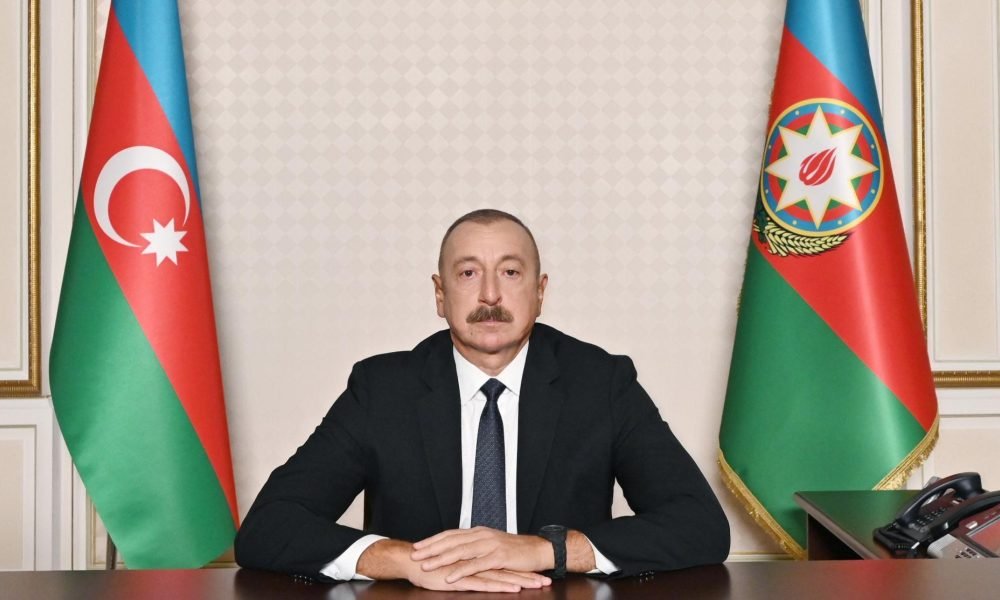
The first central theme of President Ilham Aliyev’s address was the conceptualization of peace not merely as the cessation of hostilities but as a process grounded in justice, international law, and sustained political commitment. His assertion that “peace must be just and based on international law” corresponds closely with the principles of peace journalism, which encourage media professionals to move beyond binary winner-loser narratives and instead examine the structural causes of conflict and its long-term consequences.⁵
From this perspective, the media’s responsibility extends beyond advocating peace as a normative ideal. Rather, it is expected to explain the legal, humanitarian, and societal foundations of sustainable peace while presenting the security concerns of different stakeholders within a factual and evidence-based context.
A second prominent theme concerned trust as a form of diplomatic capital. President Aliyev associated Azerbaijan’s capacity for mediation and dialogue with sincerity, the absence of hidden agendas, respect for confidentiality, and adherence to commitments. These principles correspond closely with Hallahan et al.’s understanding of strategic communication, which emphasizes that credibility is derived not merely from persuasive messaging but from the alignment between institutional behaviour and declared strategic objectives.⁶
Accordingly, trust cannot be established through communication campaigns alone. Instead, it emerges through policy consistency, predictable institutional conduct, verifiable evidence, transparency, and the willingness to acknowledge and correct errors whenever necessary.
The third theme addressed the importance of independent media in counterbalancing information monopolies and dominant narratives. President Aliyev argued that control over information can be as influential as political or economic power and highlighted the importance of independent journalism in challenging colonial and neo-colonial approaches to information dissemination.
From an academic perspective, this argument should not be interpreted as equating state communication with journalism. On the contrary, the credibility of public communication increases when a clear distinction is maintained between official governmental narratives and the editorial independence of professional media institutions. Particularly for international audiences-and especially within the United States and other democratic media environments-the determining criterion is not the political origin of a particular claim but rather whether it can withstand scrutiny through credible evidence, multiple independent sources, transparency, and open public debate.
The fourth major theme concerned the role of field journalism in overcoming information blockades. President Aliyev emphasized that reporting directly from the conflict zone during the Second Karabakh War contributed to establishing an alternative factual basis within the international information environment.
Within Gilboa’s theoretical framework, this reflects the media’s function as both a diplomatic intermediary and an agenda-setting actor capable of influencing international political processes.⁷ Nevertheless, the strategic significance of field journalism lies not solely in the speed of reporting but, more importantly, in its adherence to professional standards, including rigorous fact verification, protection of civilians, authentication of visual evidence, and restraint in the use of emotionally charged language.
References
¹ Reuters Institute. (2026). Digital News Report 2026: Executive Summary.
https://reutersinstitute.politics.ox.ac.uk/digital-news-report/2026/dnr-executive-summary
² Report News Agency. (2026). Ilham Aliyev to meet participants of the 4th Shusha Global Media Forum.
https://report.az/en/media/ilham-aliyev-to-meet-participants-of-4th-shusha-global-media-forum
³ Nye, J. S., Jr. (2008). Public Diplomacy and Soft Power. The ANNALS of the American Academy of Political and Social Science, 616(1), 94-109. https://doi.org/10.1177/0002716207311699
⁴ Shusha Global Media Forum. (2026). 4th Shusha Global Media Forum – Agenda.
https://globalmediaforum.com/uploads/2026/07/shgmf-2026-proqram-eng-12-07-2026.pdf
⁵ Galtung, J. (1998). High Road, Low Road: Charting the Course for Peace Journalism. Track Two, 7(4).
⁶ Hallahan, K., Holtzhausen, D., van Ruler, B., Verčič, D., & Sriramesh, K. (2007). Defining Strategic Communication.International Journal of Strategic Communication, 1(1), 3-35. https://doi.org/10.1080/15531180701285244
⁷ Gilboa, E. (2001). Diplomacy in the Media Age: Three Models of Uses and Effects. Diplomacy & Statecraft, 12(2), 1-28. https://doi.org/10.1080/09592290108406201
Share this article: