





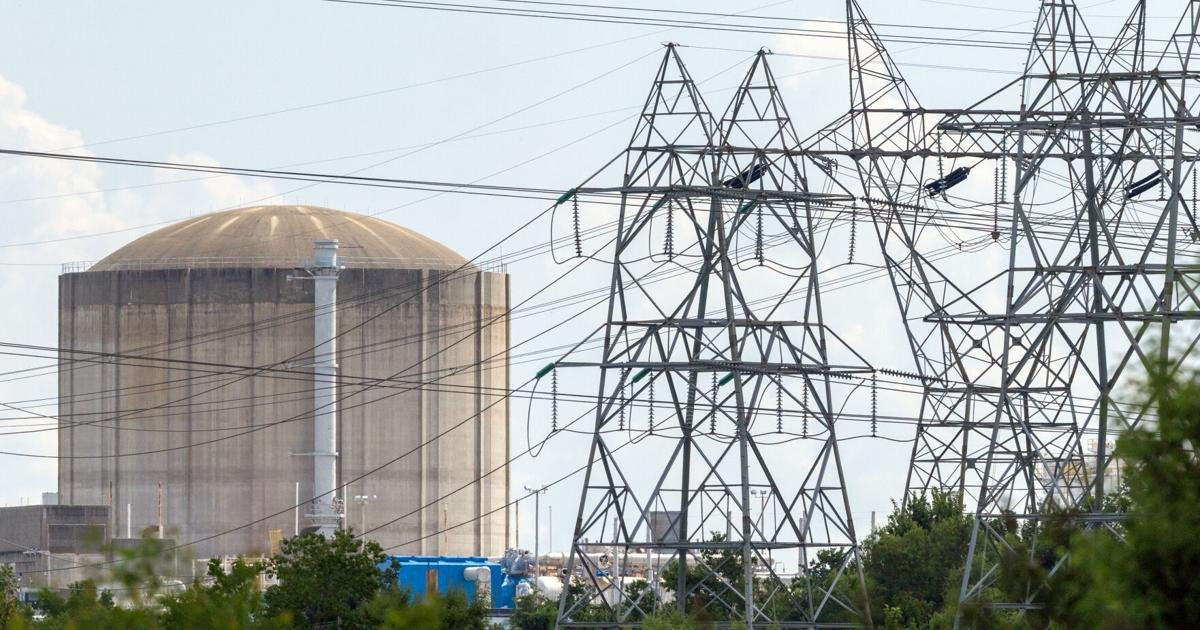
Louisiana has pitched the federal government on a plan to store nuclear waste beneath the Gulf, part of a broader effort to attract nuclear development and power massive new data-center projects in the state.
The federal initiative, called the Nuclear Lifecycle Innovation Campuses program, pairs states willing to store nuclear waste with potential federal support for new nuclear projects, including for power-generation and manufacturing.
Louisiana was one of five states selected as program finalists on Tuesday, out of 26 states that applied. All of the states selected as finalists — the others are Utah, Tennessee, Oklahoma, and Idaho — are led by Republican governors.
The state told the federal Department of Energy that Louisiana is a prime location for the development of next-generation nuclear energy and the storage of nuclear waste, noting that huge amounts of additional nuclear power will be necessary due to the surge in energy demand from data centers.
Gov. Jeff Landry celebrated the state’s advancement as a finalist for the program, and Chris Wright, the secretary of the Department of Energy, said the state or states selected would benefit from of massive economic growth, thousands of jobs, and would be “crucial to unleashing America’s nuclear renaissance.”
“Louisiana shares the President’s vision for nuclear power and America’s energy future,” Landry said in a statement. “We appreciate Secretary Wright’s leadership and the opportunity provided by the Department of Energy to further America’s energy dominance!”
The U.S. has been looking for new sites to dispose of its nuclear waste for decades. Edwin Lyman, the director of nuclear power safety at the Union of Concerned Scientists, a science advocacy group, was more skeptical of the program. In his view, the federal government is promising new investment to states willing to accept the burden of storing nuclear waste.
“It really is all about finding another place to be the nation’s radioactive dumping ground,” Lyman said of the federal program.
‘Outside-the-box’
As part of its pitch to the Department of Energy, Louisiana said that it could build new nuclear reactors in the northwest part of the state to power a military site and data centers. It proposed a new nuclear research center in Baton Rouge. And it suggested that it could store nuclear waste in salt domes on the outer continental shelf of the Gulf of Mexico, which the Trump administration has renamed the Gulf of America.
The idea of doing so, the proposal acknowledges, is an “outside-the-box option.” It also says that Louisiana is proposing to store nuclear waste in federal waters in order to bypass a state law that prohibits using salt domes in the state to store nuclear waste.
This isn’t the first time that the idea has been floated of using salt domes — the huge underground layers of salt that were deposited as ancient oceans evaporated and were covered over with sediment as the Gulf rose and fell — to store nuclear waste, which can stay radioactive for thousands of years.
The idea is to hollow out the dome and to fill the resulting underground cavern with nuclear waste. Already, the federal government stores crude oil in underground salt caverns along the Louisiana and Texas coasts as part of the Strategic Petroleum Reserve, the U.S.’s backup fuel supply.
Federal researchers first looked into the idea of using Louisiana’s salt domes in the 1970s. That idea met widespread public backlash, and it was ultimately killed in favor of storing nuclear waste in Yucca Mountain, in Nevada. But the Yucca Mountain proposal met local backlash, too, and the U.S. now has no place to permanently store more than 95,000 metric tons of spent nuclear fuel.
“What’s happening now is this stuff is being stored on concrete pads at every nuclear power plant across the nation, instead of some safer centralized area,” said Clayton Smith, the radiation safety officer at Tulane University. He thinks the idea of using salt domes merits further investigation.
“I’m not a geologist, but I think salt-dome disposition is a wonderful idea,” he said. “Over time, that salt will naturally encapsulate and compact all of that waste.”
Nuclear buildout for data centers
The proposal argues that growing demand from data centers strengthens the case for expanding Louisiana’s nuclear power infrastructure. Meta is building a $50 billion facility in Richland Parish that will cover six square miles. Louisiana will need a huge amount of additional nuclear power to facilitate the construction of similar data centers, according to the report.
Jackson Voss, government affairs and policy coordinator with the Alliance for Affordable Energy, which advocates for electricity customers, questioned whether the state should be prioritizing new nuclear energy over other forms of power.
“There are not going to be very many cases where wind and solar deployment — especially as those technologies continue to improve — are not going to be the best deal,” he said. “They tend to be the most affordable, reliable and sustainable option.”
Patrick Courreges, a spokesperson for the Louisiana Department of Conservation and Energy, stressed that the state’s proposal is still a pitch to the federal government and does not constitute any set plan for the management of spent nuclear fuel.
“We want to be part of that national discussion for nuclear energy,” he said. “We’re on the shortlist.”