






My introduction to Madras checks came during an unhurried walk along Velankanni beach in 2010, when my family had travelled there to visit the shrine. What caught my eye was the effortless elegance of the checked lungis worn by many of the men walking along the sand. The cloth had a remarkable lightness. I remember remarking that it would make a rather handsome shirt.
A family friend burst out laughing. “Why would you want to make a shirt out of it?” he asked, genuinely puzzled. “It’s worn by the poor.”
The comment lingered long after the conversation ended. Something about it felt strangely reductive, as though a textile so vibrant in colour and character could be dismissed simply because of the social status of those who wore it.

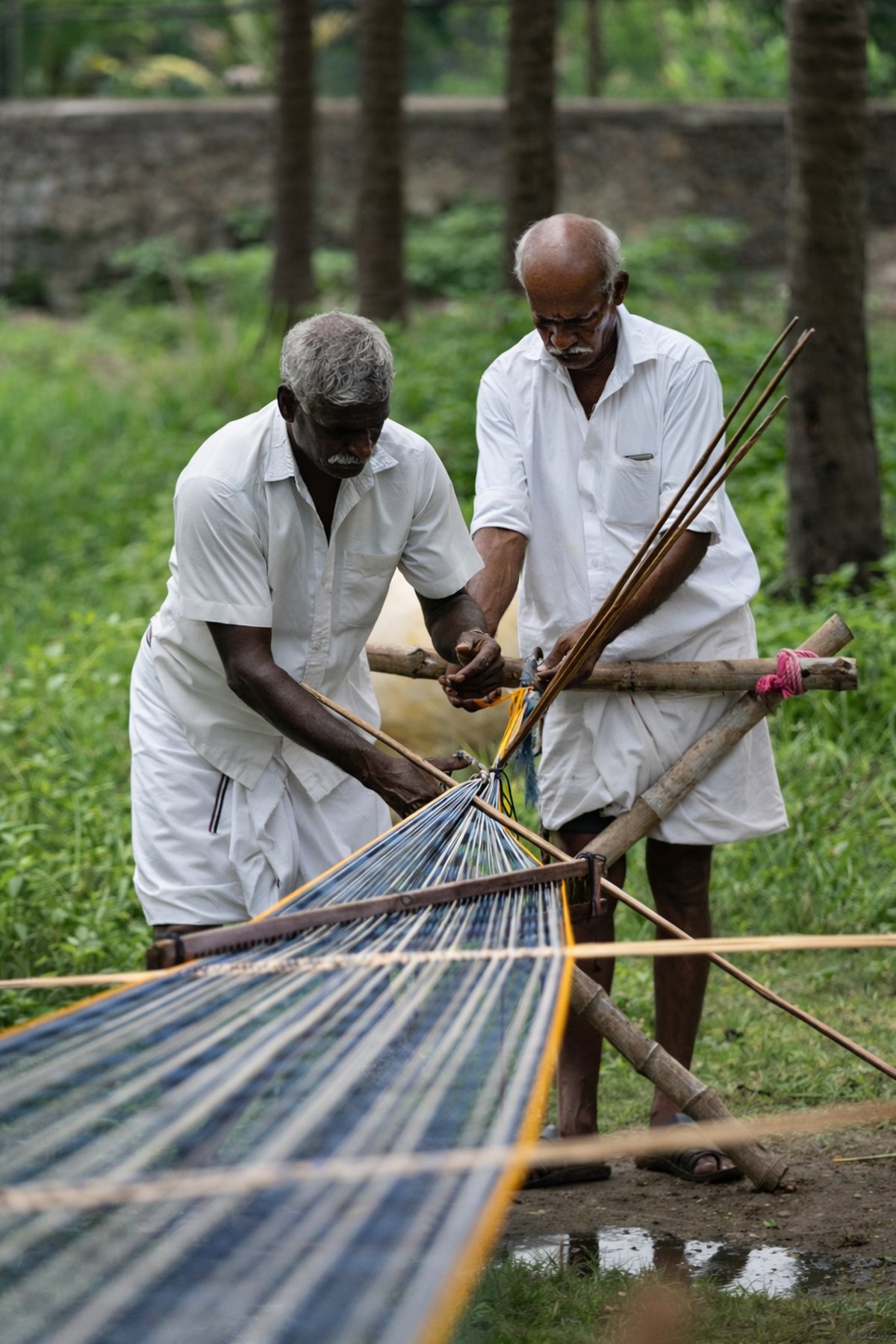
Artisans working with the fabric
| Photo Credit:
Original Madras Trading Company
For Original Madras Trading Company, revisiting Madras checks is less a rediscovery than a continuation of a family legacy. The initiative is led by Chennai-based Ranvir Shah, whose family has worked with the fabric for decades.
“Madras checks are what we’ve been doing for over 50 years,” Ranvir says. His father exported Madras check garments to major American labels, but over time he began to question India’s role in the global supply chain.
“At some point, it struck me that we were being garment coolies. We needed to create something of our own,” adds Ranvir.
The answer was to return to the source. The initiative began modestly, with two handlooms in Chennai weaving authentic Madras cloth, reviving traditional practices that had steadily declined as machine-made imitations spread across the world.
“We realised that Madras made on looms in China and elsewhere is not real Madras,” he says. “If the craft was to survive, we had to go back to the origin.”

Patchwork shirt by Original Madras Trading Company
| Photo Credit:
Special arrangement
Developed with his son Prasan Shah, who runs the New York arm of the business, the initiative pairs traditional weaving with contemporary design. Designers work closely with weavers, retaining familiar colour palettes and checks while experimenting with organic yarns, natural dyes and lower-impact fibres.
For Ranvir, the goal is not to chase trends but to sustain a craft.
“Madras comes in and out of fashion,” he says. “We’re not interested in trends. We want Madras to survive and flourish for generations.”

The weavers at Original Madras Trading Company
Ranvir is now exploring an idea that could give the fabric an even deeper sense of identity: family-specific Madras checks that could be passed down through generations, much like Scotland’s clan tartans. While tartan has existed in Scotland for centuries, the practice of linking specific patterns to individual clans became firmly established during the 19th Century. Today, these clan tartans are officially recorded in the Scottish Register of Tartans and serve as enduring symbols of lineage, heritage and belonging.

A complex history
The distinctive plaid takes its name from the port city of Madras — now Chennai — from where the cloth was historically exported, though the fabric itself was woven across several centres along the Coromandel coast. From there it moved outward along the same maritime trade routes that carried spices, cotton and dyes across the Indian Ocean and beyond.
In Nigeria, particularly among the Igbo and Kalabari communities, brightly coloured Madras cotton became known as George cloth or Injiri, worn during ceremonial occasions and celebrations. The checks themselves —often in vivid combinations of red, indigo, yellow and green — were unmistakable. Handwoven cotton checks exported from India were labelled “Real Madras”, partly to distinguish them from the machine-made imitations that European mills would later produce.
By the early 20th Century the fabric had quietly entered American fashion as well. Wealthy Americans returning from winter holidays in the Bahamas began bringing the colourful shirts back with them, and by the 1950s Madras had settled comfortably into the wardrobes of Ivy League campuses, where it became shorthand for relaxed summer dressing.
One of the most enduring anecdotes in this story dates to 1958, when the American retailer Brooks Brothers introduced naturally dyed Madras shirts sourced from India into its ready-to-wear line. Customers soon began complaining that the colours bled in the wash. Rather than apologise for the flaw, the advertising executive David Ogilvy transformed it into a marketing triumph, framing the phenomenon as part of the fabric’s charm. Thus was born the legend of “Bleeding Madras”, a cloth that subtly changed character with every wash.
For a textile that began its life on handlooms along the Coromandel coast, Madras had by then travelled an improbable distance.
Designers rediscover the check

Nicholas Daley Spring/Summer 2018 collection, Madras
| Photo Credit:
Nicholas Daley
One of the textile’s most enduring stories dates back to 1958, when American importer William Jacobson sourced naturally dyed Madras cotton from Captain CP Krishnan Nair for the US market. Brooks Brothers quickly adopted the fabric for its ready-to-wear collection, but neglected to tell customers that the vegetable dyes were not colourfast. When shirts bled in the wash, complaints followed. Advertising legend David Ogilvy turned the flaw into the fabric’s greatest asset, rebranding it as Bleeding Madras and marketing the colour run as proof of authenticity. With the memorable promise, “Guaranteed to bleed,” what began as a manufacturing liability became a badge of distinction, helping propel Madras into Ivy League wardrobes and cementing its place in American preppy style.

Nicholas Daley x Clarks Originals collaboration
| Photo Credit:
Clarks
Designer and textile manufacturer Hamza Farooq Darwaish, who runs the craft initiative Heritage by Hamza, approaches the textile from a deeply personal perspective.
“School uniforms, lungis, summer shirts — the markets in Mylapore and T Nagar,” he says. “Madras checks were always around me.” For Hamza, working with the textile is less about reviving a trend than continuing a tradition.

Dior Fall 2023 collection
| Photo Credit:
Dior
While the fabric has been endlessly reinterpreted over the decades, its distinctive checks continue to attract designers drawn to the cultural journeys woven into the textile. Few have explored that diaspora more thoughtfully than Jamaican-Scottish designer Nicholas Daley, whose collections examine the historical links between the Caribbean, Britain and South Asia. His Spring/Summer 2018 collection was dedicated to Madras, tracing the textile’s journey through colonial trade, the Caribbean and contemporary Britain. Working with the Victoria and Albert Museum archives, Daley reimagined the historic cloth for a new generation. In 2025, he collaborated with Clarks Originals to reinterpret the iconic Wallabee using Madras-inspired textiles.
Elsewhere, designers have returned to lightweight cotton checks while exploring relaxed summer tailoring. During Christopher Bailey’s tenure at Burberry, breezy plaids appeared in collections such as Burberry Prorsum Spring/Summer 2015, while Maria Grazia Chiuri’s Dior Fall 2023 show in Mumbai featured multicoloured checks that echoed the visual language of Madras.

Nicholas Daley
| Photo Credit:
Special arrangement
A living textile
If global runways have rediscovered Madras as a motif, many Indian designers are returning to it as something more intimate: a textile embedded in everyday life.
For the Puducherry-based label Wunderhaus Handmade, Madras checks represents a textile narrative that spans continents while remaining rooted in the rhythms of everyday dressing.
“We’re witnessing a resurgence in their popularity,” says founder Kedar Maddula. “Traditionally Madras checks were used for simple shirting or wraps, but we’re transforming them into handloom tees, windcheaters, shacket shirts and trousers that feel contemporary without losing their origins.”

T-shirt from Original Madras Trading Company
| Photo Credit:
Original Madras Trading Company
Culture catalyst
Several younger Indian labels are also exploring the textile in new ways. Chennai-based brand No Grey Area, for instance, incorporated oversized Madras checks into its Spring/Summer 2024 collection Inconvenience Today for a Better Tomorrow, shown at Lakmé Fashion Week in the GenNext category. The checks appeared in wrap skirts for women and sharply tailored suits for men, layered alongside woodblock printing and shisha (mirror) embroidery.

No Grey Area SS24 collection
| Photo Credit:
No Grey Area
For Mumbai-based JADE by Monica and Karishma, the textile carries a different resonance. The label’s Autumn/Winter 2025 menswear collection, Bombay Chic, approaches Madras checks through what designer Monica Shah describes as the “Bombay ethos”.

The Madras suit from the SS24 collection
| Photo Credit:
No Grey Area
“At JADE, particularly within our menswear inspired by Bombay, we don’t treat identity and aesthetics as separate ideas,” Monica explains. “Madras checks allows us to bring heritage into sharper, more contemporary shapes.”

Bombay Chic collection by JADE
| Photo Credit:
JADE
Designer and textile manufacturer Hamza Farooq Darwaish, who runs the craft initiative Heritage by Hamza, approaches the textile from a deeply personal perspective. “School uniforms, lungis, summer shirts — the markets in Mylapore and T. Nagar,” he says. “Madras checks were always around me.” For Hamza, working with the textile is less about reviving a trend than continuing a tradition.
New life
For Gul Sohrab, founded by Amit Malhotra and Saurabh Kumar in 2024, Madras checks were not an archival obsession but a familiar sight. Amit, who previously worked as a book designer and design manager at HarperCollins, grew up seeing the fabric in lungis, saris and everyday clothing. Saurabh, meanwhile, brings years of technical fashion experience from brands such as Shantnu & Nikhil, Anita Dongre and AMPM.
“Madras checks feel deeply lived-in,” says Amit. “What drew us to them was that instinctive familiarity.”
Rather than approaching the textile as heritage to be preserved behind glass, the label treats it as material meant to be worn, washed and lived in. “We approach Madras with restraint,” Amit explains. “We let the fabric exist as itself.”
For the designers, the checks also carry an inherent fluidity across forms of dress. “Madras appears effortlessly in mundus, lungis, saris and skirts,” he says. “It moves across bodies and identities without losing its ease or character, and that natural fluidity resonated strongly with our design philosophy.”
For now, Amit describes the label’s relationship with Madras as an ongoing dialogue rather than a fixed signature. “If it grows with us, that feels natural,” he says. “And if it shifts or evolves, that’s equally valid.”
A textile that carries history
Researcher and journalist Phyllida Jay sees Madras checks as far more than a simple textile. “It’s a form of intangible cultural heritage that maps the movement of people, ideas and design across cultures and continents,” she says. Yet she cautions that innovation in craft must be approached carefully. “True innovation occurs when a craft remains true to its roots yet alive to possibilities,” she says. Design interventions, Phyllida argues, should recognise the deep local knowledge embedded in weaving traditions and involve equitable collaboration with artisans rather than top-down direction.
She also points to contemporary designers offering fresh interpretations of the textile. Labels such as Purushu Arie draw on Tamil street style and the everyday cultural life of the fabric, while IOWEYOU traces garments back to their weavers through QR codes, linking fashion with transparency and craft lineage.
However, renewed visibility has not necessarily translated into economic stability for the weaving communities that produce the fabric. Mumbai-based textile professional Siddhant Beriwal points out that the contradiction reflects a broader challenge across India’s handloom sector.

Gul Sohrab
| Photo Credit:
Gul Sohrab
Research based on the Fourth All India Handloom Census (2019–20) — cited in studies published on ResearchGate (a professional network for scientists and researchers) — shows that the sector currently supports around 3.5 million workers, down from roughly 6.5 million weavers in the mid-1990s as mechanised production expanded. Handlooms today account for only about 15% of India’s total cloth production, with the majority produced by powerlooms and mills.

Genderless fashion by Gul Sohrab
“The tension between handloom and powerloom has always shaped textiles like Madras checks,” Siddhant says, adding, “powerloom fabrics can replicate the visual look at a fraction of the cost.”

Gul Sohrab
| Photo Credit:
Gul Sohrab
For Madras checks to find a more sustainable future, he suggests clearer market recognition for authentic handwoven fabric. “If the textile receives geographical indication recognition and exports move through more organised channels,” he says, “it could create a stronger value proposition for designers, buyers and, most importantly, the weavers.”
After decades of being exported, imitated and overlooked at home, Madras checks is finding its way back — not as a trend, but as a textile with history, identity and, perhaps, a second act.