






For weeks, a man starved himself in the middle of Delhi, in protest of exam irregularities that had already upended the lives of countless students in India. He was demanding the resignation of Indian Education Minister Dharmendra Pradhan. On day 20, the state moved. Not to sit across from him. Not to answer him. But to carry him away from his protest site and into a hospital.
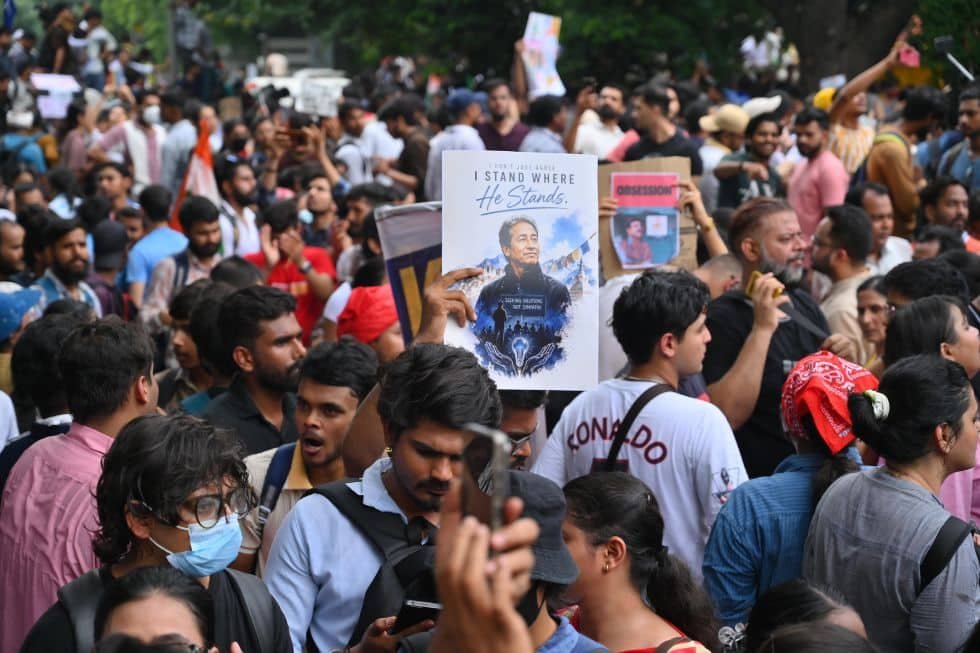
It didn’t work. Protests across the country only intensified. Many protestors alleged that police used brutal force against protestors, with at least 60 protestors wounded in central Delhi alone. Despite all of this, the protests continued and spread to other parts of the country.
Finally, six days after Delhi Police carried him out of his protest site and into a hospital bed, he ended his fast on his own terms, after government assurances that his demands would be taken seriously. Two days after that, on Saturday, July 25, Education Minister Dharmendra Pradhan finally resigned.
Put those two facts next to each other, and the lesson is almost too clean. The government tried force first. It didn’t work. It tried talking second. That worked better. A minister is gone, and the tactic that came before the resignation, the one that carried a starving man off by force instead of sending someone to hear him out, didn’t produce the resolution. It only delayed it.
So it’s worth asking, now that this has an ending: Why did the government reach for hospitalization before it reached for dialogue? Doesn’t carrying away hunger strikers ultimately undermine the very legitimacy the state is trying to protect? And is this tactic something new, or something much older that the country conveniently ignored while it played out in its own periphery?
The protests and the person leading them
The man leading the hunger strike was Sonam Wangchuk, a scientist from the Indian state of Ladakh, well known for building artificial glaciers to help farmers in his mountainous state and solar-heated tents for the Indian army stationed in the cold. Beginning June 28, he sat on an indefinite hunger strike at Jantar Mantar for 26 days, losing close to nine kilograms and reaching the point where his blood sugar and blood pressure were falling, and he needed round-the-clock monitoring — the kind usually reserved for people whose organs could start failing.
The fast was an act of solidarity with the Cockroach Janta Party (CJP), a Generation Z-led protest movement demanding Pradhan’s resignation over leaked papers in this year’s medical entrance exam, along with compensation for the families of students who allegedly died by suicide after exam-related distress. Though it was eventually held, the leak had initially forced the cancellation of a medical college entrance exam taken by 2.3 million candidates competing for spots that only 5–6% of them would win. A 60-year-old engineer turned activist chose to starve himself for teenagers he never met, whose deaths were made possible by a system that was supposed to decide their futures fairly and didn’t.
The smear campaign against Wangchuk and protestors
Ex Education Minister Pradhan’s early response to that pressure was to call the protesters, Wangchuk included, a “B-team of disruptive elements.” The CJP’s founder had said plainly that a government refusing even to sit down and talk isn’t just unaccountable, it’s cruel.
This wasn’t Wangchuk’s first fast, and it wasn’t the first time his loyalty, rather than his argument, had been put on trial. During an earlier hunger strike over statehood and constitutional protections for Ladakh, unrelated violence broke out near his protest site while he was there. He didn’t even know it was happening. And still, his wife, Gitanjali Angmo, would later say, he found himself branded as anti-national, accused of disloyalty to the very country he was starving himself to be heard by.
The carrying away of Wangchuk and intensification of protests
This time, on day 20, Delhi Police removed Wangchuk from Jantar Mantar and took him to Safdarjung Hospital, citing a Delhi High Court order for what officials called essential medical care. Police said protesters tried to stop them and that a “slight commotion” followed. Security forces then ringed both the protest site and the hospital with barricades and paramilitary personnel and asked the remaining demonstrators to leave. Protests intensified in response, with police allegedly meeting them with force.
It’s worth taking the government’s account seriously before arguing with it, because on its face, it isn’t unreasonable. Wangchuk’s vitals had been falling for weeks. A court, not a press office, ordered the intervention, on medical advice. If part of the state’s job is keeping a citizen alive, moving a starving man to a hospital is a defensible thing to have done. Framed that way, this wasn’t a crackdown. It was a rescue.
That framing survived only until the people who’d actually been monitoring his health said otherwise. Angmo, told reporters at the hospital that she was grateful the government cared enough to bring him in, then said what she actually meant: Nothing should be administered to him — orally or intravenously — without her consent, the family’s consent and the consent of the doctors who’d already been tracking his condition for three weeks. He was weak, she said, having lost muscle mass, as anyone fasting that long would. He was also alert. He was also strong. “We will handle the next steps ourselves,” she said. “There is no need for government interference in this matter.”
So was this move medical care or the dismantling of a peaceful protest, a government deciding it would rather physically remove a dissenting citizen than sit across a table from him?
A tactic from the past and the periphery
And what may further surprise many Indians watching this unfold is that none of it is new to India. In Manipur, a state in the country’s northeast, an activist named Irom Sharmila fasted for 16 years against the Armed Forces Special Powers Act, a law that lets soldiers shoot on suspicion and shields them from prosecution. She began her fast in 2000, days after paramilitary forces killed ten civilians at a bus stop near Imphal, in what is remembered as the Malom massacre.
The state’s answer resembled Delhi’s response to Wangchuk. She was arrested, confined to a hospital room and force-fed through a nasal tube to keep her alive. Her protest continued for 16 years, until she ended the fast herself in 2016 and turned to electoral politics instead. The law she fasted against is still in effect.
That is the comparison that matters here, and it’s not a flattering one for Delhi. Sharmila’s tactic was met with the same hospital bed, the same insistence that keeping the body alive discharged the state’s obligations, and it was sustained for 16 years precisely because there was no public pressure forcing the government to trade the hospital room for a negotiating table. Wangchuk’s fast lasted 26 days and ended with a resignation.
What changed wasn’t the tactic. The tactic was identical. What changed was that this time it happened in the capital, in front of national and international cameras, with a Gen Z movement organized enough to keep the pressure on after the police intervention rather than let it dissipate. Sharmila spent 16 years in obscurity because she was from the country’s periphery. Wangchuk got 26 days and a resignation, because the country was finally watching.
A lesson on neglect, apathy and indifference
For most of those 26 days, Wangchuk’s fast was met with something closer to silence than urgency, covered in fragments, largely ignored by the government, treated as an inconvenience that would presumably resolve itself if left alone long enough. This initial indifference and apathy shocked many Mainland Indians, but it isn’t unfamiliar to everyone in this country.
It’s the one the North-East region and its Indigenous inhabitants have lived with for decades: the sense that a crisis only becomes a national crisis once it happens somewhere the capital can actually see it. Ask what would have happened had Wangchuk been fasting in Imphal instead of Jantar Mantar. Not only did Sharmila’s situation already answer that question, but so did Wangchuk’s earlier protests. When he protested in Delhi, protests spread across the country, and eventually a minister resigned. When he protested for statehood for his home region of Ladakh on the northern periphery of India, not only were his demands not met, but the rest of the country mostly remained quiet.
That indifference hasn’t gone anywhere. Manipur, at this writing, is still not at peace. Ethnic clashes between Meitei and Kuki-Zo communities have continued well into 2026. In Assam, monsoon floods have killed dozens and displaced countless people. Both crises are unfolding right now, in the same northeast that once spent 16 years watching a woman fast through a feeding tube while the rest of the country simply didn’t look.
Wangchuk’s fast seems to have worked in the end, because Delhi is a place the country cannot look away from. That’s worth something. But it’s also worth sitting with what it reveals: that in this country, attention is still partly a function of geography, not just justice. The lesson of this fast shouldn’t only be that dialogue works. It should be that the country’s attention needs to learn to travel further than the Capital, Metro cities and larger states, and it shouldn’t take a scientist starving himself in the capital to send it there.
[Kaitlyn Diana edited this piece.]
The views expressed in this article are the author’s own and do not necessarily reflect Fair Observer’s editorial policy.