






The Stateless Kings: How Chess Preserves an Ideal in a Fractured World
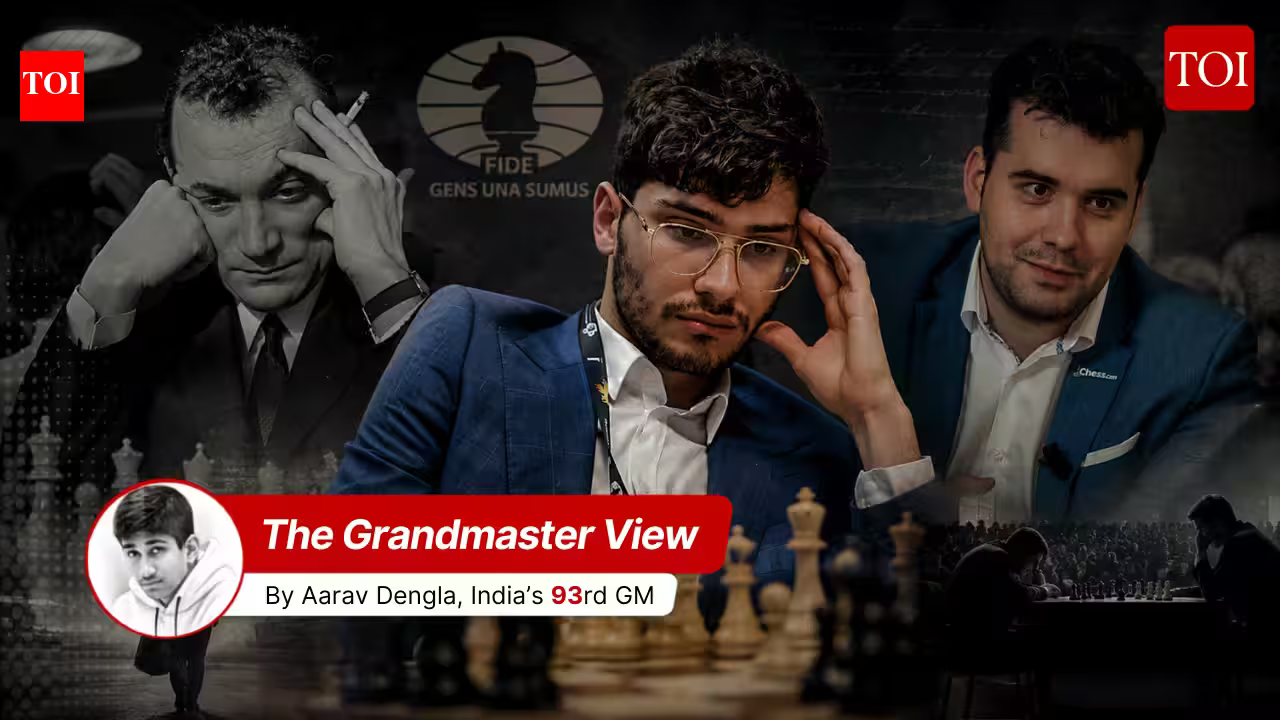
GENEVA, SWITZERLAND – In a world increasingly defined by geopolitical tensions and nationalistic fervor, the International Chess Federation (FIDE) stands as a unique bulwark, steadfastly upholding its enduring motto: Gens una sumus (we are one family). Adopted in 1952, almost three decades after FIDE’s inception in 1924, this principle has transcended its initial “naïve idealism” to become a profound guiding light, ensuring that chess remains an arena where individuals can compete free from the constraints of their nation’s political landscape.
Global sports bodies have often reacted to geopolitical conflicts with predictable cancellations and sanctions, abruptly ending athletes’ lifelong pursuits due to state actions beyond their control. FIDE, however, has consistently charted a different course. Driven by the conviction that politics should not interfere with the game, the federation has provided a sanctuary for dissidents, defectors, protesters, and sanctioned players, allowing them to compete under a neutral flag bearing the FIDE emblem. This commitment, spanning from the dramatic saga of Viktor Korchnoi in 1978 to the contemporary challenges faced by Alireza Firouzja and Ian Nepomniachtchi, illustrates the evolution of Gens una sumus from an idealistic slogan to a pragmatic and powerful principle.
The precedent was decisively set with Viktor Korchnoi. In 1976, after a tournament in Amsterdam, Korchnoi, a Soviet grandmaster, sought political asylum, defecting from the Soviet Union. This act ignited the fury of the Soviet state and its Chess Federation, which demanded that FIDE strip Korchnoi of his grandmaster title and his right to challenge for the World Championship. Had FIDE capitulated, it would have effectively reduced the governing body to an instrument of state power. Instead, under the resolute leadership of its then-president, former World Champion Max Euwe, FIDE stood firm. Korchnoi was granted the unprecedented right to compete under the FIDE flag. As a stateless individual, he navigated the Candidates cycle, triumphing over formidable opponents like Tigran Petrosian, Lev Polugaevsky, and Boris Spassky, to earn his shot at the World Championship against Anatoly Karpov. The notoriously tense 1978 match in the Philippines, where Korchnoi, then residing in Switzerland, ultimately lost 6-5, solidified FIDE’s unwavering commitment to its players’ right to compete, irrespective of political circumstances.
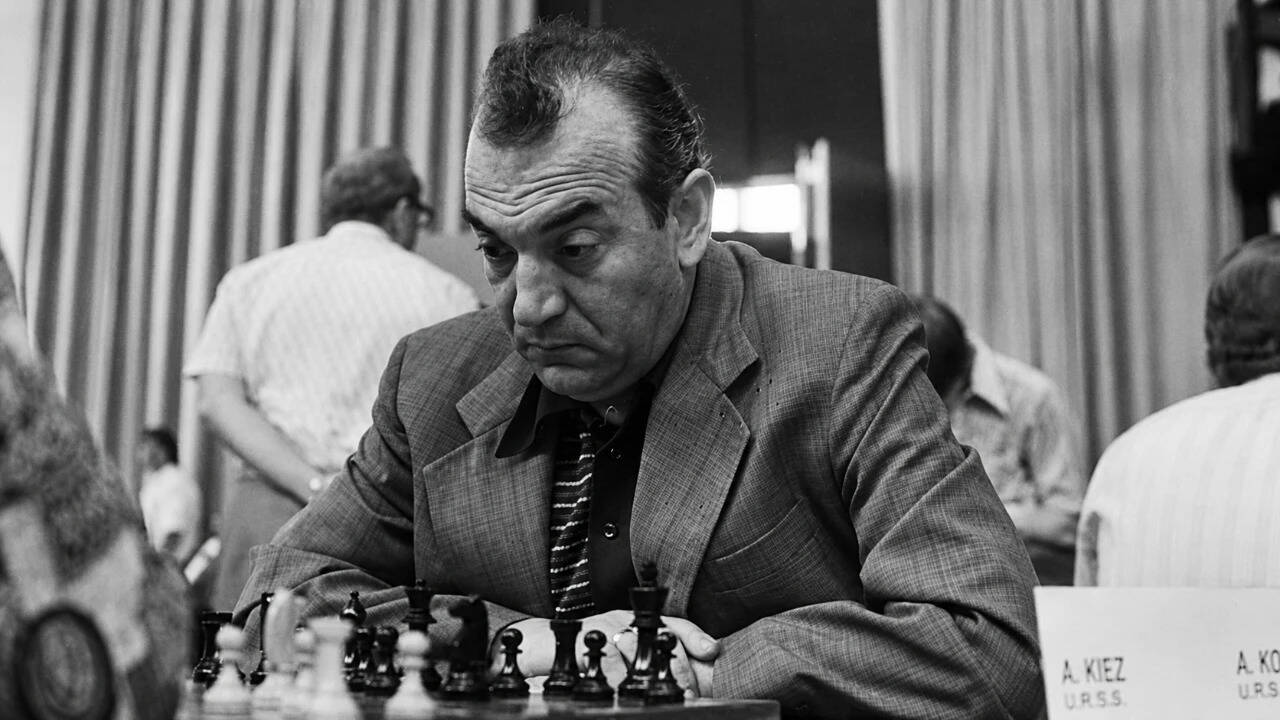
Viktor Korchnoi (FIDE Photo)
Four decades later, the FIDE flag once again proved its critical utility. In December 2019, 16-year-old Iranian prodigy Alireza Firouzja faced a professional quandary. His home federation’s mandatory boycott policy required Iranian players to forfeit games against Israeli opponents. For a talent with world championship aspirations, such state-mandated forfeits were a professional death sentence. As Iran withdrew its players from the World Rapid and Blitz Championship in Moscow to enforce this policy, Firouzja made a courageous decision: he registered under the FIDE flag. Competing quietly in Moscow with the neutral FIDE logo, the teenager secured a silver medal, finishing behind Magnus Carlsen. FIDE’s protective umbrella allowed Firouzja’s brilliant career trajectory to continue unimpeded by state dogma, a bridging mechanism until he eventually obtained French citizenship.
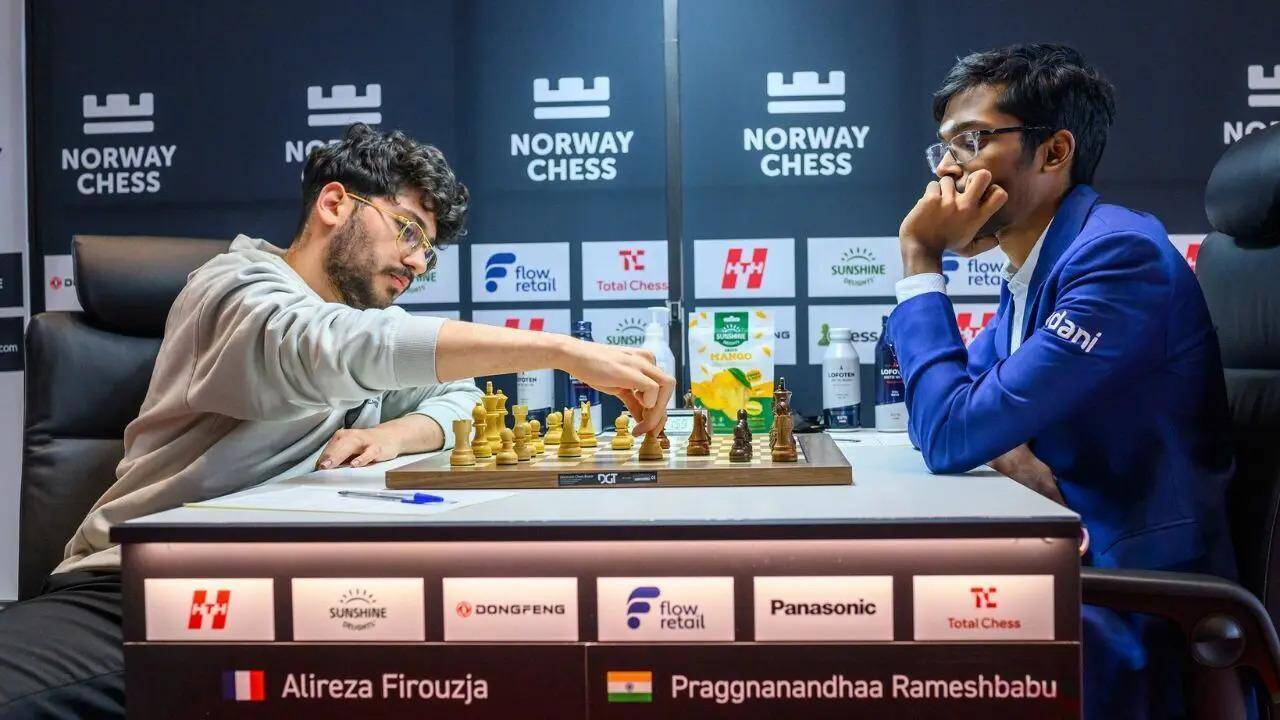
Alireza Firouzja and Rameshbabu Praggnanandhaa (Photo by Michal Walusza_Norway Chess)
The most complex test of FIDE’s principles emerged in the shadow of the war in Ukraine. Following the 2022 invasion, while global sports authorities moved to isolate Russian and Belarusian athletes, FIDE, while banning team events, provided an expedited pathway for individual players to compete under the neutral FIDE banner.
Consider the case of Ian Nepomniachtchi. In late 2021, bound by World Anti-Doping Agency (WADA) sanctions against Russia, he contested his first World Championship match against Carlsen not under the Russian tricolour, but under the neutral banner of the ‘Chess Federation of Russia.’ After losing that championship, and with the full-scale invasion of Ukraine by Russia in 2022, Nepomniachtchi was among 44 elite Russian grandmasters who signed an open letter openly opposing the war. At his subsequent World Championship bid in 2023 against China’s Ding Liren, Nepomniachtchi played under the blue FIDE flag.
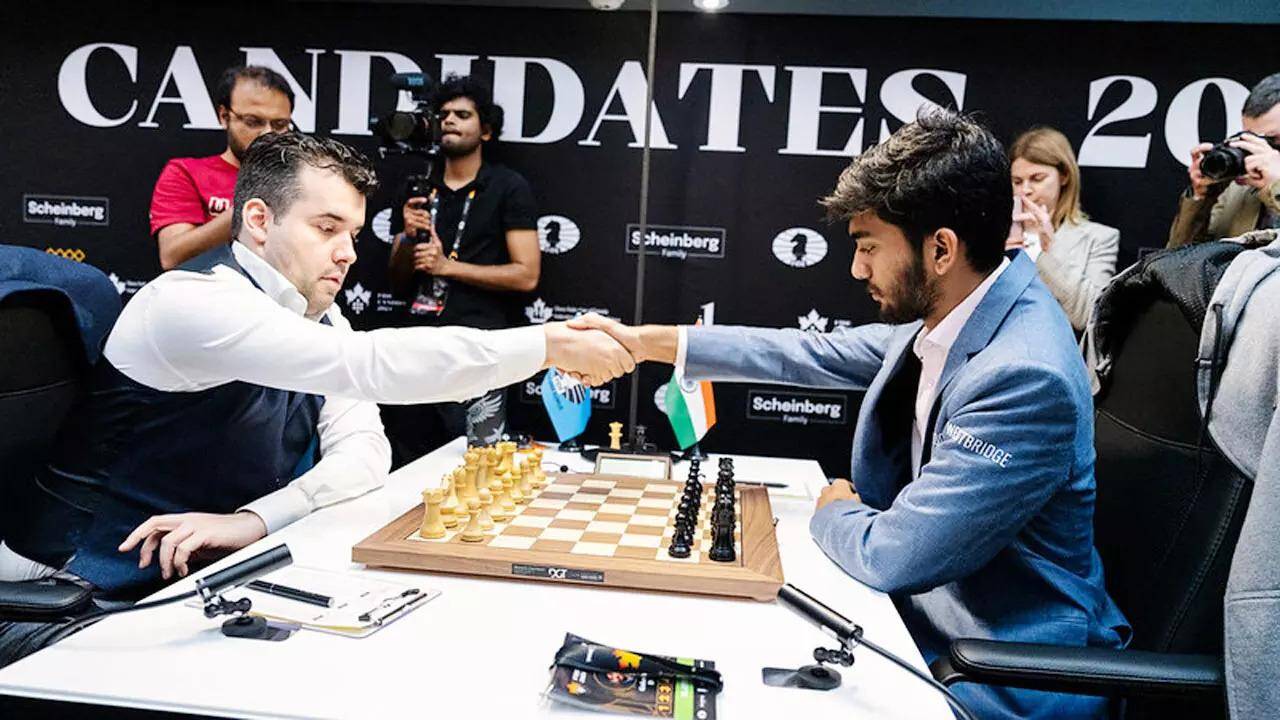
Ian Nepomniachtchi and D Gukesh
While to an outsider, a player competing under a neutral flag might appear devoid of identity, the reality is quite the opposite. When Nepomniachtchi sat in Astana, Firouzja in Moscow, or Korchnoi in Baguio, the neutral flag did not erase their individual identities. Instead, it provided a shield, protecting them from the geopolitical turmoil of their homelands. It would be naïve to suggest that chess players are immune to political realities; Korchnoi endured intense paranoia, Firouzja was compelled to leave his country, and Nepomniachtchi competed under the heavy cloud of a war he actively opposed.
Gens una sumus is not a promise of an idyllic utopia, but rather FIDE’s unwavering commitment to every chess player. It is a pledge that even when the real world fragments, there remains one arena where an individual can step forward, shake their opponent’s hand, and compete purely as an equal. Under the FIDE flag, stateless does not equate to helpless; it signifies the profound freedom to play.
(Aarav Dengla is India’s 93rd Grandmaster. He is a keen observer and student of world history in general and chess history in particular.)