









[
Teen Prodigy Rohan Arni Leverages Deep Learning to Demystify Cosmic Signals, Earns Regeneron STS Finalist Spot
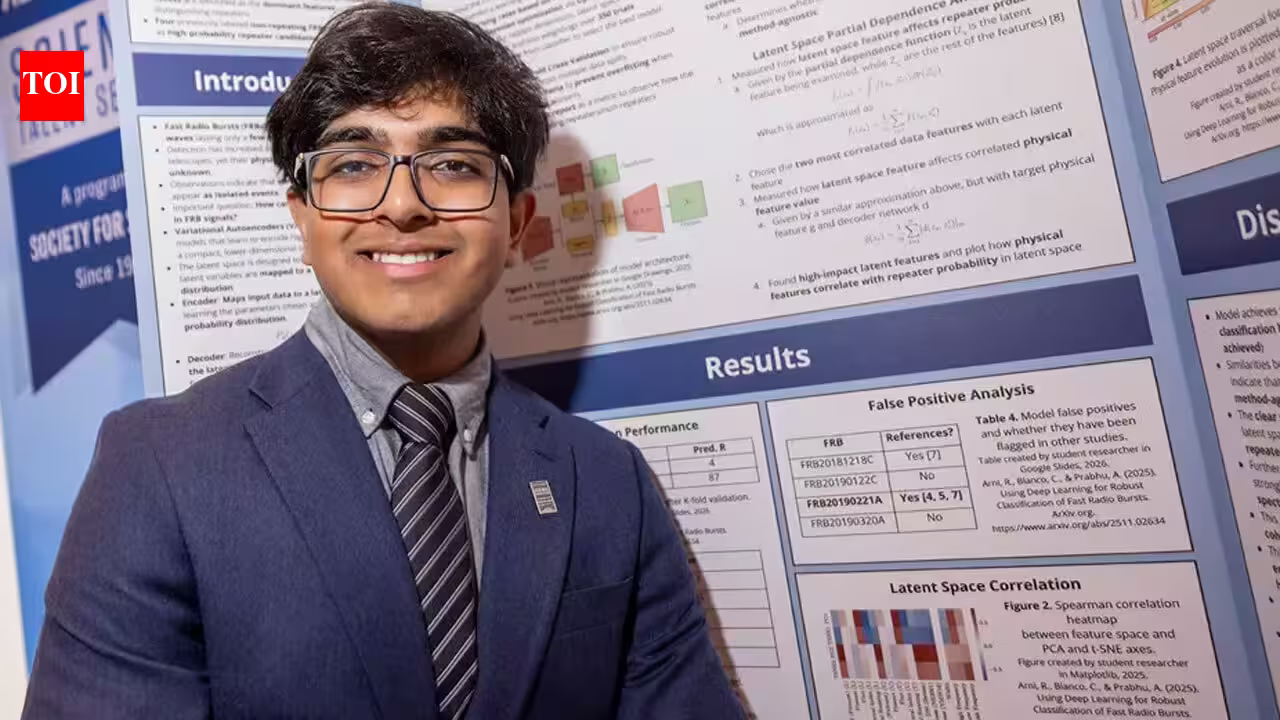
Lincroft, New Jersey – At just 17 years old, Rohan Arni, a student at High Technology High School in Lincroft, New Jersey, has achieved a remarkable feat in the field of astrophysics. Arni has developed a sophisticated machine-learning model capable of classifying fast radio bursts (FRBs) – enigmatic, incredibly powerful flashes of radio waves from deep space – with an astounding 98% accuracy. His groundbreaking research has earned him a coveted position among the 40 finalists of the 2026 Regeneron Science Talent Search, one of the most esteemed science competitions for high school students in the United States.
The Regeneron Science Talent Search finalists were chosen from an impressive pool of over 2,600 entrants, representing 826 high schools across 46 states, Washington, D.C., Puerto Rico, the Northern Mariana Islands, and 16 countries. Arni’s inclusion in this elite group underscores the significance and innovative nature of his work.
Unraveling the Universe’s Puzzling Fast Radio Bursts
Fast radio bursts are among the most perplexing phenomena observed by astronomers. These brief yet intense cosmic signals, lasting only milliseconds, can traverse immense distances across the universe. Despite their power and prevalence, scientists still grapple with understanding their origins and the reasons why some FRBs repeat while others are observed only once.
Arni’s project, aptly titled “Deep Learning for Classification of Fast Radio Bursts,” addresses this mystery head-on by employing artificial intelligence. He utilized data meticulously collected by the Canadian Hydrogen Intensity Mapping Experiment (CHIME), a powerful radio telescope designed to map the sky and detect such radio signals. Rather than the arduous task of manually sifting through vast datasets, Arni’s machine-learning model efficiently identifies patterns and classifies FRBs as either repeating or non-repeating. The model’s 98% accuracy offers a potentially invaluable tool for astronomers to analyze both historical observations and newly detected FRBs.
AI Uncovers Hidden Characteristics of FRBs
Arni’s research extended beyond mere classification. After successfully categorizing repeating and non-repeating FRBs, he delved deeper into the data to uncover distinguishing characteristics between the two groups. His analysis revealed that repeating FRBs tend to be closer to Earth and exhibit smaller frequency ranges compared to their non-repeating counterparts. This finding is particularly significant as it touches upon one of the central questions surrounding FRBs: do repeating and non-repeating bursts originate from similar cosmic objects or through distinct physical processes? Arni’s results suggest that these two categories might indeed stem from different regions or mechanisms within the universe.
While scientists continue to investigate the origins of FRBs, with proposed explanations involving extreme cosmic objects like neutron stars and magnetars, the precise mechanisms remain an open question. By providing a robust machine-learning approach to classify and analyze these signals, Arni’s research offers a powerful aid to astronomers, enabling them to efficiently process growing volumes of FRB data and uncover patterns that might otherwise be overlooked.
From Scientific Computing to Physics Research
Rohan Arni’s interest in scientific computing is not limited to his FRB project. According to the Society for Science profile, he previously collaborated with researchers at Harvard University on the development of NeuroDiffEq, a widely used library for physics-informed neural networks. These networks ingeniously combine machine learning with the mathematical equations governing physical systems, allowing researchers to solve or approximate complex scientific problems while adhering to established laws of physics. This experience highlights Arni’s broader passion for integrating artificial intelligence, mathematics, and scientific inquiry, a synergy clearly demonstrated in his FRB research.
A Finalist Among America’s Brightest Young Minds
As one of just 40 finalists in the 2026 Regeneron Science Talent Search, a program of Society for Science, Rohan Arni stands among the nation’s most promising young researchers. These finalists, hailing from 35 schools across 15 states, are vying for $1.8 million in awards and were invited to the prestigious Regeneron Science Talent Institute. The competition celebrates not only scientific quality but also the potential of research to address critical questions facing science and society. For Arni, that question lies far beyond Earth’s confines. While FRBs are fleeting, the information they carry could hold vital clues about the universe’s most extreme environments, making advanced methods for their identification and classification increasingly crucial as more such signals are discovered.
Beyond the Laboratory
Rohan Arni’s talents and interests extend well beyond scientific research and coding. He serves as the president of his school’s robotics and coding club and has mentored over 100 younger students in STEM fundamentals. His community involvement also includes volunteering as a tour guide with the Monmouth County Historical Association, demonstrating a keen interest in sharing knowledge. A simple, yet telling personal habit further illustrates his thoughtful nature: he consistently returns shopping carts, believing that this small gesture can make someone else’s life easier. From empowering young students in STEM to developing AI tools for deciphering signals from distant galaxies, Rohan’s work embodies how scientific curiosity can flourish beyond traditional academic boundaries.
AI: A New Lens for Cosmic Exploration
Our universe is brimming with signals that humanity is only beginning to comprehend. Fast radio bursts, with their extraordinary intensity, fleeting duration, and mysterious origins, are particularly captivating. Rohan Arni’s research, while not claiming to solve the ultimate mystery of FRBs, provides something arguably as valuable for future exploration: a powerful computational tool capable of rapidly identifying patterns within an ever-expanding cosmic dataset. His 98% accurate model and subsequent analysis of repeating and non-repeating FRBs could empower researchers to formulate more precise questions about the origins of these signals and whether different types of FRBs indeed have distinct cosmic beginnings. For a 17-year-old high school student, transforming mysterious flashes from billions of light-years away into a tractable machine-learning problem is an extraordinary testament to how young minds are leveraging modern technology to tackle some of science’s most profound unanswered questions.
Disclaimer: The scientific findings and observations mentioned are based on the student’s research and information provided by Society for Science and have not been independently verified by The Times of India.