








Clallam County Officials Sound Alarm on Million-Dollar Scams, Emphasize Prevention
SEQUIM — A recent financial scam prevention seminar in Sequim underscored a grim reality: Clallam County residents have collectively lost millions of dollars to sophisticated fraud schemes, with officials stressing that prevention remains the most effective defense.
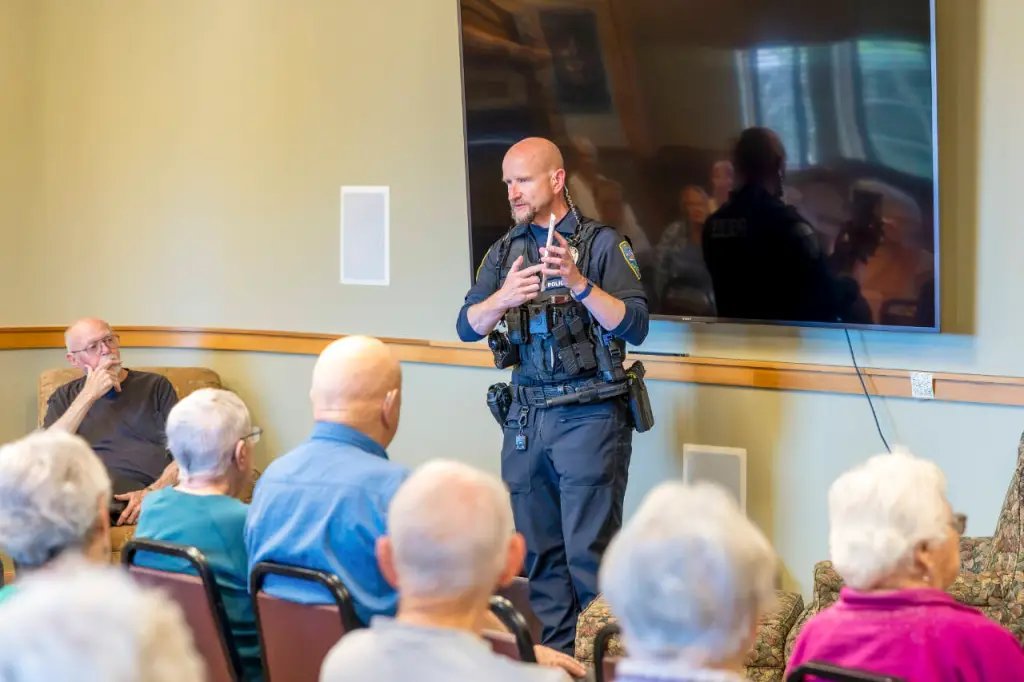
The seminar, held on July 27 at The Lodge at Sherwood Village, brought together Clallam County Undersheriff Lorraine Shore, Sequim Police Officer Roderic Sisk, and Clallam County Prosecuting Attorney Mark Nichols. The irony of the situation was highlighted early on when Undersheriff Shore’s presentation computer flagged her own slides with a “security alert,” drawing laughter from the audience but also serving as a poignant reminder of the pervasive nature of digital threats.
Shore wasted no time in delivering the sobering statistics. “It’s almost impossible to make you whole if you are a victim,” she stated, emphasizing that once funds are lost, often converted into untraceable assets like gold or Bitcoin and handed over to fraudsters posing as government agents, recovery is exceedingly rare. “So prevention is the best.”
The Elusive Nature of Financial Crime
All three presenters converged on a critical conclusion: financial fraud is notoriously difficult to investigate and even harder to prosecute. Officer Sisk contrasted it with traditional crimes, noting, “The potential risk to you is everything you’ve ever earned. That guy with a gun is hard to stop. This is easy to stop.”
Undersheriff Shore recounted harrowing examples, including several residents who, in the past year alone, have lost hundreds of thousands of dollars to callers impersonating Federal Trade Commission agents. These scammers often stay on the phone, guiding victims through emptying their accounts, converting money to gold, and then instructing them to hand it over. Shore described instances where bank tellers and even deputies tried to intervene, only to be dismissed by victims who had been manipulated for days by the scammers’ persistent influence.
The human cost of these scams is devastating. “We have a lady now who lost her house,” Shore revealed. “They sold her house from underneath her. She has no house now (at) 83 years old.”
Understanding the Vulnerability
The audience was not entirely composed of the uninitiated. One woman, who had dedicated her career to healthcare, bravely shared her own experience of losing approximately $40,000 in a scam two years prior.
Prosecuting Attorney Nichols highlighted why the senior population is disproportionately targeted: “It’s what is your strength, ironically, that can also present as a weakness.” He explained that this generation’s inherent sense of trust is exploited by scammers.
While online scams proliferate, Nichols noted that the majority of felony fraud cases his office prosecutes—roughly 15 currently in Clallam County Superior Court—involve physical paper. He cited instances of criminals checking unsecured mailboxes on county roads for sensitive documents like renewed driver’s licenses, which are then used for identity theft. Sisk cautioned against these vulnerable mailboxes, likening them to “a red flag up that basically says, ‘I have something to steal in my box. Please come and take it from me.’” Nichols endorsed this sentiment as “words to live by.”
Proactive Measures and Red Flags
Nichols strongly recommended three proactive steps: investing in a locking mailbox, regularly reviewing bank statements, and obtaining a free annual credit report. He also clarified the challenges of prosecuting online fraud, where identifying the individual behind a computer is difficult, and extradition for smaller sums is often not feasible.
Officer Sisk distributed brochures outlining critical red flags. He emphasized that legitimate transactions never involve immediate pressure or payment in gift cards or Bitcoin. He shared a poignant example of a victim who, despite intervention, continued to fall prey, shifting her gift card purchases from one store to another. “Once you’re a victim of it, it becomes psychologically easier to continue to be a victim than to face the realization that you’ve been tricked,” Sisk explained.
Nichols underscored the importance of such seminars, stating, “In my business, we’re the last to show up. This is one of the precious few opportunities that I have to do something proactive.”
Red flags that it’s a scam:
- Pressure to act immediately.
- A request to pay in Bitcoin or to buy gift cards on someone else’s behalf.
- A request to move the conversation to WhatsApp or Signal.
- A request to install software that lets someone else control your computer.
- A caller you did not contact claiming to be your bank, the IRS, Medicare, Social Security or law enforcement.
- Anyone who tells you to keep the arrangement secret from your family.
If you think you have been scammed:
- Call your bank or card issuer first, ideally within 48 hours. Call law enforcement second.
- If someone is at your door or waiting to meet you in a parking lot, call police immediately.
- Freeze your credit with all three credit bureaus and request a free annual credit report.
- If your computer is acting strangely, take it to a local repair shop rather than trusting a caller or a relative.
Helpful contacts:
Sequim Police Department: 360-683-7227
Elder Fraud Hotline: 1-833-372-8311
Adult Protective Services: 1-877-734-6277
Internet Crime Complaint Center: www.ic3.gov
________
Reporting intern Tom Buscher is a student at Peninsula College. He can be reached by email at tom.buscher@sequimgazette.com.