







Date published:
While many farmers are streamlining operations towards single-system specialisation, County Tyrone’s Tynan Roulston champions the resilience and profitability of traditional mixed farming, proving diversity can thrive.
County Tyrone Farmer Tynan Roulston Champions Traditional Mixed Farming in an Era of Specialisation
In an agricultural landscape increasingly favouring specialisation, County Tyrone farmer Tynan Roulston stands as a testament to the enduring strengths of a diversified, mixed farming system. Rejecting the prevailing trend encouraged by many Business Sustainability Groups, Roulston has successfully cultivated a multifaceted operation that blends dairy, suckler, beef, and arable enterprises, demonstrating that traditional approaches can yield both efficiency and profitability.
Roulston’s journey into mixed farming deepened seven years ago when he diversified his long-standing suckler and beef enterprises by introducing dairying. Yet, his commitment to beef production remained unwavering. In September 2025, he joined one of the College of Agriculture, Food and Rural Enterprise (CAFRE) Suckler Business Sustainability Groups, forging a close working relationship with CAFRE Beef and Sheep Adviser, John Hamilton. Through regular farm visits and active participation in group meetings, Hamilton has been instrumental in helping Roulston identify opportunities for technical improvement and explore practical measures to enhance the overall profitability and sustainability of his diverse operation.
Having previously engaged with CAFRE through its Business Development Groups programme, Roulston was keen to join a Business Sustainability Group, recognising their value as platforms for farmers to openly discuss challenges and opportunities. He particularly values the on-farm meetings hosted by group members, noting, “Every time I visit someone else’s farm, I come home with an idea, no matter how small, that I can implement in the running of my own farm.” This collaborative spirit, coupled with access to a dedicated CAFRE Beef and Sheep Adviser for queries and technical support, underpins the programme’s effectiveness.
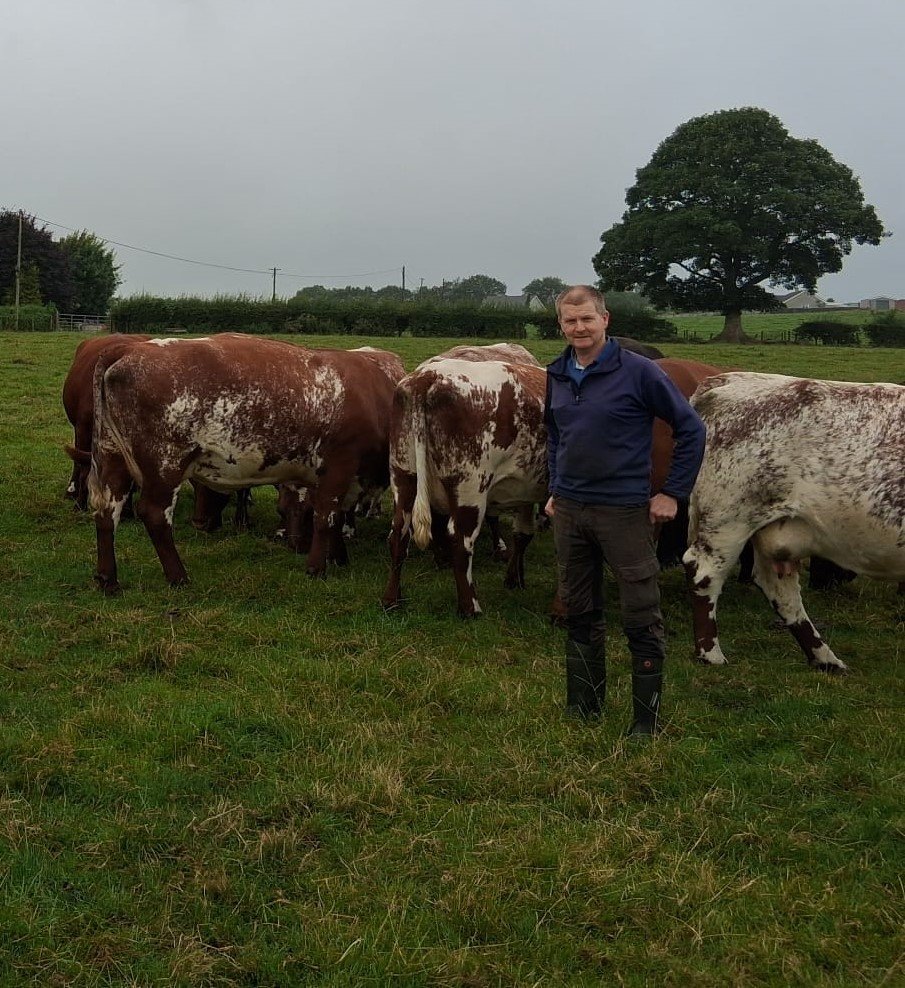
Roulston’s home farm currently supports approximately 60 Fleckvieh and British Friesian dairy cows. A significant portion of the dairy herd is bred to an Angus bull, with the resulting progeny finished directly on the farm. Complementing this, he maintains a 25-cow Shorthorn suckler herd, breeding some animals pure and crossing others with Angus sires for pedigree-unsuitable stock. Both Shorthorn and Angus-bred cattle are marketed deadweight through local processor Foyle Meats, showcasing a well-integrated production chain.
Beyond livestock, Roulston manages a substantial arable enterprise, growing approximately 60 acres of cereals annually. Most of the grain and straw produced is utilised on the farm, contributing to the self-sufficiency of the operation. Further extending his reach, he farms land in County Donegal, where he annually purchases Angus-bred yearlings for finishing the following season.
Looking ahead, Roulston plans to maintain both his dairy and beef enterprises, with a particular ambition to potentially increase suckler cow numbers. While acknowledging the financial strength dairy production has brought to the business, he openly admits his passion remains rooted in suckler cows and quality beef production. “Milk production has undoubtedly strengthened the business, but my heart still lies with suckler cows and producing quality beef. I would like to grow that side of the enterprise again in the future,” he stated.
Despite improved margins in beef production over the past year, Roulston remains focused on continually enhancing herd efficiency. He credits his membership in a Business Sustainability Group as crucial to this objective, particularly the option to financially benchmark his herds and flocks against other participating farmers across Northern Ireland. He also sees immense potential in the Bovine Genetics genomic testing project, a collaborative effort by Sustainable Ruminant Genetics (SRG) and the Department of Agriculture, Environment and Rural Affairs (DAERA).
“I have become more aware of the Bovine Genetics Programme through my participation in my CAFRE Business Sustainability Group and would encourage anyone to get involved. I believe it will deliver real benefits for the beef industry,” Roulston commented, highlighting the programme’s potential to transform the sector.
For farmers and rural businesses seeking to boost profitability, resilience, and environmental performance, joining a CAFRE Business Sustainability Group offers significant advantages. CAFRE is actively recruiting new members, with applications for Tranche 2 of the Business Sustainability Groups closing on Friday 28 August 2026 at 4:00 pm. Interested suckler, beef, or sheep farmers are encouraged to contact their local CAFRE Adviser or visit the Business Support area of the CAFRE website for further information.