









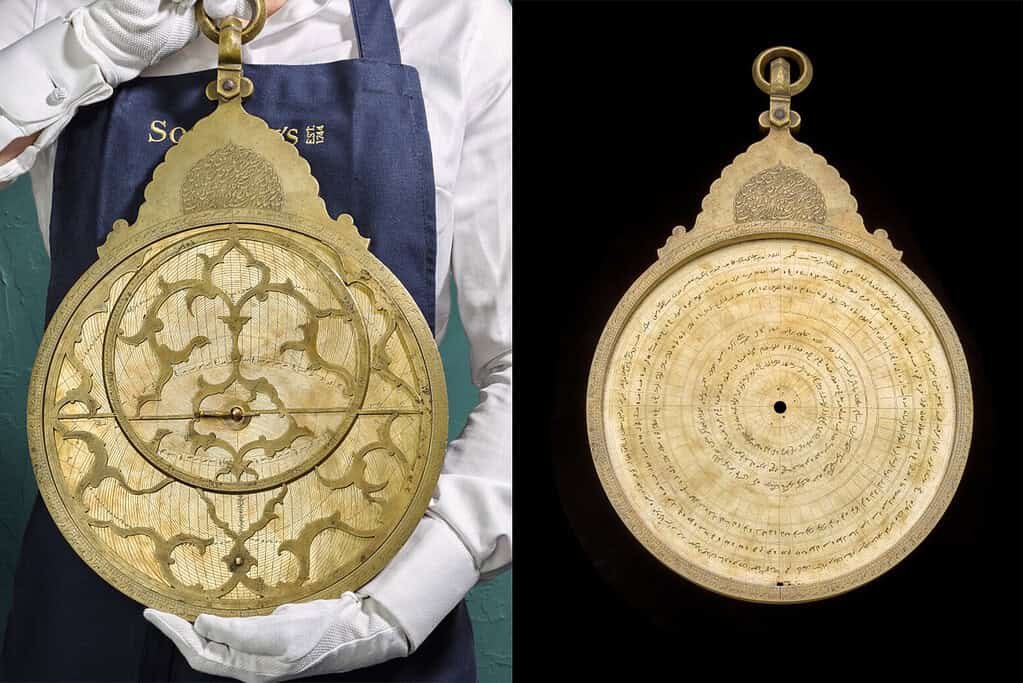
Long before smartphones compressed clocks, maps, calendars, and calculators into a pocket-sized screen, another device promised to put the heavens in a person’s hands. Made of engraved brass rather than silicon, the astrolabe could tell time, help locate a traveler, measure the height of a building, and even support the casting of horoscopes.

We’re talking about a massive 17th-century astrolabe from the Mughal world that is now heading to auction in London.
“It is not only big, beautiful, and heavy. It is so incredibly accurate that it will give you the exact degree of altitude (of a celestial body), Federica Gigante, a historian and senior research fellow at the University of Oxford, told the BBC.
Once part of the collection of the Jaipur royal family, this rare scientific instrument is remarkable for how it blends astronomy, mathematics, and craftsmanship with remarkable precision for its day.
The interesting history of the ancient computer

An astrolabe is a handheld scientific instrument, usually made of metal, that people in the past used to study the sky. By aligning its moving parts with the Sun or stars, it could help tell the time, find directions, measure heights or distances, and even partially estimate a person’s location on Earth (granted, with a lot of room for error).
Under stable conditions, a skilled astronomer or surveyor could determine latitude with an error margin of only 7 to 15 miles (about 13 to 28 kilometers) from the true position. At sea, sailors using an astrolabe could pinpoint their latitude a margin of error between 60 and 120 miles in rough waters. To estimate a location’s latitude, a navigator measured the maximum altitude of the Sun (at solar noon) or the altitude of the Pole Star (Polaris) at night. The angle was then compared with astronomical tables or a rotating plate (known as a climate) corresponding to the user’s anticipated location, yielding the north-south coordinate.
“They are essentially a two-dimensional projection of a three-dimensional universe. You can calculate the time of sunset, sunrise, the height of a building, the depth of a well, the distance, and even use them to predict the future. Along with an almanac, they were once used to cast horoscopes,” Gigante added.
Astrolabes were not new in the 1600s. They were first developed in ancient Greece and later refined in the Islamic world. By the Mughal period, they were among the most advanced scientific instruments in use—later often described as the computers of their time.
The one now heading to auction was made in 1612 in Lahore, then a major centre of learning under the Mughal Empire. It was crafted by two brothers, Qa’im Muhammad and Muhammad Muqim, part of a family workshop known for producing highly refined instruments. Only two astrolabes are known to have been jointly made by them, making this piece exceptionally rare.
It was commissioned by Aqa Afzal, a Mughal nobleman of Iranian origin who served under emperors Jahangir and Shah Jahan, including as an administrator in Lahore. The scale of the instrument reflects his status—it weighs about 8.2 kg, measures nearly 30 cm across, and stands roughly 46 cm tall, making it far larger than typical astrolabes of the time.
After its creation in Lahore, the instrument eventually became part of the royal collection in Jaipur, a princely state in western India known for its interest in astronomy. It later came into the possession of Maharaja Sawai Man Singh II, the state’s last ruling monarch.
After his death, it was inherited by his wife, Maharani Gayatri Devi, who was widely known in India for promoting and reviving various art forms. During her lifetime, the astrolabe was transferred into a private collection, where it has remained largely out of public view until now.
A fusion of different cultures
Despite its movement across regions and owners, the astrolabe itself remains remarkably intact. It contains detailed data for 94 cities, each marked with latitude and longitude, along with 38 star pointers linked by intricate floral designs.
It also includes five calibrated plates and extremely fine degree markings, allowing precise astronomical calculations.
In practical terms, the device worked by aligning its rotating parts with the positions of celestial bodies. With the right adjustments, a user could determine the time, estimate distances, calculate the height of structures, or locate their position.
“I compare them to modern-day smartphones because you can do so many things with them,” Gigante said.
One surprising feature is its mix of languages. Star names on the instrument are engraved in Persian alongside Sanskrit equivalents in Devanagari script (a writing system used to write several languages in India).
This reflects how different knowledge systems (Indian and Islamic) were combined in ancient India, not just culturally but in working scientific tools.
Why does the astrolabe matter now?

At first glance, the astrolabe might seem like just another historical artifact heading to auction. However, its significance runs deeper. This astrolabe captures a moment when science was not fragmented into disciplines but practiced as a unified craft.
Astronomy, mathematics, art, and even astrology were intertwined. Today, we rely on digital computers and software, but this object reminds us that complex problem-solving once depended on physical tools and human interpretation.
It also highlights that too much of our focus has been on Europe’s scientific revolution, overlooking parallel advances elsewhere at the time.
The Lahore School’s work shows that precision engineering and astronomical innovation were thriving in Asia at the same time.
If the astrolabe is acquired by a museum, it may finally be exhibited and analyzed in detail, offering historians and scientists new insights into pre-modern computation and cross-cultural knowledge exchange.
To know more about the astrolabe and the auction, you can go here.