








Like so many others, Isabella Schaub moved to New York with a dream. With ambitions to act, the recent college grad, a 24-year-old with a pale, heart-shaped face and curly auburn hair, started doing background work on film and TV in between barista shifts and coaching soccer, among other gigs. And in February, she got a massive break, especially for one so young and new to the game: A major Hollywood casting director got in touch.
Linda Lowy, whose keen eye for talent was apparent on Grey’s Anatomy, Friday Night Lights and Scandal, had alighted on Schaub after a review of casting platforms and professional databases. Over email, she first invited Schaub to submit a headshot for an undisclosed HBO Max series and then, after one thing led to another, a monologue.
Schaub taped Robin’s (Maya Hawke’s) coming-out speech in Stranger Things and killed it. Her performance, Lowy wrote to her, was “compelling and assured.” Her line delivery needed a little work, but it wasn’t anything some training couldn’t fix, and a day later, Lowy offered her the opportunity of a lifetime: a role on Hacks. Given the project, Schaub was required to sign an NDA, which was no issue. There was only one hitch: She needed to become a member of the performers union, SAG-AFTRA, to play the role.
Fortunately, Lowy was able to connect Schaub with a union contract administrator. But that admin didn’t have an official SAG-AFTRA email address (his was “SAG-AFTRA@contractor.net”). When Schaub Googled him, she couldn’t find someone with that name at the union. Finally, Schaub contacted the union through official channels. “Yeah, that’s fake,” she remembers a real SAG-AFTRA rep telling her. After that, she heard back from the supposed union admin: Initiation fees of $3,000 could be paid through bank transfer, PayPal or CashApp.
It feels awful to be duped. And it’s even worse when someone is taking advantage of a deeply held wish. “It just felt like all the wind came out of me. I was like, ‘Of course it’s a scam,’” Schaub remembers now. She felt so naïve. But, as she later told her Instagram followers, taking them through the NDA, the union information she received, the invitation to a future Zoom meeting with show creatives, “This is so much effort to be a scam.”
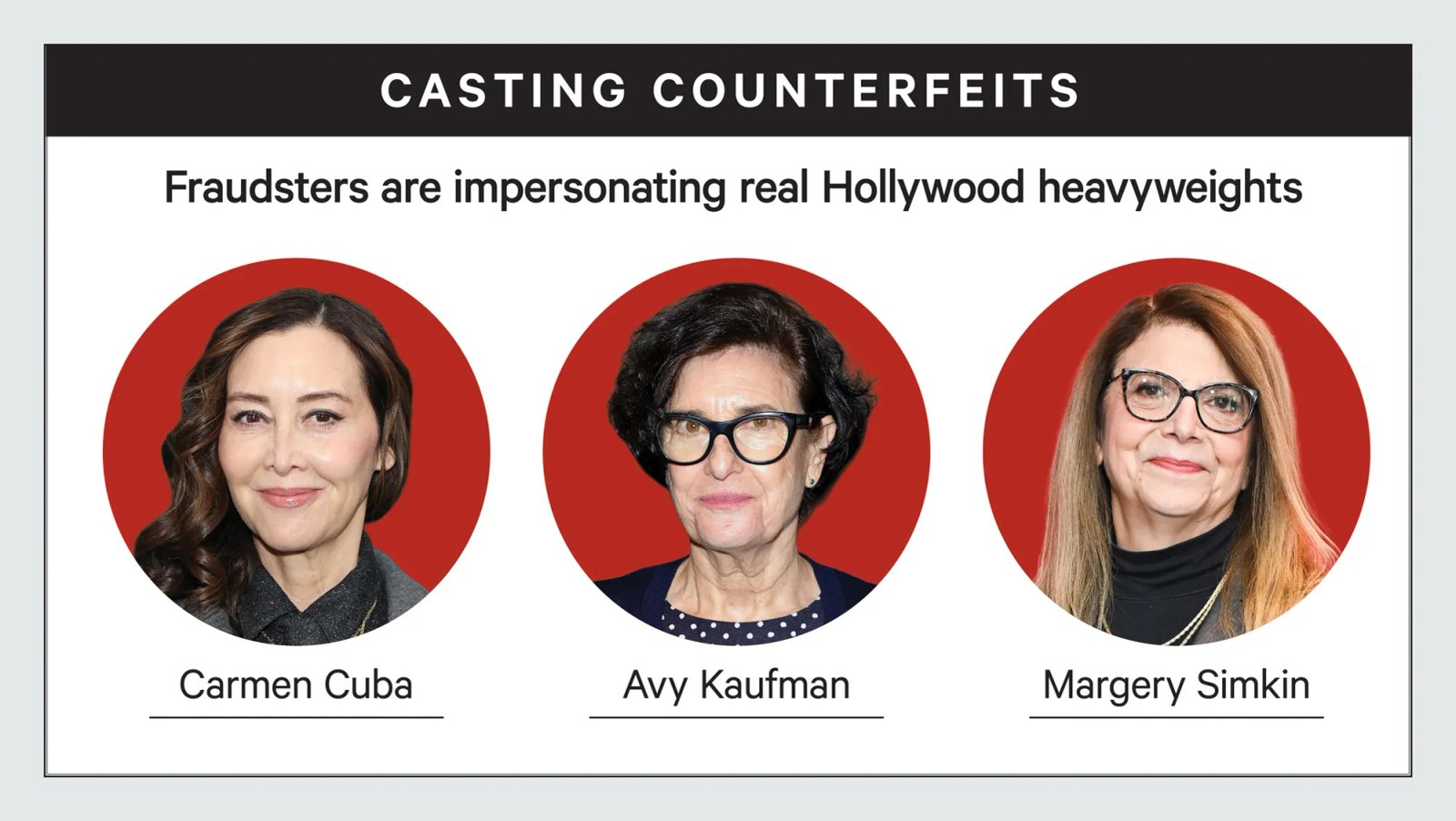
It was, and yet Schaub’s experience with Fake Linda was just the tip of a larger shady iceberg. Over the course of at least half a year, one or multiple scammers have been impersonating some of Hollywood’s most prominent casting directors among an especially vulnerable population of actors, many of them early in their career. A fake Carmen Cuba, who cast Stranger Things, is out there raising hopes. There’s an imposter version of Avatar casting director Margery Simkin and a simulated J.J. Ogilvy, who cast Riverdale and The Good Doctor. The fakes are contacting performers in the hope of extracting money through different methods, but often in the form of union fees.
Theirs is an old-school social engineering scam, and not even an especially sophisticated one, but it’s nevertheless initially fooled some actors with polished emails and a general grasp of how the casting process can work. And it may be a sign of things to come as the timeless phenomenon of hucksters selling false Hollywood dreams enters the AI age.
***
Here’s how the scheme has recently worked, according to correspondence provided to The Hollywood Reporter and those who have experienced it. A big name in casting reaches out to a performer over email or social media, inviting them to submit materials to be considered for an upcoming role. If the actor responds with some requested information, such as their headshot, the scammer may ask for a self-tape or a performance reel. The actor might receive some feedback then eventually learns they have been chosen for the part — pop the champagne! Except, wait, here come the fake fees.
Liz Weinstein, a model and actress, has in the past few months received emails from people claiming to be Avy Kaufman (Sentimental Value, Train Dreams), Rachel Tenner (Fargo, Severance), Ogilvy and “Mindy May,” a supposed casting director for a John Ridley (Shirley, Godfather of Harlem) project. While she spotted warning signs in all of these communications and stopped engaging with the senders, she notes how difficult it can be broadly for actors to separate the spam from the opportunities in the rough. “A lot of the legitimate jobs do come off as scammy,” she says, explaining that some projects require actors to sign an NDA before they can get more information, and don’t provide many details upfront.
Many of the fake casting directors are using Gmail addresses, which isn’t as sketchy as it might sound. Plenty of casting directors are freelancers and not employees of a studio, so they have their own email addresses (and some, indeed, use Gmail).
Even so, the impersonators are fumbling some key details. For those fakes asking for a “fee” as they’re onboarding an actor to a bogus project, that’s not only shady, in California it’s illegal, breaching the state’s Krekorian Talent Scam Prevention Act, says Doll Amir & Eley founding partner Gregory Doll. The fraudulent union reps also aren’t playing by the rules. An actor can’t just join SAG-AFTRA by paying a lump sum; they have to work on a union-covered project or be a qualified member of an affiliated union for at least a year first.
Then there are the occasional glaring red flags. In one email, a fake SAG-AFTRA representative named William Parker directed an actor to pay a SAG-AFTRA initiation fee to the personal checking account of one “Adeleye Ayobami” in Kansas City, Missouri.
Even so, the more plausible language in the scammers’ messages begs the question of whether the person or people behind this scheme actually know a little something about the industry. Sarah Pribis is a working actor who received an impersonator email and made a video warning fellow actors about it. She doesn’t think the perpetrators have much inside knowledge. “It’s so obviously not legit to me and anybody in the business … that there’s no way,” she says.
But others aren’t so sure. “It feels like whoever’s doing it has a strong understanding of the casting process because they’re actually asking for auditions now and sometimes even giving feedback and really leading you down the merry path,” says Tiffany Little Canfield, the Wicked casting director who is also Casting Society’s vp of communications. “They’re imitating a casting process rather than just saying, ‘Oh, I saw a picture of you. You’d be perfect for this part.”

***
Real casting director Kaufman first learned that she was being impersonated months ago. She began receiving emails from actors asking, “Is this you?” or alerting her to sketchy-sounding messages purporting to be from her. Even more disturbing, some asked follow-up questions about fake projects she allegedly was casting. “Some of them were told to send a monologue for money, and then some of them would ask, ‘What kind of monologue?’ ” she recalls. “And we would write back, ‘We don’t want anything from you. This is a scam.’ ”
Today, Kaufman is an apparent favorite of the scammers, as five sources for this story reported outreach from her digital doppelgänger. The prolific casting director personally receives at least a couple of emails about these schemes a day, she says. As of May 7, Casting Society had identified 13 fake email addresses, all using Gmail accounts, for Kaufman. (And THR found three more.)
She’s horrified by this attempt to rip off actors, and she isn’t the only one. “The idea that they’re given this false hope when hope is such a part of being an actor, hope and passion and the desire to be seen for their craft… it’s so distressing,” says Stranger Things casting director Cuba. Cuba’s office has identified eight fake email addresses for her.
Amanda Lenker Doyle, who worked on Murdaugh: Death in the Family and Chad Powers, has been impersonated on Facebook, Instagram and over email. “I am an incredibly somatic empath. And so when these things happen to other people, I feel them so deeply and I feel so horrible about it. And my physical response is like, ‘Let’s call the FBI. I’m going to get them. How dare you try to hurt somebody in my name?’ ” she says. (She did try to contact the FBI but says she got no reply.)
In the case of the Avatar casting director, Simkin, the scam has gone a level deeper: Her voice has been impersonated. In a voice memo sent to her by an actor, and shared with THR, a scammer pretending to be Simkin tells the mark, “I am sending this voice note to clear the air and let you know this is truly me and not a damn scam from, from Africa.” The voice on the audio is somewhat halting, its choice of words strange, but it undeniably sounds like Simkin’s. Listen:
“There are no words for how creepy it was to hear my voice,” Simkin says.
Casting Society has fought back against the onslaught, setting up an anti-scam committee and creating a web page to help casting directors report scams. Next, the society wants to create webinars for SAG-AFTRA actors and college programs.
“It seems to be growing, definitely,” Little Canfield, one of three leaders of the anti-scam committee, says of the scheme. “The only thing I believe that we’ve really found as a pattern is they often [pretend to be] someone who does not have an online presence themselves.”
To be clear, it’s not apparent yet how successful this scam is. No performer that THR spoke with for this story actually ended up shelling out, having gotten suspicious before money could change hands. (This is clearly no Hollywood Con Queen.) A few people have gotten close, though. “I was very excited,” one person who commented on an Instagram post about the scam wrote. “I was going to to [sic] give the them[sic] all my pay check and was going to get a second job to pay that 1,000 fee.”
And with the scam having gone on for months, it wouldn’t be unreasonable to suspect that someone’s fallen for it. “I think it’s successful,” says Peter Warmka, an ex-CIA senior intelligence officer and founder of the Counterintelligence Institute, which performs security audits and assessments for businesses. “And I think there’s also a pretty good percentage of people that have been scammed and don’t report it.” In 2025, a Pew Research Center survey found that about ¾ of adults who had been scammed online and lost money never reported it to authorities.
While it’s easy to dismiss these messages as clearly too good to be true, the ruse seems to be exploiting some realities of the casting process in 2026. Ever since the COVID-19 pandemic, casting has gone increasingly online, with self-tapes and virtual auditions becoming the new norm. While it’s still rare for casting directors to solicit materials from an experienced actor directly, finding non-professional actors who can bring greater realism to a project is in vogue. As a result, stories abound of casting directors contacting potential stars directly on social media or on the street, rather than going through more traditional channels like agents or Actors Access.
Tiffany Little Canfield, the ‘Wicked’ casting director who is also Casting Society’s vp of communications.
Photo by Dia Dipasupil/Getty Images
***
The entertainment industry has long been a magnet for fraudsters, from the contemporary romance scammers pretending to be Keanu Reeves or Kevin Costner to the age-old phenomenon of phony talent agents charging for classes or photo shoots. In the early ‘90s, a scam similar to today’s flourished over landlines. “Non-union performers are contacted by telephone by a con artist claiming to be a casting director,” reported Backstage at the time. “They are told they have been cast in a SAG commercial to be shot in Canada and need to immediately wire money (usually $93) or deliver the sum to a hotel to obtain a union ‘waiver.’”
But fraud experts say this latest scheme may be a sign of things to come for Hollywood as generative AI accelerates the volume and sophistication of consumer fraud. “Unfortunately this kind of victim profile and this particular industry are pretty much an ideal match for these types of impersonation schemes,” says Mason Wilder, the research director at the Association of Certified Fraud Examiners. The industry’s volume of high-profile people, with their voices and images widely available on the Internet, is catnip for an impersonator with AI tools at their fingertips.
Fraudsters also love to exploit desperation and dreams — like an actor’s burning desire to land a film or TV role — which pave the way for victims to overlook red flags. “Your big break, that big opportunity, you want it so badly that you want it to be true. The first place your head does not go to is, ‘This must be a fraud’ or ‘This could be a fraud,’” says John Jay College of Criminal Justice associate professor Chelsea Binns.
With an assist from AI, suspending disbelief is easier than ever. Some messages associated with this fraud have used generic corporate language with no spelling errors, deployed company logos and added “terms of use” and “privacy” links in their footers. A fake SAG-AFTRA membership application asked which other performing unions an actor belongs to (Actors’ Equity Association? The American Guild of Musical Artists?). Phony casting directors offered semi-critical feedback on self-tapes, which added just a touch of real grit.
Actor Katy Milewski had previously auditioned for a small role in one of Kaufman’s projects, on HBO’s Task, when she got an email from “Kaufman” in November. So it didn’t seem preposterous that “avy.kaufmanscasting@gmail.com” would reach out for a potential role in an upcoming Apple TV+ series. The alarm bells didn’t start to ring until “Kaufman” asked for a reel or a monologue; if Kaufman knew who she was, surely she would have seen her acting reel by now, Milewski thought.
Milewski found Kaufman’s direct email online and tried to verify the exchange, but didn’t receive a response. Still, she was suspicious enough that she didn’t engage with the message again.
But she wasn’t totally sure she had made the right choice until she saw Pribis’ post on Instagram about her own email from “Kaufman” in March. Until then, Milewski says, “In the back of my head, I always kind of wondered, could this have actually been real?”
This story appeared in the June 3 issue of The Hollywood Reporter magazine. Click here to subscribe.