







On 15 April, Julie Ward reported for North East Bylines on an upcoming community film screening of The People’s Emergency Briefing, to be held at Redhills, the former Durham Miners Hall in Durham City, on 17 April. The event was organised by Climate Action Durham. I decided to go along.
Isn’t it ironic?
Redhills, the ‘Pitman’s Parliament’ symbolizes Durham’s links with King Coal. But Durham has moved on from coal and, due to the climate emergency, the world needs to move on too.
Skip the popcorn
The briefing isn’t your average Friday night chill. But then, a climate catastrophe isn’t something to chill about. For those that aren’t aware, the People’s Emergency Briefing is an initiative spearheaded by brothers Simon and Nick Oldridge, climate funders and communicators, with a background in business. The film is a record of the National Emergency Briefing which took place at Central Hall in Westminster in November 2025. The briefing brought together leading experts to present the latest evidence on the climate and nature crisis to politicians and other influential people in Westminster.
Making it relatable
The intention of the film is to spread the expert briefing across the entire United Kingdom. As part of the film, excerpts from the expert briefings are interspersed with interactions between Chris Packham, and ‘celebrities’ such as Konnie Huq, Jennifer Saunders and Adam Buxton.
On that cheerful note…
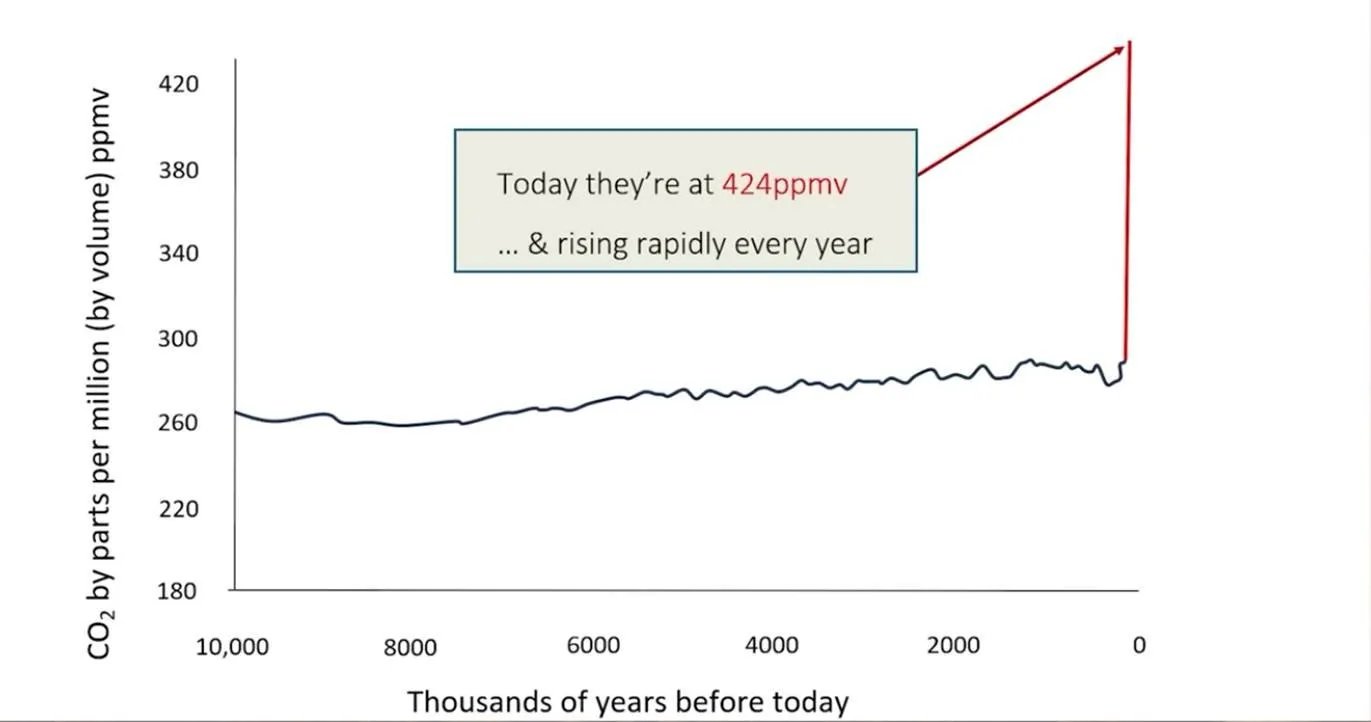
So here are some highlights from the expert briefings: Prof Nathalie Seddon warned about continued environmental degradation throughout the UK; Government agencies that are meant to protect nature are having funding cut at the very time that they are needed most. We’re pouring billions of pounds into harmful practices that degrade soils, pollute rivers and destroy habitats. We need legislation to stop this insanity. Prof Kevin Anderson reported on a startling increase in atmospheric CO2 since the world started burning fossil fuels at scale during the industrial revolution. Here’s an excerpt from Kevin’s briefing, with the red line showing the exponential change that has taken place in less than 200 years:

In just two centuries the CO2 increase has driven the biosphere temperature up by almost 1.5℃. But, at the current rate of change, we’re heading for a 4℃ increase by the end of the century. The journey towards this will bring unprecedented societal and ecological chaos, geopolitical instability and increased military tension. Later on Lt General Richard Nugee CB CVO CBE warns of this too, as seen here
No half measures
We’re already there with all of the disruption foretold by Kevin Anderson, but this is just the opening act. It’s no use just cutting fossil fuel consumption. We’ve got to eliminate it, and we’ve got to do it quickly. The scientific consensus is that the world has probably already blown past the 1.5℃ maximum limit agreed by the UN Climate Change Committee (CCC) at Paris in 2015. Richard focused on the two types of technologies that are supposed to take us on the journey to net zero. The first of these is Delay ‘technology’, as shown in this excerpt:

The carbon capture caper
Taking just one example, CCS (Carbon Capture and Storage) is the favoured sorcery of the fossil-fuel shills. Kevin noted that the lobby has been promising CCS for more than 30 years. But, in 2024 for example, CCS stored less than 0.03% of global fossil fuel CO2 output. All of the ‘delay technologies’, not just CCS, are expensive, and will be funded mostly through tax and bill players. They’re false solutions designed to delay meaningful legislation.
What’s the real solution?
Kevin then contrasted ‘delay’ technologies with ‘timely’ technologies (i.e. real ones). Kevin suggests a Marshall Plan style deployment to rapidly reduce CO2 production in order to keep our planet habitable. Most people would readily agree with the aims, although rapid cuts in aviation would be a bitter pill for some to swallow.

Tipping points
As a side order, why not read about the unsustainability of ‘sustainable’ aviation fuel? This one’s on me.
Prof Tim Lenton was there to talk about Global Tipping Points? These are zones where we are close to the point of irreversible damage. Whoa! Tim has identified ten of these, most of which interact with each other:

News from the home front
But it’s the disruption to the Atlantic circulation that hits home. Tim told the audience about the collapsing Atlantic Meridional Overturning Circulation. That’s easy for you to say, Tim. Let’s call it AMOC for short. The AMOC delivers the Gulf Stream when heading north, then heads south past the coast of Greenland in a deepwater current, cooling as it goes. Or at least it does when it’s working. Even before human intervention, AMOC failed 25 times during the last ice age. Recent state-of-the-art modelling shows that human-induced climate change is bringing AMOC to the brink of a Tipping Point right now.

Boxing Day dip
At a local level, once past the Tipping Point, an AMOC collapse induced by 2℃ Global Warming would result in sea ice extending as far south as Norfolk by February each year. This would turn Boxing Day dips at places such as Roker and Redcar into extreme challenges.

Blowing hot and cold
The UK would experience climate more suited to its latitude, with the wide seasonal variations that this would bring. London, for example, would see regular winter temperatures of -20℃, and three frozen months each year. But the summers would still be hotter than they are today; the South East of the country would run out of water every year. In terms of agriculture, the UK simply wouldn’t be able to grow crops anymore. On a worldwide basis, the amount of land available for the main food crops, such as wheat, would be halved.
But we can attain positive tipping points too
This has already been done with the eradication of coal from the UK’s electricity grid. It can also be done with effective fossil fuel mandates on such things as petrol and diesel cars, diesel trucks and domestic gas boilers.
Green policies versus fossil fuel
There was some optimism towards the end of the film. Angela Francis from the World Wide Fund for Nature (WWF) noted that the UK government should press ahead with plans to invest just £4bn in green technology each year to stay on the CCC’s balanced pathway. Most of this investment would be from the private sector, along with a small amount of public sector intervention. “We can’t afford Net Zero” say fossil fuel shills such as Nigel Farage and Kemi Badenoch. This plainly isn’t true. Tessa Khan stated that the evidence is clear: An energy system powered by renewables will be more affordable, and more economically secure, than the fossil fuel status quo.
Lobby your MP
During the film, Jennifer Saunders jokingly thought out loud about how she would go about lobbying her MP, as she’d never done it before. As it happens, there’s not much to it. Simply click on this link, and tap in your postcode. Your MP’s details will appear, including an email address. Send a concise email to them, reminding them about the severity of the climate emergency, and asking them to join the Parliamentary Call for a Televised Emergency Climate Briefing. Please don’t lobby MPs other than your own; these attempts will be disregarded.
What can we do locally?
After the film, members of Climate Action Durham (CAD) reminded audience members of its support for the mission of the Big Solar Co-op. This is a non-profit dedicated to using rooftops across the UK to install more solar panels for electricity production. Donations to CAD will be invested in Big Solar Co-op.
Coming soon to a ‘cinema’ near you
Just a reminder of future local showings of the National Emergency Briefing film:
- 22 April Newcastle University
- 9 May Queen’s Hall Arts Centre, Hexham
- 14 May Waddington Street United Reformed Church, Durham
- 15 May Port Independent, Sunniside, Sunderland
- 19 May Tyneside Cinema, Newcastle
- 23 May Waddington Street United Reformed Church, Durham
- 24 May Dry Water Arts Centre, Amble
- 9 June Ocean Road Community Centre, South Shields
- 10 June Forest Hall Ex-Servicemen’s Institute
- 16 June Summerhill Bowling Club, Newcastle
- 18 June Jesmond Library
An interactive map of these screenings can be found here
The full playlist of expert briefings is available on YouTube here.
Friends of Bylines Network
There has never been a greater need for grassroots journalism that investigates the stories that really matter, holds power to account and champions the voices of everyday citizens. We are proudly powered by volunteers but what we do isn’t free.
STAND WITH US for independent, citizen-led journalism that makes democracy stronger, and you will even get some exclusive benefits.