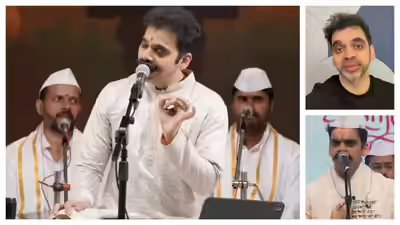
For Rahul Deshpande, Abhangawari is far more than a concert series; it is a pilgrimage. Inspired by the enduring wisdom of Maharashtra’s Bhakti saints, the vocalist has transformed devotional music into a journey that transcends language, region and generation. As the initiative prepares to travel across India, Deshpande discusses the relevance of saint poetry in the age of social media, the universal appeal of spiritual music, and the delicate balance between preserving tradition and allowing it to evolve for contemporary audiences. Excerpts from an interview: Abhangawari positions saint poetry as timeless and relevant to modern India. Yet today’s audiences consume music in short-form, algorithm-driven formats. How difficult is it to persuade younger listeners to engage with centuries-old abhangs? Do you worry about the Bhakti tradition being reduced to a cultural experience rather than a spiritual one? I actually see this as an opportunity rather than a challenge. When I was about twelve years old and singing abhangs, I myself did not fully understand many of them. The language of saint literature is very different from the Marathi we speak every day. I could sing the words, but the philosophy and deeper meaning revealed themselves gradually over time. Perhaps that experience shaped my journey. Today, I have composed over 230 abhangs. Every one of them is my tribute to Lord Vitthal. Through Abhangawari, I want to give today’s audiences what I feel I missed as a child. I want people to understand the meaning behind the words, feel the spirit of the saints and carry their wisdom forward. That is why I am working on the Abhangawari Series: One Abhang, One Story. Every abhang has a story of its own. Through this initiative, I want younger audiences and non-Marathi listeners to understand not just the poetry but also the context and philosophy behind it. The series will be in English so that Gen Z audiences can connect with teachings that remain as relevant today as they were centuries ago. When timeless poetry is woven into beautiful compositions and shared honestly, people connect with it naturally. That is how culture survives. As for spirituality, I don’t think it can be imposed. Some people come for the music, some for the poetry and some for the cultural experience. Eventually, many discover the spiritual dimension for themselves. If music can open the door, the saints will do the rest. The saints whose works you perform spoke fearlessly about social inequality, caste hierarchies and human dignity. In an era when artists are often expected to remain apolitical, do you believe musicians have a responsibility to foreground the reformist and radical aspects of these saint-poets rather than focusing only on their devotional appeal? The saints never separated devotion from humanity. Sant Tukaram, Sant Dnyaneshwar, Sant Namdev and Sant Eknath spoke about faith, but they also spoke about equality, dignity, compassion and social harmony. I believe our responsibility as musicians is to present their words honestly and sincerely. We don’t need to artificially emphasise one aspect over another because their literature already contains all these dimensions. If we perform their compositions with understanding and respect, the reformist, philosophical and devotional aspects emerge naturally. That is one reason why saint literature has survived for hundreds of years. Human nature has not changed. The questions we ask today about identity, dignity, purpose and humanity are not very different from the questions people asked centuries ago. As Abhangawari travels beyond Maharashtra into cities with diverse linguistic backgrounds, how do you balance authenticity with accessibility? Is there a risk that in trying to make abhangs universally appealing, some of their regional and philosophical nuances could be lost in translation? Authenticity is non-negotiable for me. The essence of the abhangs, the philosophy of the saints and the integrity of the music must remain intact. At the same time, I strongly believe that the message of the saints belongs to everyone. Music itself is a universal language. I have seen audiences who do not understand Marathi connect deeply with abhangs because they connect with the emotion behind them. That is why I spend time explaining the context and meaning of many compositions during performances. The Abhangawari Series: One Abhang, One Story is also an extension of that effort. The goal is not to simplify the philosophy. The goal is to make it accessible. If we can help people understand the saints without compromising their essence, then we are helping the tradition travel rather than diluting it. You have often been seen as a custodian of Maharashtra’s musical and literary heritage. With Abhangawari now evolving into a national cultural movement, do you feel the burden of preservation, or do you believe traditions survive only when artists are willing to reinterpret and challenge them for a new generation? I believe preservation and evolution must coexist. If tradition becomes frozen, it risks becoming distant from people. If it changes without respecting its roots, it risks losing its identity. The responsibility of an artist is to preserve the essence while finding new ways to communicate it. Every generation experiences the world differently. We have to build bridges without compromising authenticity. For me, Abhangawari is much more than a concert series. It is my own Wari. Just as devotees walk to Pandharpur to offer their reverence to Lord Vitthal, Abhangawari is my musical pilgrimage. This year, that pilgrimage will travel through Pune, Mumbai, Nashik, Chhatrapati Sambhajinagar, Nagpur, Indore, Bhopal, Hyderabad, Bengaluru, Delhi, Ahmedabad, Surat and Goa, carrying the timeless words of Sant Tukaram, Sant Dnyaneshwar, Sant Namdev and Sant Eknath to audiences across linguistic, cultural and geographical boundaries. My dream is not only to take abhangs across India but eventually to audiences across the world. Wherever I travel, people are curious about Indian spiritual traditions and devotional music. They want to understand it. The challenge is time. Between concerts, recordings, theatre, films and other commitments, one can only dedicate a certain number of performances each year to Abhangawari. Yet every year I consciously choose to dedicate this time to the saints because this journey means a great deal to me personally. The message of the saints is universal. Love, humility, compassion, devotion and self-discovery belong to humanity, not to any one language or region. When timeless poetry is woven into beautiful compositions and shared with sincerity, people connect with it naturally. That is how culture survives. That is how traditions remain alive. People often say they attend an Abhangawari concert. I feel they are actually undertaking a pilgrimage while sitting in one place. It is not just my journey. It is a journey we take together. We are living in times marked by conflict, anxiety and division. Music has the power to transcend borders and bring people together. It creates peace where words often fail. If audiences leave with a sense of reflection, calm and connection, then I feel the purpose of Abhangawari has been fulfilled.