







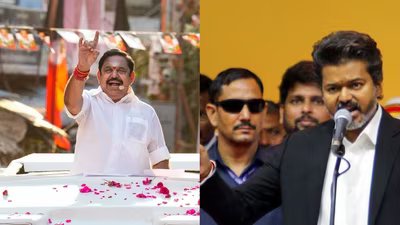
The spectacular political rise of actor-turned-politician Vijay has triggered a full-blown internal crisis within the AIADMK, with rival camps now openly battling over whether to support the new Tamil Nadu government or continue under party chief Edappadi K Palaniswami.

Just days after Vijay was sworn in as chief minister, a major faction within the AIADMK publicly extended support to his government, exposing deep divisions in the party that once dominated Tamil Nadu politics.
The faction led by senior AIADMK leaders CV Shanmugam and SP Velumani on Tuesday announced support for the ruling Tamilaga Vettri Kazhagam government. “The people’s mandate is not for TVK. The mandate is for Vijay to become the chief minister,” Shanmugam said while congratulating the new chief minister and extending support to the government.
The faction also claimed that a majority of the party’s 47 MLAs were backing them, not party chief Edappadi K Palaniswami. The camp asserted that while EPS retained the support of only around 20-22 legislators, most MLAs favoured extending support to the Vijay-led TVK government in the interest of political stability.
Worst crisis for AIADMK since Jayalalithaa
The turmoil follows AIADMK’s crushing defeat in the Tamil Nadu assembly election. The party contested 167 seats but managed to win only 47 – among its poorest performances since the death of former chief minister J Jayalalithaa in 2016.
In contrast, Vijay’s TVK stunned political observers by emerging as the single-largest party with 108 seats in the 234-member assembly.
At one stage after the results, TVK was still short of the majority mark despite support from the Congress and allies, triggering intense political negotiations across Tamil Nadu.
The defeat has intensified calls within AIADMK for a leadership change, with several leaders and MLAs blaming EPS for the party’s declining electoral fortunes.
MLAs split over backing Vijay
The divisions within the AIADMK became visible soon after the results, when EPS called a series of meetings with party MLAs. Senior leaders Shanmugam and Velumani skipped the meetings along with legislators loyal to them, signalling an open rebellion against the party leadership.
According to party insiders, one faction opposed offering any support to the TVK government, while another favoured extending outside support to ensure political stability in the state.
Reports suggest that as many as 28 AIADMK MLAs held a closed-door meeting in Chennai urging the party leadership to support the Vijay-led government.
Adding to the political drama, some legislators were reportedly shifted to a resort in neighbouring Puducherry for three days amid fears of defections and pressure tactics — a familiar strategy in Tamil Nadu politics.
Buzz over AIADMK-DMK alliance worsened tensions
The rebellion inside the AIADMK further intensified after speculation emerged that sections of the party were considering a possible understanding with the rival Dravida Munnetra Kazhagam to prevent Vijay from forming the government.
Following the fractured verdict, there was widespread buzz in Tamil Nadu political circles over a possible post-poll understanding between the AIADMK and DMK — a scenario described by many as “almost unthinkable” given the decades-long rivalry between the two Dravidian giants.
Amid Vijay’s battle to rake up numbers, speculation arose that the AIADMK and DMK could explore a temporary arrangement, with smaller parties emerging as potential kingmakers in the battle for government formation.
The possibility gained traction after reports suggested that if the AIADMK’s 47 MLAs and the DMK’s 59 legislators came together, they could attempt to stop TVK from taking power with support from smaller parties.
DMK spokesperson TKS Elangovan publicly denied the possibility of an alliance but added that the final decision would rest with party chief MK Stalin.
Shanmugam later claimed that EPS was open to aligning with the DMK to form the government – an allegation that further widened the cracks within the AIADMK.
Reports suggested Shanmugam strongly opposed any engagement with the DMK, and the speculation eventually pushed his camp closer towards supporting Vijay and the TVK government.
EPS under pressure
The rebellion has now evolved into a direct challenge to EPS’s leadership. While Palaniswami is believed to have the support of around 20-22 MLAs, the Shanmugam-Velumani camp claims it enjoys the backing of a majority of the party’s legislators.
Former AIADMK leader KC Palanisamy warned that the party could witness more MLAs drifting towards TVK if EPS continues as leader.
“There is a clear split within the party. Many MLAs want a change in leadership,” he said, while urging Palaniswami to step down voluntarily to save the party from further damage.
However, EPS has shown no signs of stepping aside and has continued to chair party meetings despite the growing rebellion.
Split visible inside Assembly
The widening divide was visible during the oath-taking ceremony of the new Tamil Nadu assembly on Monday.
Traditionally, AIADMK legislators enter the Assembly together as a united bloc. This time, however, MLAs arrived in two separate groups — one led by EPS and the other by Shanmugam and Velumani.
The two camps also sat separately inside the House and left the venue independently, further fuelling speculation of an imminent split in the party.
There were also reports that both factions separately submitted letters to the Assembly pro-tem speaker naming different legislative party leaders, though the claims could not be independently verified.
Vijay’s rise reshapes Tamil Nadu politics
Vijay’s emergence has dramatically altered Tamil Nadu’s political landscape, especially within the opposition space once dominated by AIADMK. The party has struggled to recover after Jayalalithaa’s death and has suffered repeated setbacks in the 2019 Lok Sabha polls, the 2021 assembly election, the 2024 general election and subsequent bypolls.
Now, Vijay’s victory appears to have accelerated the crisis within the AIADMK, with one faction seeing cooperation with TVK as politically necessary, while another remains determined to preserve the party’s identity and rebuild independently.