







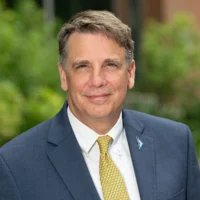
When Tulane University announced last month it had reached an agreement to take control of the long-stalled effort to redevelop the former Charity Hospital downtown, Andy Kopplin was among those cheering the most.
Since 2016, Kopplin has served as president and CEO of the Greater New Orleans Foundation, backer of the BioDistrict, which would bring together hospitals, research and teaching institutions to reinvigorate downtown and stimulate the economy.
A reimagined Charity Hospital is a key part of the plan.
Kopplin has decades of experience bridging the gap between government, business and nonprofits. He assumed the reins at GNOF after serving as former Mayor Mitch Landrieu’s chief administrative officer. His CV also includes stints as a senior adviser to Teach for America, executive director of the Louisiana Recovery Authority and chief of staff for Govs. Kathleen Blanco and Mike Foster.
In this week’s Talking Business, Kopplin discusses the role GNOF has played in the creation of the BioDistrict, why it matters and what he sees as New Orleans’ biggest opportunities — and challenges.
Interview has been edited for length and clarity.
We’ve been talking about a biomedical corridor downtown for 30 years, but there’s still not much to show for it. What is the problem?
The BioDistrict was created (by the state) in 2005 before Katrina but didn’t have any money. It got some one-time funding in 2008 but nothing after that. Then, in 2018, the GNOF board made a generational commitment to get behind the idea of a redeveloped Charity. So, we did a strategic plan that talked about everything that could flow from that — small business development, entrepreneurship, increased research, reactivating that section of downtown.
Part of the plan called for creating an economic development entity — a public-private partnership — that would lead the way. We started working on that and invested resources in getting the BioDistrict back up and secured funding from the city and the state. So, we really feel that from 2018 to today, the biggest champion of the BioDistrict, hopefully anchored now by Charity, is GNOF.
How much money does the district have now? What is it actually doing?
Between now and 2040, the district is eligible to receive up to $40 million from the city through tax increment financing, and the state will match up to $25 million. So, we have the ability to earn up to that amount assuming there is incremental sales tax revenue generated in that area.
But there’s not much around there yet, so where does the revenue come from?
Not yet, but the new Trader Joe’s on Tulane Avenue is in the district, and it has been a significant generator of sales taxes, so that has been a real boost. We actually got our very first funds at the end of 2025, about $1 million in all.
What have y’all spent it on?
We spent some on an immediate beautification effort, landscaping the area. We also have been investing through the New Orleans Bioinnovation Center (a nonprofit business incubator on the edge of the BioDistrict), helping researchers get seed funding to develop new companies based upon their research.
Why does this have the power to be so transformative?
When you look at other cities around the country, you can see how this works. Pittsburgh is one example. It has done some really impressive things, transforming the old industrial district into a medical district, thanks to the University of Pittsburgh and the University of Pittsburgh Medical Center.
Of course, there’s Kendall Square in Cambridge, Massachusetts, which has spawned countless tech companies. And from a medical district standpoint, Birmingham (Alabama) is a good example of a city that has become a hub of world-class medicine in just one generation. There is no reason we cannot do that here.
But, again, this requires a lot of cooperation among rival teaching institutions that have not really collaborated over the years.
Thirty years ago, they did not. During Mike Foster’s administration, my job was to negotiate a détente between LSU and TU. What is different today is that the leadership of these institutions now recognize that as a small region, we have to work together to punch above our weight. Today, there is more collaboration than there has ever been, and I think the BioDistrict’s work has advanced that because it includes Tulane, LSU, Delgado, Ochsner, Xavier, LCMC and folks appointed by the mayor.
Why is GNOF, a community foundation, doing this kind of place-based work?
Because if you look at the biggest challenges facing this community, it is economic development. We cannot address the disparities in our city without growing our economy. New Orleans, if it is going to be successful, has to grow, and we have to grow in a way that enables all our folks to benefit.
There seems to be an optimism in New Orleans around the new mayor. How much of that is grounded in real, positive change that is actually happening?
There is a lot of reason to be optimistic. Tulane’s research investments are the biggest untold economic development story of the past decade. They are bringing in $100 million more a year to New Orleans than they were a decade ago — net new money to the region. There is excitement around the BioDistrict.
And several big projects are finally moving forward. The NSA apartments in Bywater is under construction. Lindy Boggs is being knocked down. The River District is activated, and the Shell Building is beautiful and creating a new neighborhood. The port’s deepwater terminal is not a done deal, but there is strong support for it.
Those are all good reasons to be optimistic.
What is the biggest challenge facing the community?
Economic growth, no question. We need to grow, and we do that by creating jobs. The more jobs we are able to create, the more we will be able to build a middle class.