Transforming Apple Silicon into Private AI Infrastructure
Apple subsidiary Claris has introduced an experimental software application titled Harbor, designed to transition Apple silicon Mac computers into dedicated private artificial intelligence inference servers. This development marks a significant shift in how hardware-level AI capabilities can be managed, moving away from complex command-line configurations toward an accessible, unified interface. Harbor allows users to host open-weight large language models directly on local hardware, ensuring that data processing remains contained within a secure, offline environment.
The primary function of Harbor is to streamline the deployment of high-parameter models that would traditionally require cloud-based infrastructure. By utilizing the proprietary architecture of the Apple silicon M-series chips, the software taps into the efficiency of unified memory, providing a high-performance environment for inference tasks. Because the entire process occurs locally, users benefit from complete data sovereignty, as no information is transmitted to external servers or third-party cloud providers.
Leveraging Thunderbolt 5 for Hardware Clustering
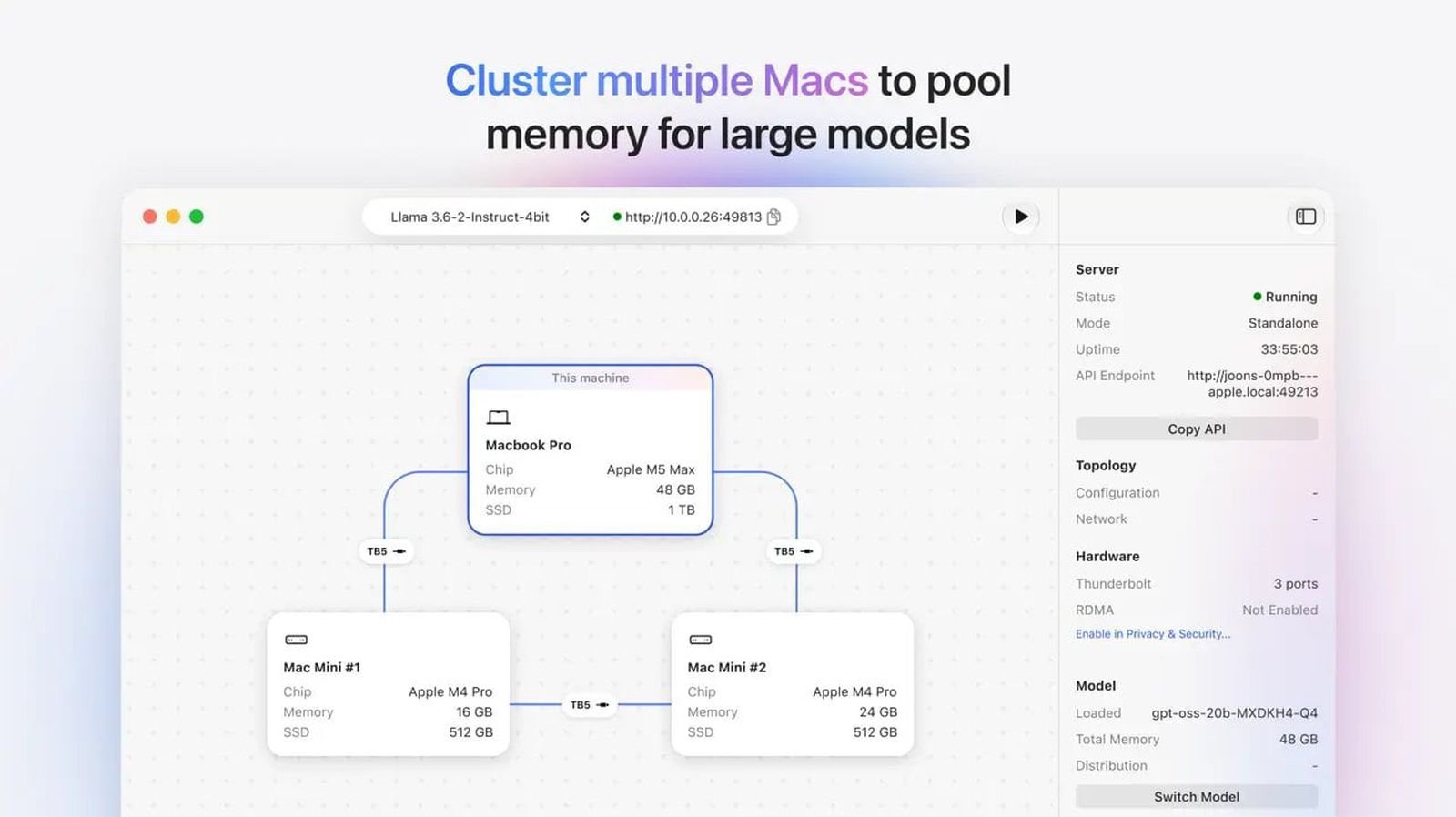
A standout feature of the Harbor application is its capability to cluster multiple Mac computers to function as a single, cohesive processing unit. This is achieved through the integration of Remote Direct Memory Access (RDMA) over Thunderbolt 5, a feature introduced in macOS Tahoe 26.2. By connecting multiple machines via high-speed Thunderbolt 5 cables, Harbor pools the unified memory across the connected devices.
This memory pooling is critical for running modern, resource-intensive AI models. Large models often require a specific threshold of video RAM to execute efficiently; when a single machine falls short, the model either fails to load or experiences significant performance degradation. Through the cluster mechanism, Harbor distributes the workload across the interconnected Macs, effectively creating a virtual supercomputer. This allows researchers and developers to run larger parameter counts or handle higher concurrency rates than a standalone workstation would permit.
Streamlined User Experience and Model Management
One of the most notable aspects of Harbor is its focus on ease of use. Traditionally, establishing a local AI server requires advanced knowledge of infrastructure, model quantization, and software dependencies. Harbor eliminates these barriers by automating the detection of hardware. Upon connecting additional Macs via Thunderbolt 5, the software identifies the nodes and integrates them into the existing cluster without the need for manual configuration.
The application also includes a built-in browser for discovering and downloading open-weight models. Rather than navigating terminal-based repositories or manual installation processes, users can manage their model library directly from the Harbor interface. Once a model is selected, the application handles the loading and optimization process. This design reflects a broader trend within the developer ecosystem toward lowering the barrier to entry for local AI, ensuring that users can focus on their specific applications rather than the underlying systems administration.
Enterprise Applications and Business Strategy
Although Harbor is currently in the early access phase and recently saw a brief, transient appearance on the App Store, its origin from Claris provides insight into its intended trajectory. Claris, historically recognized for its FileMaker database platform, caters primarily to business and professional enterprise environments. The registration process for Harbor specifically requires a company name, signaling that Apple likely views this tool as a component of a professional AI workflow rather than a general-purpose utility for home users.
The potential for business adoption is substantial. For organizations dealing with sensitive intellectual property, health records, or private internal documentation, sending data to a cloud-based AI service presents inherent security risks. Harbor provides a path for these organizations to leverage advanced AI capabilities while maintaining strict adherence to internal security and privacy protocols. By keeping the AI server on-premises or within a private office network, companies gain the utility of modern language models without sacrificing data privacy.
Comparison with Existing Ecosystem Alternatives
The market for local AI inference on Apple hardware is not entirely empty. Existing solutions such as Exo have long provided the ability to cluster Mac computers for inference, while platforms like LM Studio have established themselves as standard tools for individual, single-device model management. Harbor attempts to bridge the gap between these two methodologies.
While tools like LM Studio excel at simplified model management on a single workstation, they often lack native clustering capabilities. Conversely, tools capable of clustering often require a steep learning curve related to network configuration and infrastructure management. Harbor’s value proposition lies in its ability to combine the user-friendly design of a consumer application with the professional-grade scalability of a clustered server. By lowering the technical threshold, Apple is positioning the Mac as a viable, high-performance alternative to traditional rack-mounted server infrastructure for specific types of enterprise AI tasks. As the software moves beyond its experimental stage, its integration with future macOS updates and hardware iterations will be a key metric for determining its long-term viability in the professional development landscape.
Disclaimer: This content is auto-generated for informational purposes only.
Source: Read Original News