







A mysterious pulse of cold, fresh water surging down the northeastern US coast has left oceanographers and fishing communities grappling with a new layer of ecological uncertainty. According to a recent study led by the Woods Hole Oceanographic Institution (WHOI), this anomalous shift in ocean conditions—originating as far north as the Labrador Sea—has significantly disrupted marine migratory patterns and dealt a major blow to regional commercial fisheries.
The northeastern coastal ocean is defined by a constant, complex tug-of-war between cold, fresh water flowing south from the North Atlantic and warm, salty water pushing offshore from the Gulf Stream. “It’s always in flux,” explains WHOI Senior Scientist Glen Gawarkiewicz, the study’s lead author. However, the recent event saw that balance tip dramatically. Researchers, utilizing 11 years of ocean profiles gathered through a unique collaboration with the Commercial Fisheries Research Foundation (CFRF) of Rhode Island, found that surface temperatures across the continental slope and shelf dropped 5 to 9 degrees Fahrenheit below the 20-year average, accompanied by a notable decrease in salinity.
For those working on the water, the shift was unmistakable. “In 2021 and 2022, captains were seeing big sportfish like bluefin tuna off Block Island, while in spring 2024, I heard from several that their target species were up to five weeks late or missed their usual spring run altogether,” says Noelle Olsen, a senior research biologist at CFRF.
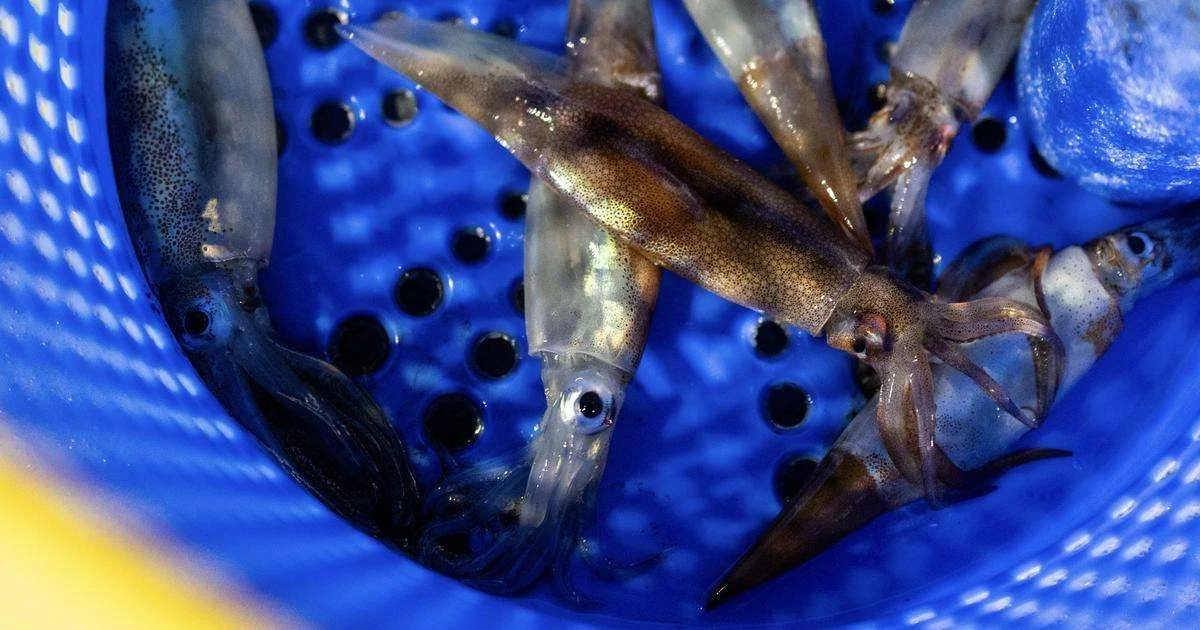
The economic consequences of this environmental “cold pulse” have been stark. The longfin squid fishery, a cornerstone of the southern New England economy, faced a particularly challenging season. Typically arriving in May, the squid did not appear until August in 2024. Data from the NOAA Fisheries Commercial Fishing Landings database shows that the commercial harvest of longfin squid in the Northeast plummeted by 10 million pounds between 2023 and 2024—a 25.6% decline representing a $6.5 million loss in commercial value.
The research suggests that the cold, fresh water was delivered to the region by a combination of shifted wind patterns in the southern Labrador Sea and a southward migration of the Gulf Stream. While the team can trace the trajectory of this water, the precise weighting of each contributing factor remains an active area of investigation.
Paula Fratantoni, Chief of the Oceanography Branch at NOAA’s Northeast Fisheries Science Center and a co-author of the study, emphasizes that the region’s local climate is inextricably linked to the circulation of the entire North Atlantic basin. “A relatively small shift in the trajectory of a large-scale current like the Gulf Stream can lead to dramatic changes locally,” Fratantoni says. “Understanding these relationships can help us better anticipate anomalous conditions in the future.”
The success of this study underscores the growing importance of “co-production” of science—a model where professional researchers and commercial fishers work in tandem. By combining high-tech scientific datasets with the granular, firsthand observations of those who spend their lives on the water, experts are building a more comprehensive understanding of how shifting ocean dynamics affect marine life and human livelihoods.
Gawarkiewicz notes that the relationship between these two groups has evolved into a vital partnership. “There is a lot of positivity in terms of the fishermen being really receptive to hearing about the science now, and for scientists to be more open-minded about all the knowledge that the fishermen have,” he says. “There’s a real opportunity to bring those two perspectives together, because fishermen are out there experiencing these changes firsthand, and scientists can help put those observations into a broader scientific context.”
As climate change continues to alter ocean circulation, this collaborative approach may prove essential in helping fishing communities adapt to a future where the only constant is, indeed, flux.
Disclaimer: This content is auto-generated for informational purposes only.
Source: Read Original News