







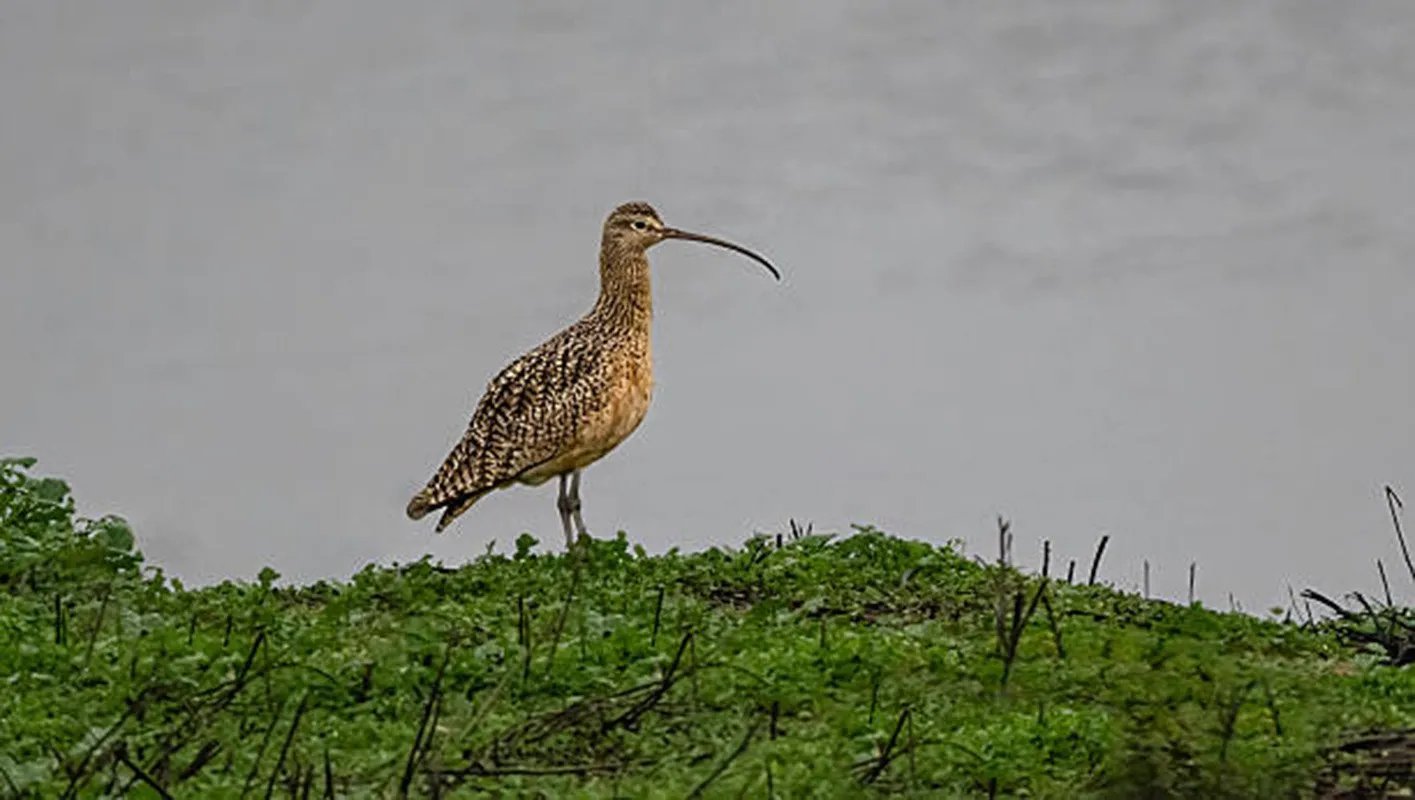
Populations of Curlew – the official iconic symbol for Northumberland National Park – have stabilised in the region’s uplands thanks to the combined work of farmers, land-owners and conservationists. The tall wading species, known for its long probing bill and unique trilling call, heads to upland moors, rough pastures and wet grasslands each spring to breed, before returning to the coast.
In recent decades numbers have fallen to an endangered level as habitats have changed and the number of predators, like crows and gulls, has increased. But now a partnership between the RSPB, Natural England, farmers and conservation trusts has put the brakes on that decline.
MP becomes species champion
The bird also has a new ambassador in Westminster – Joe Morris the Labour MP for Hexham. The RSPB has made him Parliamentary Species Champion for the Curlew.

On a beautiful spring day in the Allen Valley, shortly after World Curlew Day, he trudges across a small-holding just outside Allendale to see the conservation work for himself, accompanied by local farmers and representatives of the RSPB.
“The Curlew is iconic,” he says. “There’s a reason why it’s become symbolic in our part of the world. It’s not just the species itself, it’s about what we can do to conserve the land to make sure the population is stable. And also, it’s about what can be done to protect all aspects of rural life, transport links and more.”
“My late grandfather was very passionate about his bird watching, so I’m very proud to be a champion for the Curlew. It’s a way of paying tribute to him and his legacy.”
The ground is dry for the MP’s visit after very little recent rainfall – which is just as well, because one of his assistants is wearing a dainty pair of purple velvet ballet pumps. Luckily, they survive the trip.

Bylines Network Gazette is out!
The latest Bylines Network Gazette is out now. Become a Friend of Bylines Network or upgrade to a paid Substack subscription, and you will get access to a vital collection of citizen articles and stories days before seminal elections in Scotland, Wales and English councils.
Journalism by the people, for the people.
Helping the environment
Such dry conditions are not ideal. Janet Fairclough of the RSPB explains that Curlew like wet ground and are heavily dependent on it for feeding and breeding. With their long-curved bills, they rely on wet, soft ground to probe for food – worms, beetles, and larvae.
But lower down in the valley, where it is wetter, we are shown areas of scrubby moorland where tufts of straw-coloured tussock grasses punctuate the landscape. This is what the Curlew revels in. There’s cover for nests and chicks to hide them away from predators – mainly gulls and crows.
Janet explains that the birds haven’t yet laid their eggs. They arrive in uplands towards the end of February, early March, and then spend time getting to know each other and finding the best sites to nest.
Janet has monitored 28 farms in the North Pennines every three years since 2013. “Over this period, we’ve established that the number of Curlew is now pretty stable in these uplands,” she says.
Countryside Stewardship Scheme
The land we’re meeting on is managed under a Countryside Stewardship Scheme which encourages farmers via grants to support environmental efforts improving the management of meadows and rough grazing. The theory is that this will help birds and other wildlife to thrive.
Areas have been cut back so that the scrub doesn’t become too dense. Drainage pipes have been put in to bring water down from higher ground. Small ponds, rich with insects the Curlew like to feed on, have been created or expanded.
The idea is to achieve a balance between farming the land and preserving the environment for wildlife. It’s tricky, there has been progress, but it was evident in the exchanges between those in the group with practical experience and their MP, that government departments and bodies don’t always, if ever, get it right.
Local farmer, Robert Phillipson, tells Joe Morris, “The people at the top need to listen more to those on the ground. They seem to throw these policies at us without any practical experience.”
The arguments revolve around how many animals can be kept on the land, which type of animals and when grass can be cut.

Bring back cattle
There are no longer any cattle on uplands after they were discouraged for fear of destroying the upland environment. But Robert Philipson believes some cattle should be brought back. He argues the manure helps the quality of the soil and provides bugs for Curlew to feed on.
Joe Morris admits he’s no expert but agrees with the principle that locals know best. “What Westminster should be about is diverting as much power as possible and making sure that decision making is closer to the ground.”
The group discusses whether it would be a good idea to bring more Westminster bureaucrats out from behind their mahogany desks to see this beautiful environment for themselves.
“The problem is that policies are brought out for the whole country,” says Janet. “It’s the same for Cornwall as it is for Northumberland.”
This summer a new round of Countryside Stewardship Schemes will be launched. There’s £225 million pounds of grants on offer.
Let’s hope for the sake of all of us – especially the Curlew – they get it right.