





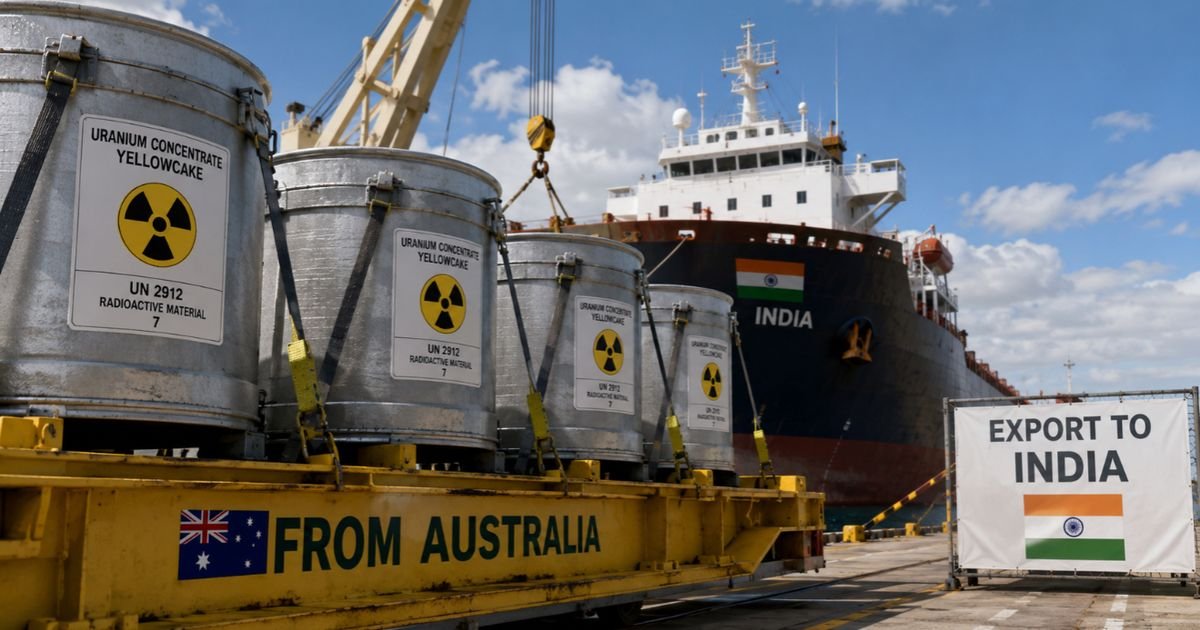
Australia’s uranium sector could gain access to a multibillion-dollar export opportunity after Prime Minister Anthony Albanese and Indian Prime Minister Narendra Modi finalised arrangements allowing Australian uranium to be supplied to India for peaceful nuclear energy use.
The administrative arrangement activates the export pathway established under the 2015 Australia-India Nuclear Cooperation Agreement, removing technical barriers that had prevented shipments from beginning.
For Australian uranium companies, the agreement provides exposure to one of the world’s fastest-growing energy markets as India moves to expand nuclear generation and reduce its reliance on fossil fuels.
“The arrangement facilitates Australian uranium exports to India to help increase the share of non-fossil fuel power capacity, providing an additional market for the Australian resources sector,” Albanese said.
India targets 100 gigawatts of nuclear capacity
India is aiming to develop 100 gigawatts of nuclear energy capacity by 2047 as it seeks to meet rapidly growing electricity demand across its economy and population of around 1.4 billion people.
Modi said Australia’s substantial uranium resources were directly linked to India’s long-term nuclear ambitions.
“This will pave the way for uranium supplies from Australia to India and give our clean energy objectives fresh momentum,” he said.
The scale of India’s proposed nuclear expansion could create a long-term source of demand for Australian uranium producers, particularly as countries increasingly look to nuclear power to support energy security and emissions-reduction targets.
Australia holds more than a quarter of the world’s known uranium resources, positioning the local industry to benefit from rising global reactor construction and renewed government support for nuclear generation.
New growth avenue for Australian uranium sector
The agreement potentially adds India to the expanding group of international markets available to Australian uranium miners and developers.
While exports must be used exclusively for civil nuclear purposes, the arrangement could support greater investment in Australian uranium exploration, mine development and production capacity.
The commercial impact will depend on future supply contracts, pricing arrangements and India’s nuclear construction schedule, but the agreement provides a clearer pathway for Australian material to enter the market.
India’s growing energy needs and its efforts to diversify fuel supplies could strengthen the strategic value of Australia’s uranium resources over the longer term.
Broader economic and investment ties deepen
The uranium agreement was announced alongside measures covering defence, maritime security, cyber capabilities, critical technologies and investment.
AustralianSuper will invest a further $500 million in India’s National Investment and Infrastructure Fund, increasing its total exposure to the country to almost $3.3 billion.
The Business Council of Australia will also lead a senior business delegation to India in December as both governments seek to encourage greater trade and investment between the countries.
Albanese said the bilateral economic relationship had previously been “underdone, under-explored and under-examined”, but had strengthened considerably over the past decade.
Nuclear debate returns to domestic market
The export decision has renewed political debate over Australia’s prohibition on domestic nuclear power.
Opposition figures welcomed the opportunity to export uranium to India but argued it was inconsistent for Australia to support nuclear energy overseas while preventing its use in the domestic electricity market.
Angus Taylor said there was “real hypocrisy” in allowing uranium exports while maintaining the federal nuclear power ban.
The government has maintained that the India agreement is focused on trade, energy security and emissions reduction, with all uranium exports subject to safeguards limiting their use to peaceful civil nuclear activities.
For investors, the agreement strengthens the long-term demand outlook for Australian uranium and highlights the increasing strategic importance of the commodity in the global energy transition.