







Axopar has announced a significant evolution in its helm technology, integrating the high-performance Simrad NSO® 4 multifunction display platform across its flagship vessel lineups. This upgrade represents a strategic shift for the marine manufacturer, which is moving to offer its customers a choice between traditional tactile reliability and modern, sleek digital interfaces.
By deploying the NSO 4 system, Axopar is catering to two distinct types of boaters: those who prioritize the physical feedback of tactile controls and those who demand a minimalist, smartphone-like glass cockpit. This initiative marks a deeper collaboration with the Navico Group, the parent company of Simrad Yachting, and leverages the latest in maritime processing power and software architecture.
Next-Generation Processing and Interface Design
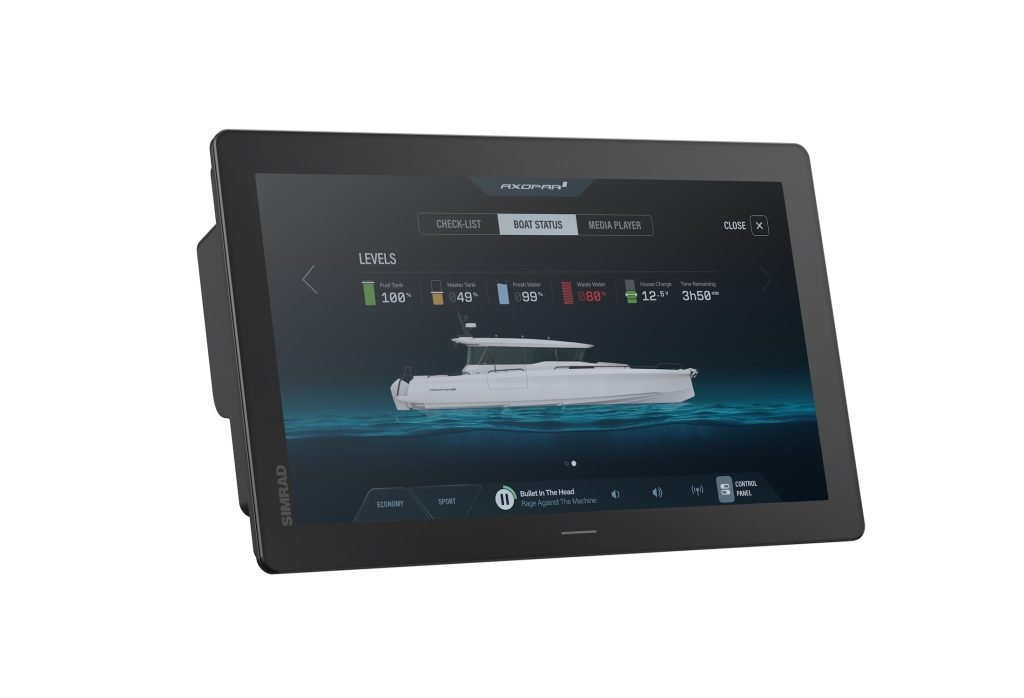
At the heart of the NSO 4 is the new Simrad NEON™ operating system, which provides the foundation for a much more responsive user experience. The hardware is built around an eight-core Qualcomm® processor, resulting in a 35% improvement in boot times compared to previous iterations.
For the modern boat owner, the “glass-to-edge” aesthetic is a major draw. By removing physical knobs and buttons from the display bezel, the NSO 4 allows for a seamless, flush-mount installation that creates a clean, unobtrusive dashboard. Despite the focus on touch-based simplicity, the system remains a powerhouse. It handles multiple demanding tasks—such as simultaneous chart plotting, high-definition radar monitoring, and real-time camera feeds—without the performance lag often associated with complex marine electronics. The display features full-HD SolarMAX™ IPS technology, specifically engineered to remain readable even when viewed through polarized sunglasses, a critical feature for high-speed navigation in bright conditions.
Strategic Integration and Model Availability
The deployment of this new tech will follow a tiered roll-out strategy across the Axopar and BRABUS Shadow ranges. The Axopar 45 will offer the NSO 4 as part of a premium package, while the BRABUS Shadow 45 will feature the system as standard equipment starting with the 2027 model year. The BRABUS Shadow 38 will also gain access to the technology through an optional Extended Navigation Package.
Crucially, the NSO 4 does not replace the existing Axopar User Interface; rather, it works in tandem with it. This maintains the brand’s signature control ecosystem while allowing for more advanced data integration, including support for Mercury® engine data, CZone® digital switching, and complex sonar arrays like the S5100 module.
The “Tactile vs. Digital” Paradigm Shift
The industry-wide move toward “all-glass” helms mirrors trends in the automotive sector, where physical buttons are increasingly being replaced by software-defined interfaces. However, Axopar’s CEO, Kari Kulojärvi, emphasizes that technology should adapt to the driver, not the other way around.
“Our goal is not simply to offer the latest technology, but to let customers choose the helm experience that suits the way they actually drive,” Kulojärvi stated. By maintaining the availability of the Simrad NSS 4—which features a physical control wheel—alongside the touch-only NSO 4, Axopar is acknowledging that in rough seas or high-stakes maneuvers, some captains will always prefer the “tactile confidence” of a physical dial.
This hybrid approach allows the company to push the boundaries of digital cockpit design without alienating traditionalists. With the new system making its public debut at the Cannes Yachting Festival, the industry will get a firsthand look at how these sophisticated navigation platforms translate to real-world performance on the water. As connectivity and processing power continue to advance, this dual-interface strategy provides a roadmap for how marine manufacturers can balance cutting-edge tech with ergonomic safety.
Disclaimer: This content is auto-generated for informational purposes only.
Source: Read Original News