








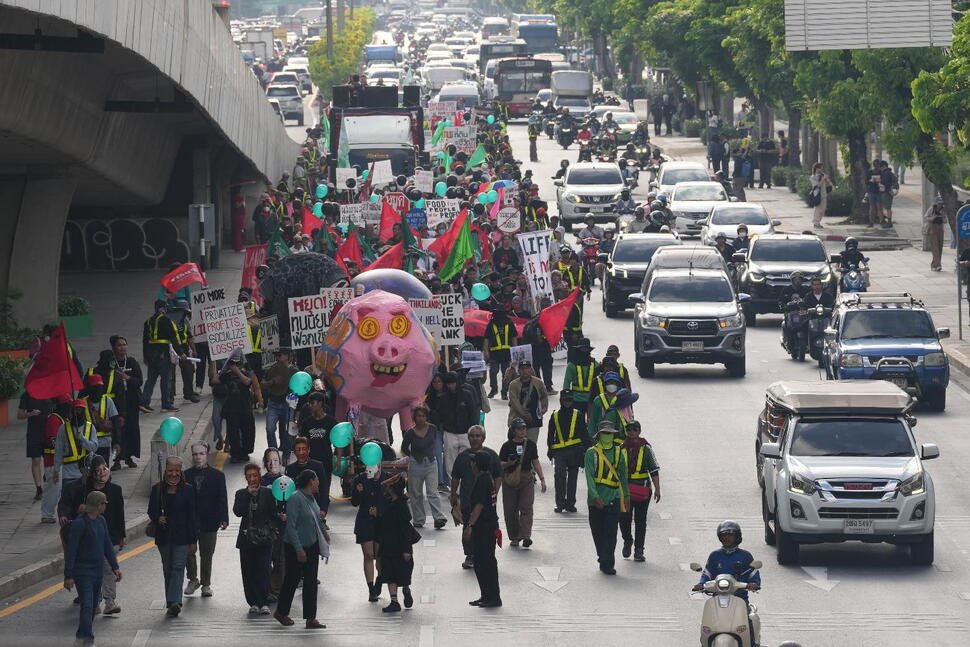
BANGKOK — A coalition of demonstrators marched through the streets of Bangkok on Thursday, creating a stark visual contrast to the high-level policy discussions taking place at the nearby IMF and World Bank autumn meetings. Carrying a satirical float featuring a giant pink pig with dollar signs for eyes and wearing masks depicting global political figures, protesters sought to force a conversation about the widening chasm between the world’s elite financial leaders and the daily realities of the impoverished.
The protest, which moved from the Khlong Toei slum toward the heavily guarded convention center, served as a pointed critique of the institutions hosting more than 15,000 officials and experts. While the conference focuses on global macroeconomic stabilization, participants on the ground argued that the policies discussed inside the halls rarely account for the suffering caused by household debt, environmental collapse, and extreme income inequality.
## Economic Headwinds and Regional Stability
The protests coincide with sobering economic forecasts presented by the International Monetary Fund. Economists at the summit have signaled that growth in Asia is expected to decelerate from 5% in 2025 to 4.8% this year, with further dips projected as global trade barriers and geopolitical conflicts—including the ongoing war involving Iran—continue to rattle supply chains.
These broader economic pressures have hit low- and middle-income nations particularly hard. In Thailand, which the World Bank has identified as the most income-unequal nation in its region, these challenges are compounded by the rising cost of energy. With oil prices hovering above $100 per barrel for much of the year, the local population is facing a cost-of-living crisis exacerbated by recent severe flooding that has decimated both rural crops and urban infrastructure.
## The Role of AI and Data in Financial Policy
As IMF leadership emphasizes the necessity of “targeted and temporary” government spending to manage national debt, the role of advanced technology has become a central subtext of these meetings. In recent policy briefs, the IMF has warned that the integration of artificial intelligence into the global economy is a double-edged sword. While AI offers potential productivity gains, it also threatens to widen the gap between advanced and developing economies if access remains unequal.
Financial analysts attending the summit are increasingly leveraging AI-driven predictive modeling to navigate the volatility caused by climate disasters and energy price shocks. By utilizing big data to track real-time poverty indicators, some advocates argue that institutions like the IMF could better allocate aid. However, protesters remain skeptical of the tech-heavy approach favored by these global bodies, arguing that sophisticated data tools often prioritize abstract fiscal health over the human cost of structural adjustments.
## Balancing Growth with Social Equity
The tension in Bangkok highlights a mounting global debate: can the current financial order effectively address the climate crisis and systemic inequality, or is it inherently built to favor the interests it serves?
The People’s Network Against the World Bank and IMF, the primary group behind the demonstration, issued a formal declaration highlighting that their community is enduring a “crisis of household debt.” For these citizens, the presence of thousands of international delegates in luxury hotels is a reminder of a disconnect in priorities. While the IMF continues to call for fiscal discipline and structural reforms, many regional observers note that the success of these measures will ultimately be measured not by GDP growth or AI-driven market efficiency, but by the ability of local governments to protect their most vulnerable populations from the next wave of climate-related and financial instability.
As the weeklong meetings conclude, the pressure remains on the IMF to move beyond traditional austerity mandates and address the humanitarian consequences of an increasingly fragile global economy.
Disclaimer: This content is auto-generated for informational purposes only.
Source: Read Original News