





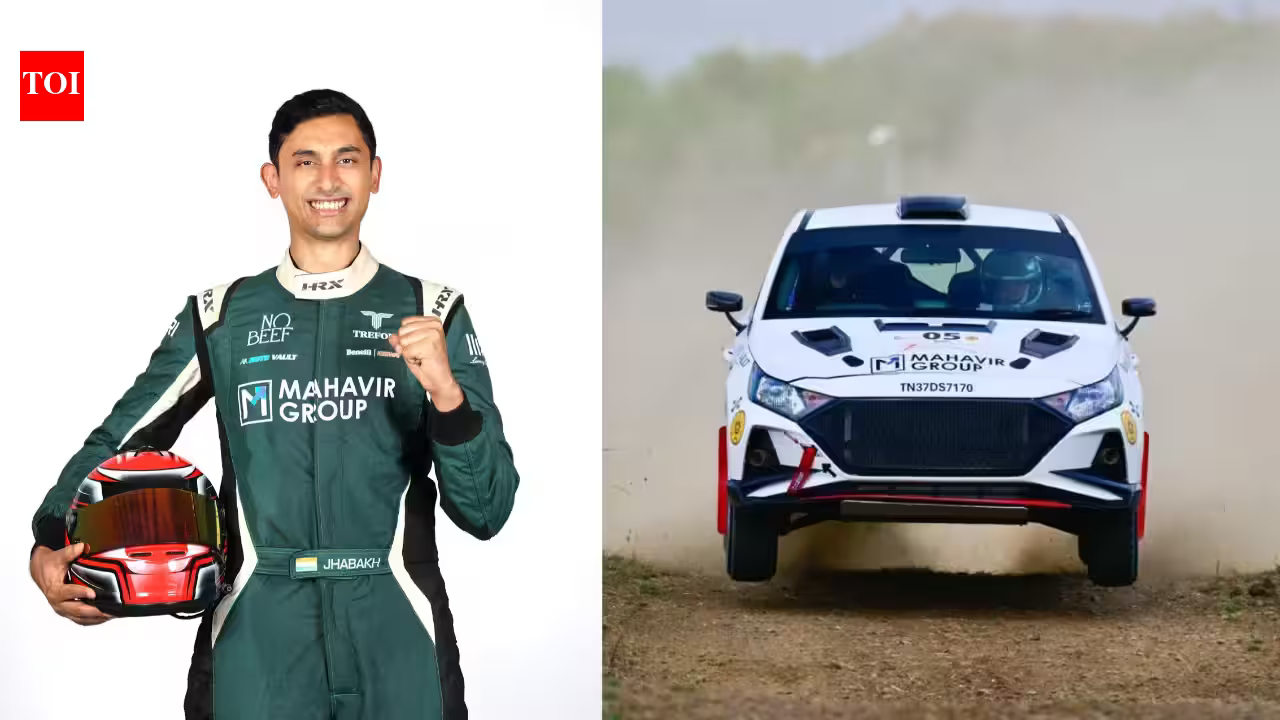
HISTORY was etched into the annals of Indian motorsport recently, as Hyderabad-based driver Jeet Jhabakh, accompanied by co-driver Musa Sherif, conquered the 2026 FIA Asia-Pacific Rally Championship (APRC). Their crowning achievement did more than just secure a trophy; it broke a 38-year-old barrier, marking the first time in the championship’s storied history that a two-wheel-drive car has claimed the overall title.
Beyond the technical marvel of their performance, the duo solidified their place in history as the first all-Indian pairing to secure the prestigious continental crown. However, for Jhabakh, the champagne-soaked podium was less about personal glory and more about highlighting the precarious reality of racing in India—a landscape where raw talent is frequently stifled by the crushing weight of financial demand.
From Street-Cricket Aspirations to Rally Dominance
Like countless young athletes across the subcontinent, Jhabakh’s initial sporting hunger was fed by cricket. It was a natural entry point—a bat, a ball, and a neighborhood street were all that was required to start. But as Jhabakh matured, the allure of mechanical precision began to eclipse the pitch. Inspired by the tactical genius and clinical dominance of Formula One legend Michael Schumacher, Jhabakh shifted his focus toward the track.
“Michael Schumacher was the person we followed,” Jhabakh revealed in an exclusive interview. “He wasn’t always the fastest on track, but his strategy and thinking were always on point. I realized it isn’t just about pure speed; it’s about a holistic approach, thinking out of the box, and the ability to adapt.”
This transition from cricket to high-octane rallying was bolstered by his family’s background in the automotive industry, providing him with a unique vantage point on the mechanics of the sport. Yet, the leap into professional competition exposed him immediately to the sobering economic gatekeepers of motorsport.
The “Rich Man’s Sport” Dilemma
Jhabakh is candid about the disparity between motorsport and mainstream Indian sports. While a cricketer requires minimal equipment to begin their journey, a budding rally driver requires a vehicle, high-level technical support, and a significant infrastructure investment—costs that balloon exponentially as a driver climbs the ranks.
“It is an extremely expensive sport,” Jhabakh explained. “In cricket, most people just require a bat and a ball. In motorsport, you need a full-fledged car. As you go higher, the costs skyrocket. It is definitely a ‘rich man’s sport.'”
For many, this financial ceiling is insurmountable. Jhabakh acknowledges his own fortune, having bypassed the traditional, costly karting circuit to enter through a single-make championship. His success there caught the eye of Utsavya Motorsports, where he served as a factory driver for four and a half years. “I was sponsored completely by them,” he noted. “I was very fortunate. A lot of people don’t get that opportunity.”
Bridging the Continental Gap
The disparity between Indian racers and their European counterparts, according to Jhabakh, is not one of talent, but of “seat time.” In Europe, established ecosystems allow young drivers to pursue racing as a full-time, professional career. In India, the reality is far more grueling.
“In India, I cannot make this my only source of income. We are all working Monday to Friday just to fund our weekends on the track,” he said. “European drivers are in the car training five days a week. With that level of guidance and time, there is naturally a quality gap. But if Indian drivers are provided with the same resources, we can absolutely compete at that level. My APRC title is a testament that it is possible.”
A New Horizon for Indian Motorsport
The loss of the Indian Grand Prix—which ceased operations after 2013—remains a sore point for the nation’s motorsport community, signaling a “lost generation” of exposure. Jhabakh admits it broke his heart as a child to see the pinnacle of the sport exit the country. However, he sees a flicker of hope in the revival of domestic platforms like the Indian Racing Festival.
“When events like that come to India, the public sees that it’s possible,” Jhabakh said. “Motorsport doesn’t get the media coverage of cricket or badminton. But when there is media presence, the money follows through sponsorships and advertising. That is the engine that drives a sport forward.”
As Jhabakh looks to the future, he is determined to ensure his historic APRC win serves as a catalyst for others. His ultimate goal is to see a structured pathway for upcoming Indian drivers that relies on merit rather than deep pockets. “I’m hoping this championship opens doors for others,” he concluded. “There is so much talent in India. It is time we start nurturing it properly.”
With a continental title now firmly in his grasp, Jeet Jhabakh has proven that Indian drivers have the pace. Now, he is fighting to ensure they finally get the fuel they need to keep winning.
Disclaimer: This content is auto-generated for informational purposes only.
Source: Read Original News