







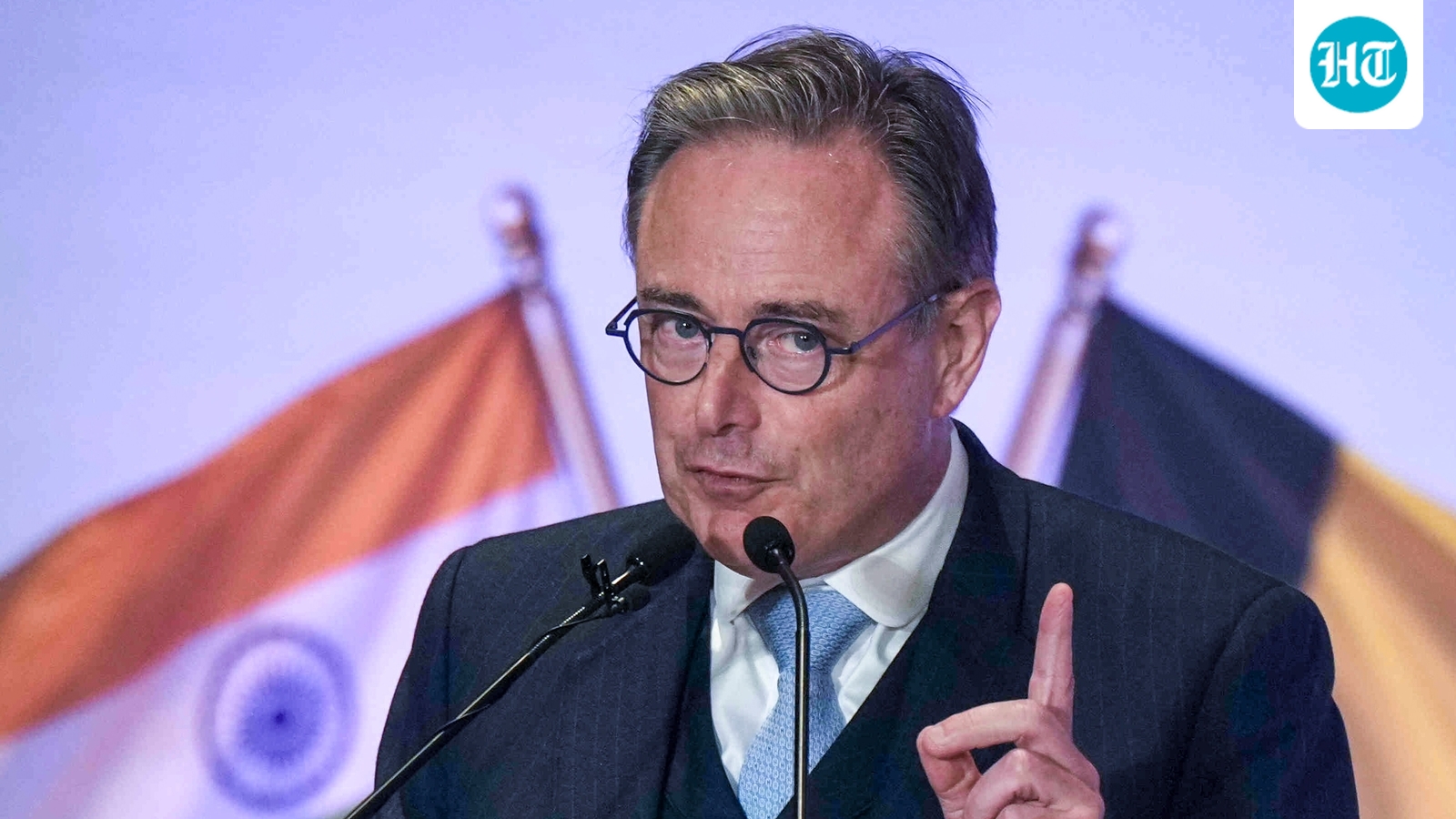
Belgian Prime Minister Bart De Wever issued a sharp warning against the twin threats of protectionism and market distortion, cautioning that these geopolitical maneuvers are jeopardizing global economic stability. Speaking at a high-level dialogue on the India-European Union (EU) Free Trade Agreement (FTA) at Mumbai’s Jio Convention Center, the Belgian leader delivered a critique of global trade policies, implicitly targeting both the United States and China.
Addressing an audience of policymakers and industry leaders, De Wever took aim at the rise of unpredictable trade barriers. “These days, more and more voices are calling for barriers to go up, for markets to shut off and for tariffs to be imposed. Some do it entirely arbitrarily,” he said. While refraining from naming US President Donald Trump, his description of leaders who “decide something on Monday, revoke it on Wednesday and reinstate it on Saturday” left little to the imagination, drawing knowing laughter and applause from the gathered delegates.
De Wever contrasted this “arbitrary” protectionism with what he described as the systematic, structural market distortions practiced by other powers—an apparent allusion to China. “Others take a different approach and set out deliberately and structurally to distort markets. In doing so, they inflict serious economic damage on their trading partners in order to make them dependent and turn them into vassals,” he warned.
Strengthening India-Belgium Ties
Despite the volatile global backdrop, De Wever underscored his commitment to strengthening bilateral economic ties. He announced that the Port of Antwerp-Bruges will lead a comprehensive business delegation to India in February 2027. This mission will focus on concrete cooperation across logistics, chemicals, energy, and infrastructure. “We are not coming to discuss what we might do; we are coming to agree on what we are going to do together,” he stated.
The Belgian Prime Minister particularly welcomed India’s decision to open its maritime services and dredging sectors under the proposed India-EU FTA. Given Belgium’s global expertise in port infrastructure, De Wever expressed optimism about building on existing partnerships to modernize India’s maritime capabilities. Furthermore, he highlighted green hydrogen as a pivotal area for future collaboration, noting that India’s production ambitions align perfectly with Belgium’s goal to become a key importer of green energy molecules for Northwest Europe.
Diamond Diplomacy and Strategic Growth
The dialogue also featured Union Commerce Minister Piyush Goyal, who proposed an expansion of the traditional India-Belgium diamond partnership into the emerging sector of lab-grown diamonds. “Let us co-create, design. Maybe lab-grown diamonds would be a new area we should look at working together in,” Goyal said. He envisioned a synergy between the world-renowned diamond hubs of Antwerp, Mumbai, and Surat.
In a poetic flourish, Goyal used the gemstone as a symbol for the two nations’ shared future: “A diamond is formed under tremendous pressure. In a world under pressure and turmoil, let India and Belgium form something as beautiful and precious as a diamond, not just for our countries, but for the world.”
Maharashtra Chief Minister Devendra Fadnavis echoed this enthusiasm, pledging that his state would act as a proactive partner to fast-track projects emerging from the India-EU FTA. “If Belgium identifies a project, we will dedicate a team and work with them to make it happen,” Fadnavis assured.
Earlier in the day, De Wever made history by becoming the first foreign head of government to visit the Bharat Diamond Bourse (BDB) in Mumbai. This visit, coupled with his high-level dialogue in the city, signals a strategic pivot by Belgium to deepen its industrial and commercial footprint in India, positioning the two nations as stable partners in an increasingly fragmented global order.
Disclaimer: This India news content is auto-generated and paraphrased from original sources for informational purposes only.
Source: Read Original News