









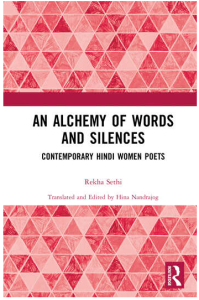
Beyond recovering and interpreting contemporary Hindi women poets, An Alchemy of Words and Silences reconfigures feminist literary criticism by proposing a more expansive feminist poetics attentive to aesthetics and literary form as much as politics and social location.
“While a sustained opposition to patriarchy is undeniably a significant element of women’s literature, it encompasses much more than mere expressions of pain, anger or resistance to gender binaries,” writes Rekha Sethi in the opening pages of her study of seven major contemporary Hindi women poets titled An Alchemy of Words and Silences.
Through close readings of poetry by Gagan Gill, Katyayani, Anamika, Savita Singh, Neelesh Raghuwanshi, Sushila Takbhoure, and Nirmala Putul, Sethi traces the intersections of gender with caste, class, labour, ecology, indigeneity, and citizenship. Refusing to reduce women’s poetry to a literature merely of resistance, she demonstrates through her selections from these poets that it is equally concerned with language, desire, ethics, ecology, and social imagination.
While one misses a more sustained engagement with contemporary debates in Hindi literary criticism, the poets gathered here inhabit markedly different social and imaginative worlds, allowing Sethi to map the diverse contours of contemporary Hindi women’s poetry.
Theoretically, Sethi moves with ease between Western feminist thought and vernacular, folk, and indigenous epistemologies. Equally evident is Sethi’s affection for poetry as a literary form, reflected in the care with which she parses metaphor, sound, and image, granting each the autonomy it deserves.
Genealogies of the self
The book’s historical opening is a crucial intervention: by tracing a genealogy from Vedic women seers and the Therigatha poets through Bhakti traditions and nationalist and modern feminist writing, it situates contemporary women poets within a long genealogy of literary expression and experimentation.
Drawing on Indian philosophy and oral cultures, Sethi reconstructs a history of women’s literary authority and continuity by delineating how women have always negotiated access to cultural and intellectual publics through their poetry.
At the heart of this tradition lies the emergence of what she repeatedly identifies as a “strong sense of self”. Before women can participate in public life, the volume suggests, they must first claim ownership of the body and subjectivity.
Sethi’s reading of Gagan Gill is particularly illuminating, using poems on motherhood, labour, grief, and desire to explore the porous boundaries between the inner and outer worlds. What really stands out is her nuanced attention to the ideological antinomies that run through Gill’s work, most importantly, her refusal of feminist labels despite a sustained engagement with feminist concerns.
What would appear to be hard-wrung contradictions become in Sethi’s polite hands a delicate balance of dualities that she challenges but does not forcibly resolve.
On a retrospective glance, the reader realises that it is a critical method she adapts across the volume, refusing reductive binaries while skilfully working with them. As Gill’s poetry dwells in ambiguity and introspection, a mode that Sethi masters when needed, Savita Singh’s verse speaks in a more declarative register, transforming feminist selfhood into an explicit act of affirmation and liberation. Desire here is not merely thematic but constitutive of Singh’s poetics, according to Sethi, enabling a language through which women articulate their sense of self.
The feminist citizen
At the other end from the question of internal selfhood, the volume touches upon the outward self through questions of labour, citizenship, and public life.
A slow and tempered authorial treatment of Gill and Singh gives way to a direct and quick-paced engagement with the formation of the feminist citizen of poets Katyayani and Raghuwanshi.
She shows how these poets imagine women as participants in public worlds, instead of dwelling on the interiority of the self alone. Describing Katyayani as a poet of “revolutionary consciousness,” Sethi combines Marxist feminist analysis with the poet’s diaries and prose writings to show how her poetry transforms class struggle and democratic resistance into a complex literary practice rather than mere political rhetoric.
A similar concern with class and political participation emerges in her reading of Raghuwanshi, whose poetry chronicles the aspirations of lower-middle-class women negotiating work, motherhood, and autonomy.
In citing the poet’s pertinent demand “One should see me as a citizen,” Sethi demonstrates how feminist poetry transforms citizenship from a juridical category into a lived and affective claim.
Underlying her readings is a faith in poetry as a form of knowledge and social imagination, one through which women move from private experience to public presence and articulate new forms of citizenship. The inclusion of Raghuwanshi’s meta-poetic reflections only adds flavor to this. The self is re-formed here, but through the sieve of historical change.
Reconfiguring feminist poetics
A particularly valuable contribution of the volume lies in its refusal to homogenise women’s writing, foregrounding instead a plurality of feminist poetics through which questions of selfhood and community are differently imagined.
An Alchemy of Words and Silences: Contemporary Hindi Women Poets,
Rekha Sethi, translated and edited by Hina Nandrajog, Routledge India, 2026.
The chapters on Sushila Takbhoure and Nirmala Putul reveal how feminist poetics is transformed when viewed through the lens of caste and indigeneity. At what Sethi calls the “crossroads of caste and gender,” Takbhoure’s poetry challenges aesthetic paradigms that privilege refinement, universality, or formal detachment, insisting instead upon lived experience, social truth, and collective struggle as aesthetic categories. The discussion moves beyond identity politics toward a reconsideration of the very grounds of literary judgement.
Putul’s poetry similarly broadens feminist poetics through an Adivasi worldview in which gender is inseparable from questions of land, displacement, ecology, and indigenous identity, revealing forms of subjectivity that emerge from collective histories rather than just individual experience.
As in other parts of the volume, but here most strongly, Sethi refuses the familiar opposition between aesthetics and politics. If in the author’s formulation of a new aesthetics, Takbhoure and Putul expand poetics through caste and indigeneity, Anamika’s poetry brings many of the volume’s concerns together, challenging the very separation between aesthetics and ethics.
Situated at the intersection of language, ethics, history, and everyday life, Sethi’s reading of her work demonstrates how poetic form itself can become a mode of relationality and coexistence. It is here that the inner and outer, the public and the private truly coalesce, with the language of care becoming the very political ethos of poetry.
Coda
Across its readings of women’s poetry, the book repeatedly attends to the movement from invisibility to presence as well as from lived experience to literary expression.
The titular phrase, “an alchemy of words and silences,” offers a useful way of understanding the volume’s larger achievement, which foregrounds historically silenced accounts of marginality while subtly bringing to light the lacunae in critical accounts of women’s poetry thus far, becoming what Sethi, in another context in this volume, calls a “muted liberation”.
There is something to be said about the English-language accessibility of the volume for newer linguistic publics, enhanced by the inclusion of translations by Arlene Zide, Lucy Rosenstein, Malashri Lal, Mrinal Pande, and K. Satchidanandan, among others, as well as about Hina Nandrajog’s translation of the volume itself, which preserves the nuance of Sethi’s critical voice.
Beyond recovering and interpreting contemporary Hindi women poets, An Alchemy of Words and Silences reconfigures feminist literary criticism by proposing a more expansive feminist poetics attentive to aesthetics and literary form as much as politics and social location.
Sanchita Khurana is assistant professor of English at Mata Sundri College for Women, University of Delhi, where she teaches literary criticism, aesthetic theory, and visual culture.
This article went live on July eighth, two thousand twenty six, at sixteen minutes past six in the evening.
The Wire is now on WhatsApp. Follow our channel for sharp analysis and opinions on the latest developments.