









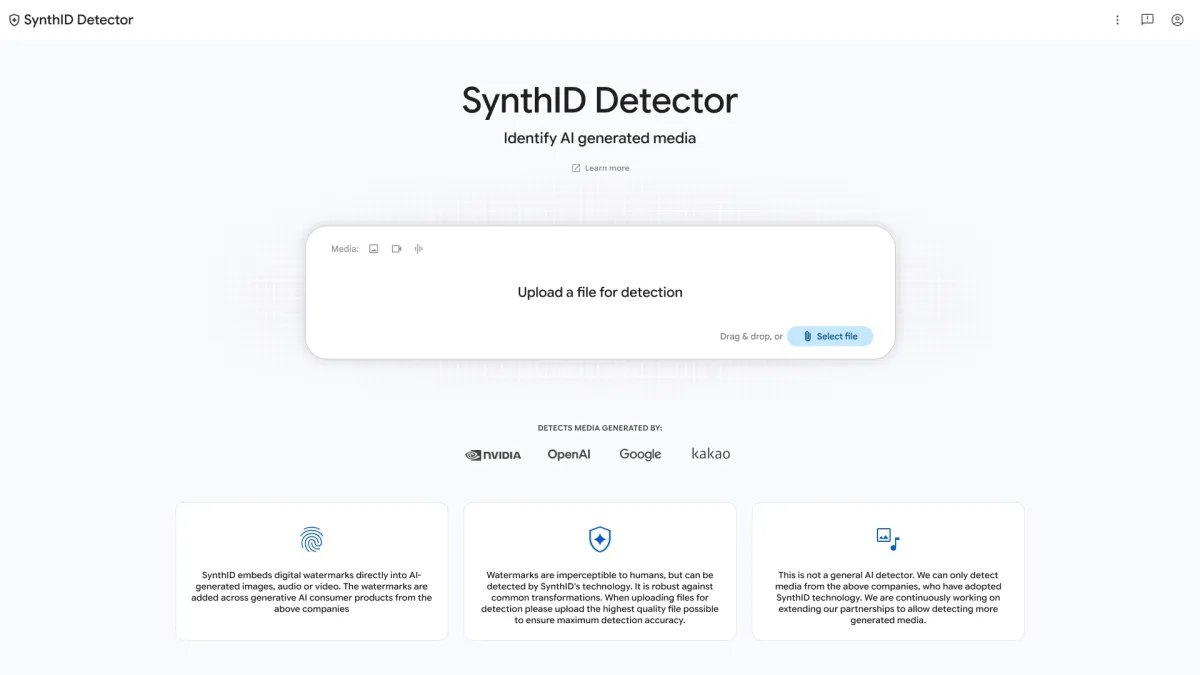
Understanding the Mechanics of SynthID
The rapid proliferation of generative artificial intelligence has fundamentally altered the digital landscape, making it increasingly difficult for users to discern between human-authored and synthetic content. To address these concerns regarding media authenticity, Google has launched a centralized portal that allows the public to verify whether images, videos, or audio clips were produced by AI models. This initiative is powered by SynthID, a technology introduced by Google DeepMind in 2023, which embeds imperceptible digital watermarks directly into the pixel data of images or the waveform of audio files.
Unlike traditional watermarking techniques that overlay visible text or logos—which can be easily cropped or edited out—SynthID operates at a deeper level. It modifies the data in a way that remains statistically detectable by Google’s verification algorithms, even if the file undergoes significant modifications such as compression, color grading, or resizing. This makes it a robust solution for tracking the provenance of media. The verification process works by scanning the uploaded file for these specific markers; if the algorithm detects a high probability of a SynthID signature, it flags the media as being AI-generated.
Extensive Support for Modern Media Formats
A primary challenge in digital authentication is the wide variety of file formats utilized across the internet. Google’s newly released platform is designed with broad compatibility in mind, ensuring that creators, journalists, and researchers can verify content without needing to convert files into proprietary formats first. For image verification, the tool supports standard formats including JPG, JPEG, and PNG, as well as modern, efficient web standards such as WEBP, AVIF, HEIC, and TIFF.
Video verification, which is particularly critical given the rise of sophisticated AI-generated video models, is supported through MP4, MOV, and WEBM containers. Furthermore, audio authentication—a growing necessity due to the prevalence of deepfake voice synthesis—handles common formats like WAV, MP3, OGG, FLAC, and AAC. By providing this level of support, Google aims to minimize the friction involved in content verification, allowing for a seamless transition from detection to analysis. The system is already integrated into the broader Google ecosystem, including the Gemini app and the Chrome browser, reflecting the company’s intent to make these verification capabilities part of the standard web browsing experience.
The Ecosystem of SynthID Adoption
SynthID is not merely a proprietary tool isolated to Google’s internal models; it has become an industry standard supported by major technology players. Google has successfully integrated the watermarking technology across its own model suite, including Nano, Banana, Veo, and Lyria. Additionally, popular generative interfaces such as Gemini, Flow, ProducerAI, and Vids automatically apply these markers to any media they produce.
The utility of SynthID extends beyond Google’s immediate borders, as organizations like OpenAI, Nvidia, and Kakao have adopted the technology for their respective platforms. Apple is reportedly preparing to integrate similar support, signaling a broader industry push toward interoperable authenticity standards. This collaborative approach is vital; if media provenance is to be tracked across the entire internet, companies must agree upon a shared language of digital watermarking. With users already conducting over one million verification requests per day, the infrastructure for tracking AI-generated content is clearly being stress-tested by a global audience.
Use-Cases and the Limitations of Detection
The primary impact of this tool lies in the preservation of digital integrity for news organizations and content creators. Journalists can use the verification portal to investigate the origin of viral images before publishing, while researchers can better categorize datasets during their studies on AI trends. By providing a clear signal as to whether a piece of content has been synthesized, the tool helps reduce the risk of misinformation spreading through digital channels.
However, it is essential to approach these tools with a nuanced perspective. While SynthID represents a significant technical leap, it is not infallible. Detection technology functions as a probabilistic exercise rather than a binary certainty. Furthermore, competing standards exist; Microsoft and Meta have developed their own methods for labeling content. Recent performance reports indicate that even proprietary detectors often struggle to identify images produced by their own parent models, particularly when those images have been heavily edited or cropped. These failures highlight the ongoing “arms race” between generative models that become increasingly adept at bypassing detection and the forensic tools designed to catch them.
Future Outlook on Digital Provenance
The transition from a closed testing phase—formerly reserved for select researchers during last year’s Google I/O—to a fully open web platform represents a maturation of AI safety initiatives. As synthetic media becomes indistinguishable from reality, the burden of truth will increasingly rely on these hidden digital signatures. Moving forward, the goal is to standardize the metadata and watermark layers across all generative platforms, ensuring that even if a user downloads an image from one service and uploads it to another, the proof of its origin remains intact.
As digital literacy evolves, the public will need to grow accustomed to checking content against these verification portals. While these tools currently serve as a robust first line of defense, they also mark the beginning of a larger shift in how we establish trust in digital information. The success of this initiative will depend not only on the sophistication of the algorithms but also on the willingness of all technology providers to commit to these transparent standards, eventually fostering an internet where the provenance of every pixel and sound wave can be accounted for.
Disclaimer: This content is auto-generated for informational purposes only.
Source: Read Original News