







As nations race to meet the ambitious targets set by the Kunming-Montreal Global Biodiversity Framework (KMGBF), the global transition to renewable energy faces a pivotal balancing act: scaling up clean energy infrastructure without compromising the health of fragile marine ecosystems. A new initiative, spearheaded by the GINGR (Global Infrastructure Nature-positive, Grid-compatible and Resilient) coalition, seeks to reconcile these two goals by providing the offshore wind sector with a concrete roadmap for “Nature-Positive” development.
Offshore wind is a cornerstone of the global effort to decarbonize, but the expansion of turbine arrays and subsea grids carries inherent risks to underwater habitats. Historically, industry standards have focused on impact mitigation—the defensive goal of doing as little harm as possible. The newly launched Offshore Wind Nature-Positive Contributions Framework seeks to shift this paradigm, encouraging developers to move beyond passive safeguards and toward active, measurable restoration of biodiversity.
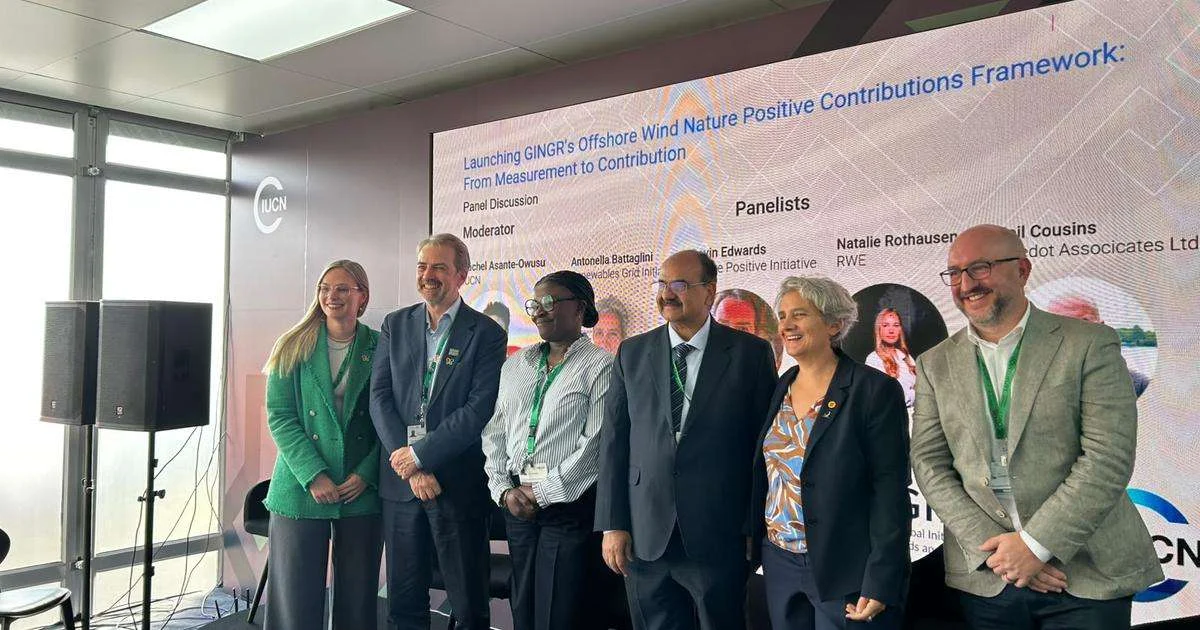
“We need a shared understanding of what credible contributions to nature look like in practice,” said Rachel Asante-Owusu, Senior Programme Coordinator for Energy Transition at the IUCN. “This framework unites developers, policymakers, financiers, and conservation organizations around a shared approach to credible, measurable biodiversity contributions from offshore wind.”
The framework is structured as a modular, five-step process: Frame, Assess, Measure, Define, and Deliver. By utilizing these steps, projects are guided through the complexities of assessing ecological integrity and understanding the difference between measurable loss and net gain. Central to the initiative is an interactive “Metrics Toolbox,” which helps developers align their internal project data with emerging global consensus on how to monitor and report ecological change.
For industry leaders, the challenge has often been a lack of standardized language. Antonella Battaglini, CEO of the Renewables Grid Initiative (RGI), emphasized that the goal is to bridge the gap between high-level environmental rhetoric and operational reality. “Through GINGR, we’re going beyond ambitions by developing practical ways to help the offshore wind and electricity grid sectors protect biodiversity and put people and nature at the heart of their projects,” she stated.
The introduction of the framework comes at a critical time for environmental financing. As financial institutions come under increased pressure to ensure their portfolios meet ESG (Environmental, Social, and Governance) criteria, the demand for transparent biodiversity data has never been higher. Ajay Bhushan Pandey, Vice President of Investment Solutions at the Asian Infrastructure Investment Bank, noted that the framework offers a vital common language for investors and developers. “Financing the energy transition must go hand in hand with safeguarding nature,” Pandey said. “For financial institutions, robust biodiversity data and transparent reporting are essential to understanding what projects aim to achieve and whether they deliver.”
The practical application of these tools is already being tested through case studies, which demonstrate how site-level planning can transform a standard wind farm into a site that fosters biodiversity. Neil Cousins, Founder and Director of Bluedot Associates, noted that the primary objective was to remove the ambiguity that often stalls conservation efforts. “The primary reason for developing this framework is to establish how offshore wind projects can credibly deliver measurable contributions at the site, addressing key challenges that may undermine or limit intent in achieving such outcomes,” Cousins explained.
As the framework moves into wider circulation, the GINGR coalition is shifting its focus toward implementation. This involves ongoing engagement with governments and private stakeholders to refine the metrics and governance structures necessary for long-term accountability. Feedback from current pilot projects will be instrumental in the next phase of development, with the coalition planning to showcase progress and further “challenge” the industry to adopt these standards during the upcoming 31st UN Climate Change Conference (COP31).
By providing a unified, rigorous approach, this initiative aims to ensure that the offshore wind sector contributes not just to a cleaner climate, but to the restoration of the marine life that sustains the planet’s resilience. As the industry scales to meet global energy demands, the framework serves as a reminder that the path to a sustainable future is paved with more than just zero-carbon electrons; it requires a proactive, restorative relationship with the natural world.
Disclaimer: This content is auto-generated for informational purposes only.
Source: Read Original News