









Martel pointed to fleet utilisation data as a leading indicator of continued services momentum.
Canadian business jet manufacturer Bombardier’s services business delivered revenues of $617m in the first quarter of 2026, a 25% year-over-year increase, anchoring a strong start to the year. Total revenues grew 5% to $1.6bn and free cash flow reached its highest first-quarter level in nearly two decades.
“The first quarter of 2026 was a very strong start to the year for Bombardier,” said Éric Martel, president and CEO. “We delivered unprecedented positive free cash flow for a first quarter and at the same time, we saw exceptional momentum on orders that gives us again and again, trust in our strategy, in our people and in our products.”
The services strength helped absorb a $47m decline in manufacturing revenues driven by delivery mix, as well as a supplier issue that temporarily held back a handful of aircraft deliveries during the quarter.
“This challenge has now been resolved, and we expect to progressively catch up over the coming quarters,” said Martel, adding that the diversification of the business model “helped offset some of the lost revenue and margin from this headwind.”
Martel pointed to fleet utilisation data as a leading indicator of continued services momentum. “On our platform, if you think of the Global quarter-one-over-quarter-one, 8% more flying hours since last year, 6% more flying hours on the Challenger. Those are for us leading indicators that leads us to believe that work will come our way in a more consistent fashion,” he said.
The company delivered 24 aircraft in Q1 2026, one more than the 23 in the same period last year, comprising 14 medium-cabin and 10 large-cabin jets.
Adjusted EBITDA came in at $246m, broadly flat year-over-year, with margin contracting 90 basis points to 15.4% due to higher SG&A (Selling, General and Administrative expenses) and R&D expenses.
Bart Demosky, chief financial officer was clear the margin softness was expected and temporary. “We would have had obviously higher EBITDA and EBITDA margin as a result of that supplier snag. So, we’ll recover that throughout the year. It’s why we’re so confident in achieving our guidance for the year.”
Reported net income grew 20% to $53m, while adjusted net income surged 178% to $189m. Adjusted EPS reached $1.81, up from $0.61 last year.
The quarter’s standout metric was free cash flow of $360m, a $664m swing from the $304m outflow in Q1 2025, driven by nearly $1.1bn in customer advance growth from strong order activity and progress payments on existing backlog.
Demosky emphasised that there were no one-time items behind the number. “It reflects the structural improvements we have made to our business and the discipline we’ve embedded across our sales and operations,” he said.
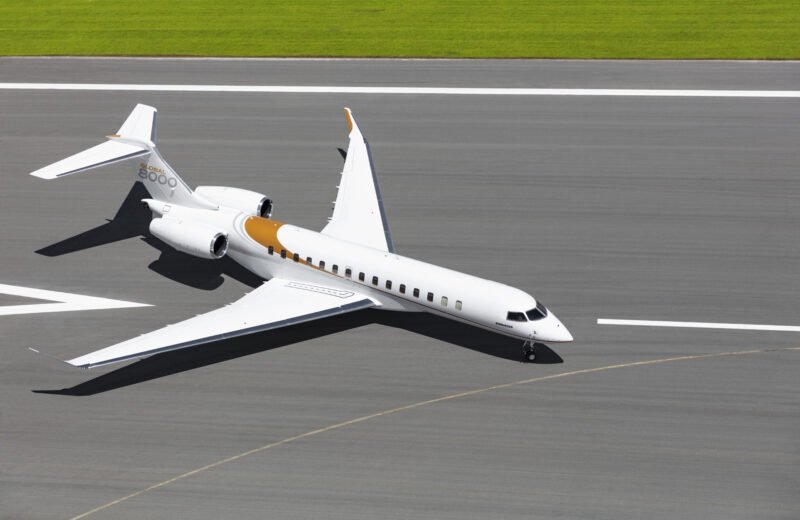
Backlog reached $20.3bn at quarter end, up $2.8bn sequentially and 43%YoY, with a unit book-to-bill of 3.6x driven by fleet operators and strong demand for the Global 8000.
Bombardier repaid $750m in senior notes during the quarter and announced a further $108m Canadian debenture repayment post quarter end, bringing total debt repaid by end of Q2 to $860m and generating annual interest savings of more than $52m. Adjusted net debt fell to $2.74bn, with the net leverage ratio improving to 1.8x.
S&P Global revised its outlook on Bombardier to positive on April 14.
Full year 2026 free cash flow guidance was raised to greater than $1.0bn from the prior range of $600m to $1.0bn, with all other metrics reaffirmed: deliveries above 157 units, revenues above $10.0bn and adjusted EBITDA above $1.625bn.
“It also reinforced our conviction that Bombardier is now a consistent and resilient cash-generating business,” said Martel.