







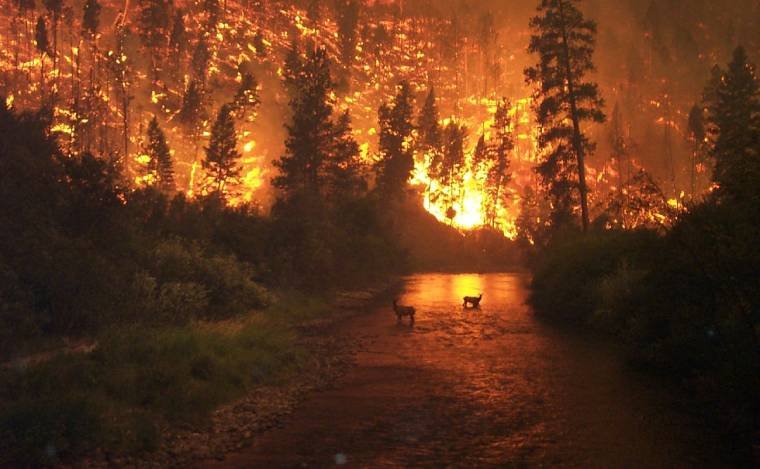
Wildfires raging across rural Canada are caused by Government policy, and indigenous communities are being hit the hardest
By Pat Meusel
Downloading PDF. Please wait…
Tuesday 21 July 2026

Wildfires are devastating indigenous communities in Canada
The “air smells like it’s on fire” as wildfires rage in Canada.
Almost 1,000 burned across the country–and 250 were out of control–as Socialist Worker went to press on Tuesday.
Air quality in Toronto, Canada, was the worst in the world last week, according to IQAir, an environmental technology agency based in Switzerland.
Towards the end of the week, as the smoke travelled south, US cities, such as Detroit, Minneapolis, New York and Washington, DC topped the tables.
Matt, who lives in Toronto, spoke to Socialist Worker about the impact on day to day life in the city.
“It makes it incredibly difficult to breath.” He said “I went out for around ten minutes, to get some groceries, and that was all I could handle.
“The air smells like it’s on fire”
Smoke covered Toronto as the city was already suffering through a heatwave.
“On Wednesday last week, the temperature topped out at 38 degrees,” Matt said.
“I’m lucky enough to live in a building with air conditioning, so it was just about manageable. Because you couldn’t open your windows, obviously. But if you didn’t have AC, it would’ve been unbearable.”
Sid, an activist in Toronto, explained that the wildfires were no accident.
“As wildfires rage, federal and provincial governments are calling for the construction of more pipelines for the extraction of more fossil fuels,” he told Socialist Worker.
Mark Carney, prime minister of Canada, has recently abandoned his government’s already meagre emissions targets.
And he’s rubber stamped the construction of pipelines across the country.
In April, the federal government approved a £2 billion expansion to the Enbridge Sunrise pipeline in British Columbia.
It already carries 3.6 billion cubic feet of fracked gas to the US border every day.
And more recently, the provincial premiers of Alberta and Ontario published plans for the 3,300 kilometre-long Northern Shield pipeline.
When completed, this will transport up to 800,000 barrels of oil per day across the country, for export to Europe.
Sid added, “All of this is happening while politicians have slashed funding for fire services.”
In Ontario, funding for fire services has been cut by £25 million, as part of the government’s austerity program.
And Sid pointed out that the people on the front lines of the crisis are the First Nations of Canada.
“People in the north, predominantly Indigenous people are bearing the brunt of these cuts,” he explained.
So while people in Toronto struggled to breath, entire communities in remote, rural parts of Ontario were burned to the ground.
A press statement put out by the Chiefs of Ontario First Nations said, “Members of Namayhoosisagagun First Nation were forced to flee by boat as fires engulfed their community.”
“The increasing frequency and severity of wildfires are not isolated events. They are part of a broader climate crisis that is putting First Nations at growing risk.”
But there’s hope–and it lies in resistance from below.
Wet’suwet’en First Nation resistance to the construction of the Coastal GasLink pipeline in 2020 sparked the Shut Down Canada movement in solidarity.
It was only disrupted by the Covid-19 pandemic, and a brutal crackdown by the Canadian state.
Workers struggling against cuts to jobs and public services, alongside Indigenous people struggling for sovereignty, can build confidence to fight back against the system as a whole.