Forty years after the nuclear disaster, questions remain about fallout, farming and public reassurance
THE CHERNOBYL nuclear disaster is usually remembered as something that happened far away.
The explosion at reactor four in Ukraine, then part of the Soviet Union, took place on April 26, 1986. It caused devastation close to the plant, forced mass evacuations, and became the world’s worst nuclear accident.
But Chernobyl was not only a Soviet story.
Radioactive material released by the explosion was carried across Europe. Within days, the plume had reached Britain. Rainfall brought radioactive particles down over parts of the UK, including Wales.
The effects in Wales were real. Welsh farms, particularly in upland areas of North Wales, were placed under sheep movement restrictions after radioactive caesium was found in the environment. Some restrictions remained in force until 2012 — 26 years after the disaster.

The scale was enormous: around 9,800 UK holdings and more than four million sheep were originally placed under restrictions. By 2012, Welsh Government said 327 farms in North Wales were still under some form of control before the remaining restrictions were lifted.
That is not speculation. It is part of the official record.
There was also monitoring in south-west Wales.
After Chernobyl, milk was tested across Wales. In this part of the country, samples were taken from creameries and farms. Rainwater was also sampled at Milford Haven.

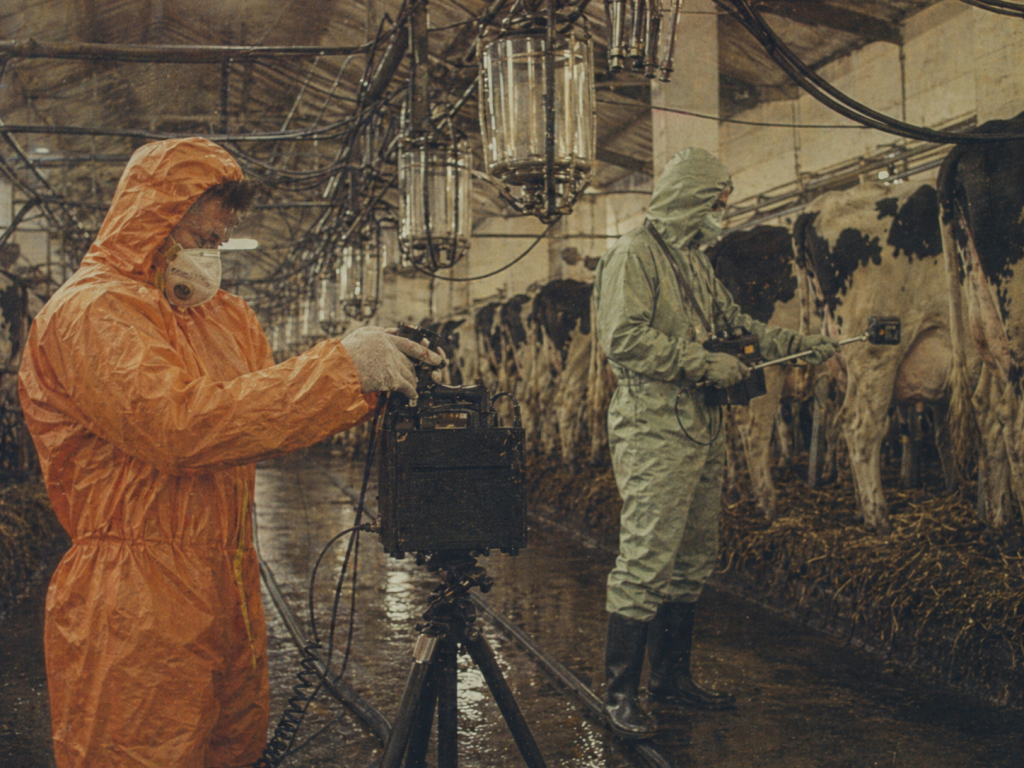
Radiation was detected locally.
In May 1986, iodine-131 was found in milk from Haverfordwest. Caesium-137 was also later detected in milk from the same source. Iodine-131 was found in rainwater at Milford Haven.
Officials said the levels were low and well below the emergency reference limits in place at the time. That is an important point. This article is not claiming that Pembrokeshire children were poisoned, or that any individual illness can be blamed on Chernobyl.

But the readings were not zero.
That is why the subject still matters.
For scientists, the figures were a matter of becquerels, half-lives and exposure levels. For parents in 1986, the issue was far simpler. Radioactive material had been found in rainwater and milk.

The official reassurance may have been accurate, but it was never likely to remove all public anxiety.
Children were always the group people worried about most. They drank milk. They were still developing. They were more vulnerable to some forms of exposure, particularly radioactive iodine, because iodine concentrates in the thyroid gland.
The levels recorded in Pembrokeshire were far below those seen in the worst-affected areas near Chernobyl. They were also below the action levels used by the UK authorities.
Even so, many people who grew up in Wales at that time are entitled to ask what the long-term impact may have been.
Those of us born in the late 1970s were around seven years old when Chernobyl happened. We were too young to understand the news reports or the government statements. We did not understand iodine-131, caesium-137 or the food chain.
But we were part of the generation living through it.
I remember a teacher at my secondary school later saying that our year group appeared to have been academically stunted by something. He may have been wrong. Teachers often notice differences between year groups, and there may have been many other explanations.
It could have been social factors, family pressure, poverty, schooling, or simply one difficult cohort.
But his comment stayed with me.
So has something else. A number of people from that school generation have since died from unusual or aggressive cancers at a relatively young age.
That does not prove a link to Chernobyl. Cancer is common, and apparent clusters can happen by chance. It would be wrong to claim that Chernobyl caused those deaths without evidence.
But it is also understandable that people ask questions.
Public health is not only about whether officials can prove a direct cause. It is also about public confidence, communication and whether people feel they were told enough at the time.
The government’s position in 1986 was that the readings in areas such as Pembrokeshire were low and did not require emergency action. That may well have been correct.
But it does not mean the concern was irrational.
If radiation was found in rainwater at Milford Haven and in milk from Haverfordwest, then local people had a right to know what was found, what it meant, and how the risk was being assessed.
The wider Welsh experience shows why trust was so important. In North Wales and other upland areas, sheep farmers lived with the consequences of Chernobyl for decades. Restrictions on some farms lasted until 2012.
That gave the disaster a long life in Wales. It was not a one-week scare on the television news. It affected agriculture, food safety, public confidence and the relationship between rural communities and government.
The question of whether Chernobyl affected children in Wales is harder to answer.
Official assessments have generally concluded that the levels received by the UK population were low, and that any health impact would be difficult to detect at population level. The worst health effects were seen much closer to the plant, particularly in parts of Ukraine, Belarus and Russia.

But “low risk” is not the same as “no concern”.
Nor does it mean the subject should be dismissed.
The responsible position is to say this: Chernobyl fallout reached Wales. Radioactive material was detected in parts of the Welsh food and water environment. Welsh farming was affected for decades. Children living in Wales at the time were exposed to low levels of fallout, mainly through the wider environment and food chain.
What cannot be said is that Chernobyl caused a particular illness, a particular death, or a particular school year’s difficulties in Pembrokeshire.
The evidence does not allow that.
But the question remains legitimate.
Forty years on, Chernobyl is still remembered because it showed how far the consequences of a nuclear accident can travel. Wales was not at the centre of the disaster, but it was not untouched by it either.
For Pembrokeshire, the local facts are enough to justify looking back again: rainwater was tested at Milford Haven, milk was tested in Haverfordwest, and radioactive material was found.
The official view was that the levels were low.
The public memory is more complicated.