








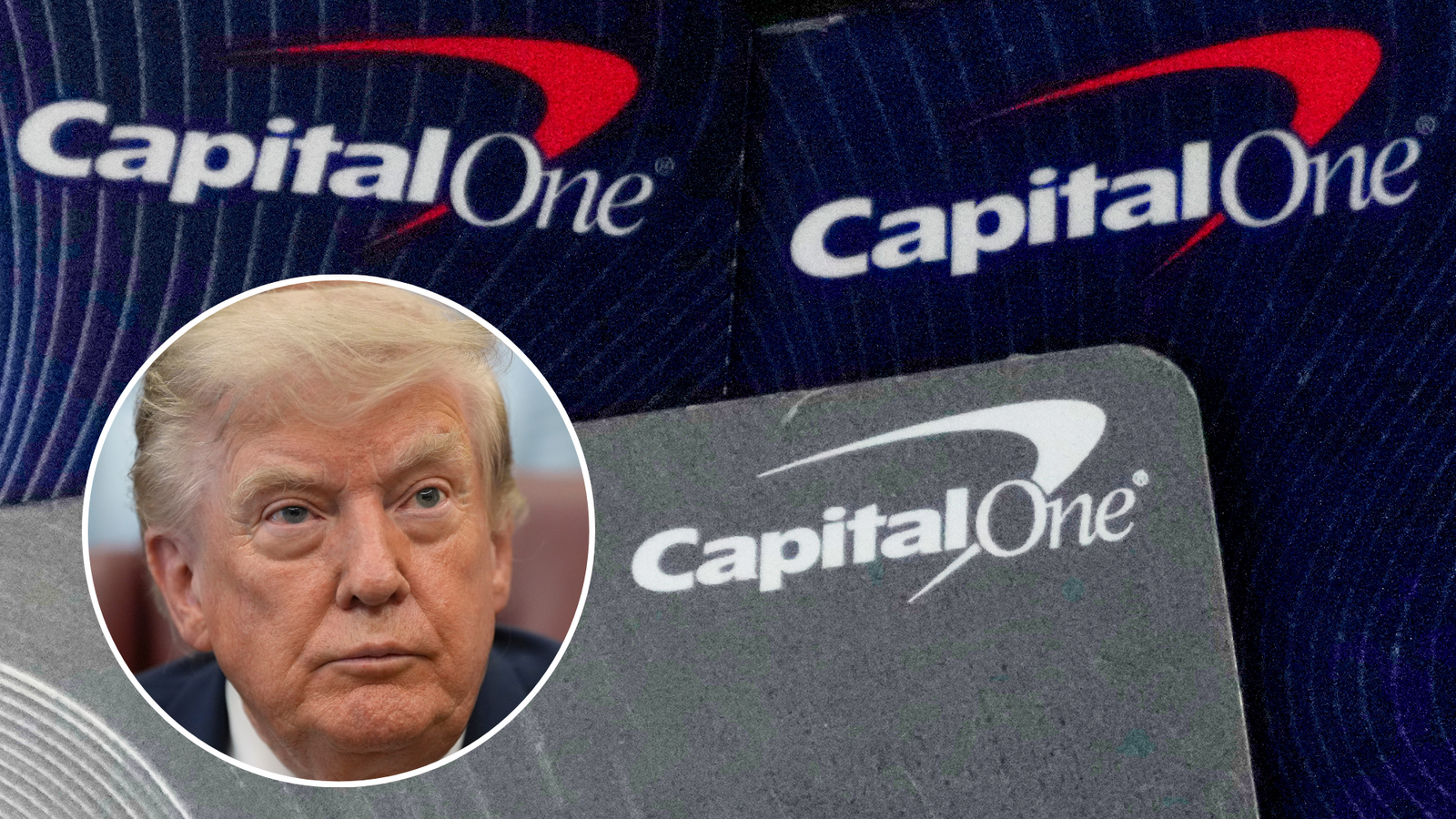
Capital One says it closed hundreds of bank accounts associated with President Donald Trump and his businesses in 2021 “for anti-money laundering reasons,” according to a recent court filing from the financial institution.
Capital One disclosed the money laundering review for the first time in a motion to throw out the president’s lawsuit against the bank over the closure of his businesses’ bank accounts, which the Trump family has alleged was politically motivated and unlawful.
While the bank did not accuse the Trump Organization of money laundering, Capital One said Trump’s accounts were closed after a monthslong review by the bank’s anti-money laundering team — not for political reasons as alleged by the president and his family.
“The closures were the result of months of analysis and a careful review by Capital One’s AML team in accordance with bank policies and regulatory guidance,” lawyers for the bank said in a court filing on July 31. “Capital One never publicized the termination decision nor its confidential internal process giving rise to the closure, and it permitted Plaintiffs several months (and granted several extensions) to find new banking services, which they did.”
In a statement to ABC News, a spokesperson for the Trump Organization alleged that Capital One was trying to manufacture a justification to close the accounts “to conceal what was plainly a politically motivated decision to debank the Trump accounts.”
“Capital One’s after-the-fact attempt to justify its debanking of Trump related accounts is completely baseless. Following the events of January 6, 2021, Capital One manufactured a post hoc rationale by selectively resurrecting a handful of isolated transactions that had occurred years earlier and had never once been identified as cause for concern,” the spokesperson said, referring to the Jan.6 attack on the U.S. Capitol.
The lawsuit, filed against Capital One last year by Trump’s trust, his companies, and his son Eric Trump, alleged that the financial institution canceled approximately 385 bank accounts associated with Trump for political reasons following the public backlash to the Jan. 6 attack.
“Plaintiffs have reason to believe that Capital One’s unilateral decision came about as a result of political and social motivations and Capital One’s unsubstantiated, ‘woke’ beliefs that it needed to distance itself from President Trump and his conservative political views. In essence, Capital One ‘de-banked’ Plaintiffs’ Accounts because Capital One believed that the political tide at the moment favored doing so,” the Trumps wrote in their lawsuit.
Trump similarly sued JPMorgan Chase over debanking allegations. JP Morgan said Trump’s lawsuit has “no merit” and that they close accounts because they pose “legal or regulatory risk for the company.” That lawsuit is pending.
Capital One instead argues that the basis for closing the accounts was the lengthy anti-money laundering analysis and review conducted by the bank. Months before closing the accounts, Capital One agreed to pay a $390,000,000 penalty to the Financial Crimes Enforcement Network for failing to implement and maintain an effective anti-money laundering program.
“Capital One’s decision to close Plaintiffs’ accounts only became public because of Plaintiffs’ own decision to pursue this litigation,” the motion said.
U.S. District Judge Roy Altman — a Trump appointee — tossed Trump’s lawsuit earlier this year because his attorneys failed to state a legal claim, but he allowed them to file an amended complaint last month.
New York prosecutors heavily scrutinized Trump’s financial records after he left the presidency in a civil case brought against Trump that focused on the alleged inflation of his assets to get better loan terms, and a criminal case centered on the allegation that Trump falsified business records to hide hush money payments made to adult film actress Stormy Daniels. Neither case involved allegations of money laundering.
Trump was convicted in 2024 for falsifying business records as well as found liable for inflating his business assets. He has appealed both cases, and a mid-level court tossed the financial penalty associated with his civil case last year.
Copyright © 2026 ABC News Internet Ventures.