






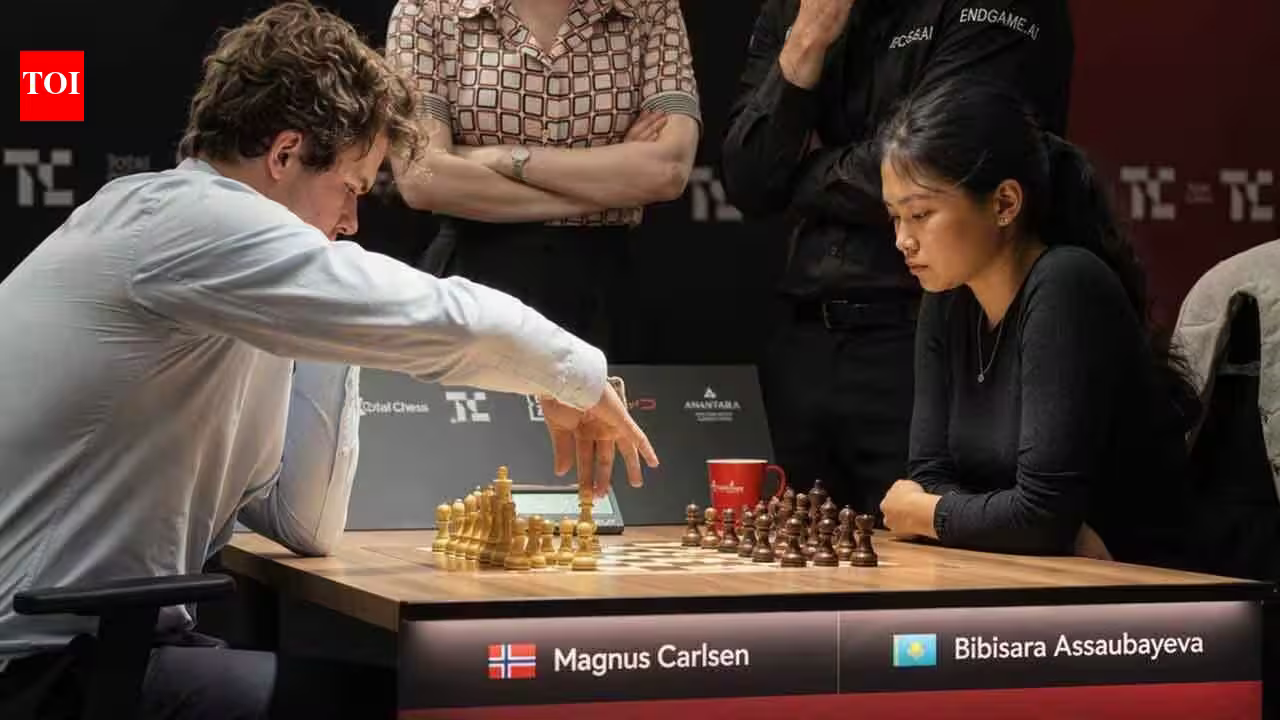
BUDAPEST — In a move that has sent shockwaves through the international chess community, World No. 1 Magnus Carlsen has sparked a heated debate regarding professional conduct and the future of tournament regulations. The Norwegian grandmaster, widely considered the greatest player of the modern era, opted to forfeit his “Fast Classic” games against Bibisara Assaubayeva on back-to-back days during the Total Chess World Championship Tour pilot in Budapest.
The controversy unfolded as Carlsen, who was competing for a 17th-place finish after falling out of title contention, effectively abandoned the playing hall. Despite having secured an unassailable lead in the overall tie, Carlsen’s refusal to participate in the final legs of the contest left his opponent, Assaubayeva, waiting at the board in an empty venue. While he did inform the tournament arbiter of his intent to depart, the lack of communication with his opponent drew immediate criticism from observers and fans alike.
The “Meaningless” Defense
Carlsen, never one to shy away from expressing his disdain for formats he finds tedious or unnecessary, offered a blunt justification for his actions. Speaking to Norwegian broadcaster TV2, the former world champion dismissed the final portions of the tie as redundant.
“There will be no classical game, as I understood, the match is over,” Carlsen remarked following his departure on Tuesday. “The only consequence of not showing up is that you will lose a totally meaningless game. I think that if you play a World Championship and it counts for points and such, I can understand [the necessity of playing it out].”
His stance highlights a growing rift between elite players and organizers regarding the structure of new experimental tournament formats. For Carlsen, the mental toll and technical requirement of playing classical-time-control games in a match that has already been decided—mathematically—by blitz and rapid results, feels like a chore rather than a sport.
A Legacy at Risk
Beyond the immediate controversy, the timing of Carlsen’s withdrawal has raised questions about his own motivation and the preservation of his historic statistics. The Budapest event has been nothing short of a nightmare for the Norwegian in terms of his world rankings.
Heading into this competition, Carlsen occupied a rarefied space in the chess pantheon, having maintained an Elo rating above 2800 since 2009. The “Fast Classic” format proved particularly treacherous for him, as he struggled to find his rhythm, finishing fifth in his group and recording nine draws against one loss to Armenia’s Haik Martirosyan.
The poor performance has cost him 21.8 rating points over the past week alone. Analysts now suggest that his reluctance to play the classical games may be rooted in a desire to avoid further rating erosion. With his world No. 1 ranking, which he has held for over 15 years, now technically vulnerable, every game has become a high-stakes gamble for the legend. Carlsen’s own words earlier in the week hinted at his mounting frustration with the format: “This is an awkward situation to be in; I would rather not play that much more classical anymore.”
Organizers Seek Answers
As the dust settles, the organizers of the Total Chess World Championship Tour are left to manage the fallout. Kjell Madland, CEO of Total Chess, emphasized that the Budapest event was designed as a pilot to stress-test the ruleset before the inaugural season officially kicks off in March 2027.
“The Budapest pilot is an important learning exercise for Total Chess,” Madland stated. “While we have developed the format and regulations with considerable thought and input, the real test is how they work in a live competitive environment. We want to hear directly from the players and arbiters, understand their experiences and take on board constructive feedback.”
Madland noted that the organization is not wedded to the current ruleset and is open to refining the regulations to ensure that players are incentivized to complete all scheduled games. However, whether the organization will impose retroactive fines or sanctions on Carlsen for his unilateral withdrawal remains a point of intense speculation. Tournament officials have yet to confirm if the Norwegian’s actions triggered an automatic penalty.
The Future of the Format
The incident has ignited a wider conversation about the integrity of chess tournaments. While proponents of the Total Chess format argue that it provides a comprehensive test of a player’s range—from speed to classical accuracy—critics argue that the scoring structure currently in place can lead to “dead rubber” scenarios that devalue the effort required to organize a professional event.
For now, the chess world waits to see if this incident acts as a catalyst for reform. As Total Chess prepares for its official 2027 debut, they must balance the demands of sponsors and the public with the realities of managing the world’s most fiercely independent, and perhaps most frustrated, superstar. Whether through rule changes or a total shift in philosophy, the events in Budapest have made one thing clear: the current state of professional chess is in flux, and its biggest star is not afraid to walk away from the table to prove a point.
Disclaimer: This content is auto-generated for informational purposes only.
Source: Read Original News