








Later imagery increasingly linked counting with population control, prominently featuring the two-child norm – a reflection of the anxieties of the era.
For Kumar, these fragile postal artefacts capture more than bureaucratic history.
They reveal how the Indian state sought to build legitimacy and trust through everyday communication – and how the census became intertwined with ideas of development, diversity and national identity.
That question of trust remains relevant today.
While digital tools may speed up data collection, Kumar argues that technology alone cannot guarantee reliable data.
“Awareness about the census is critical to building trust,” he says, cautioning that the government must find new ways to build public confidence as the reach of the postal system fades.
And yet, the census India is preparing for today is vastly different from the one remembered in these fading postal artefacts.
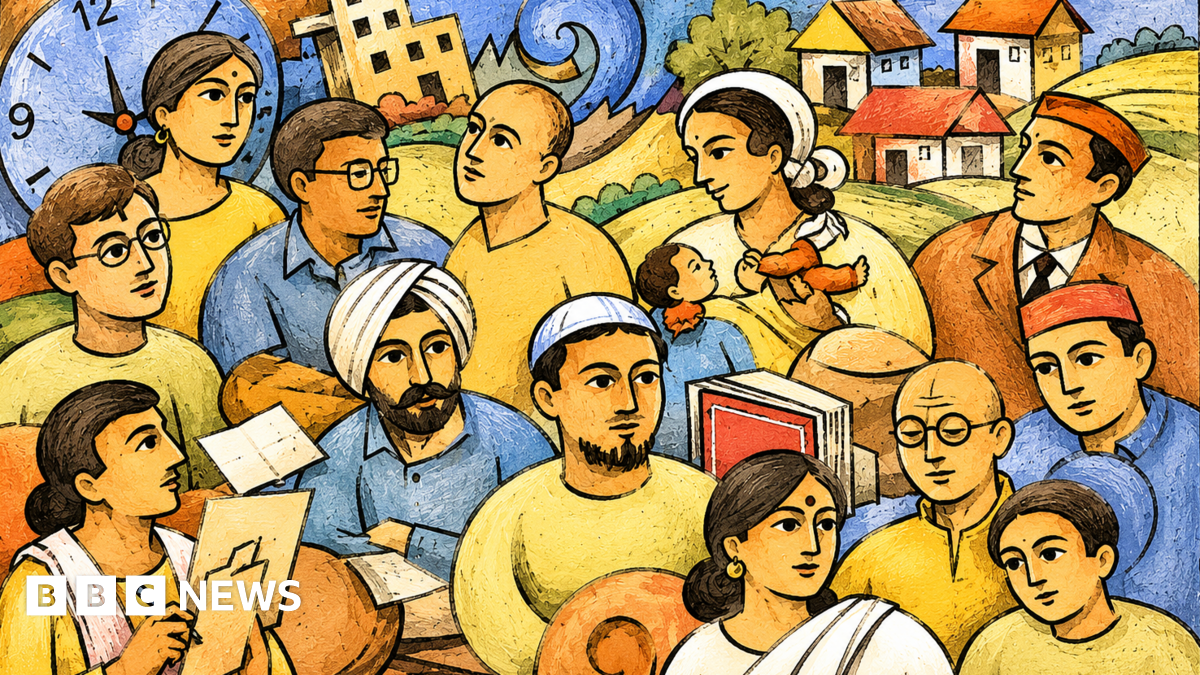
The new census is seen as crucial for policy planning, welfare delivery and political representation in the world’s most populous country. It will also, for the first time in decades, collect caste data – a politically sensitive exercise in a country where caste continues to shape social and economic life.
The scale remains staggering: the exercise will span 36 states and federally administered territories, more than 7,000 sub-districts, over 9,700 towns and nearly 640,000 villages. Millions of households will be surveyed by enumerators and supervisors – typically teachers, local officials and government staff.
But one thing has changed fundamentally. For the first time, the census will be conducted digitally, with enumerators using mobile apps to collect and upload data in real time.
From family-shaped postmarks stamped on envelopes to data uploaded instantly from smartphones, the census has travelled a long way.
Yet the underlying challenge, as the exhibition suggests, remains much the same: persuading more than a billion people to trust the state enough to count themselves into the story of the nation.