





By Colleen Howe and Sethuraman N R
BEIJING/NEW DELHI, April 22 (Reuters) – In the rolling, wind-swept grasslands of Chifeng in northern China’s Inner Mongolia, towering white wind turbines line hilltops like sentinels over a hydrogen industry Beijing is trying to prise away from coal.
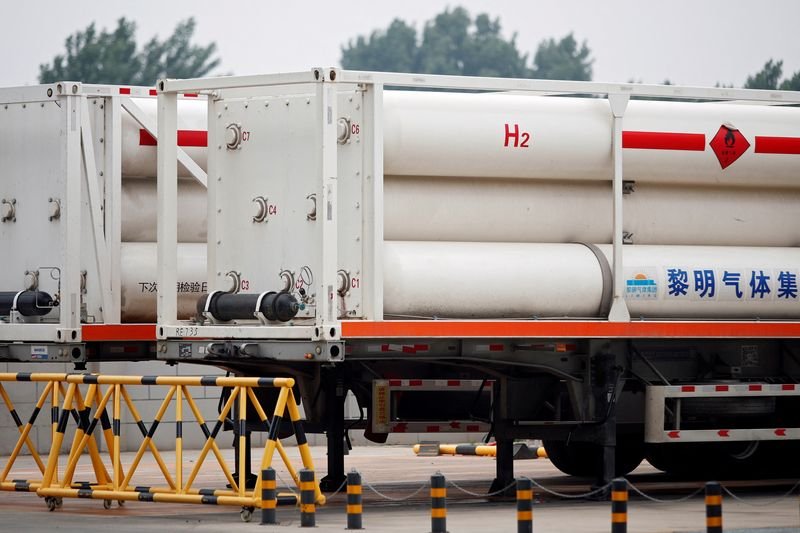
They are part of a $2 billion project – the biggest of its kind – that harnesses renewable energy to run banks of electrolysers that produce the molecules needed for fertilizer, marine fuel and low-emission steelmaking.
India shares China’s “green hydrogen” ambitions, but its commitments are even more concrete and aggressive. Backed by subsidies worth some $2.1 billion, New Delhi is targeting 5 million metric tons of green hydrogen annually by 2030 – five times the current size of the global market and about double what analysts estimate Chinese output will be by then.
The massive bets by the world’s two most populous nations come at the same time that the West has quietly backed away from its ambitious green hydrogen goals from the start of this decade after cost constraints proved stickier than anticipated.
What China and India have in common – despite very different motives – is the power and political will to force a market into existence, by underwriting projects, steering demand and pushing costs down through scale.
India has drawn private capital by pairing subsidies with offtake guarantees from refineries, fertiliser plants and steelmakers, making projects bankable from the outset.
The motivation is energy security. Hydrogen in India is overwhelmingly derived from imported natural gas, whose supply has suffered a sequence of shocks from the Middle East, Ukraine and the pandemic.
For China – able to deploy state-owned giants or attract private firms with large-scale, planning-led industrial projects – the aim is to preserve its dominance in hydrogen as the industry shifts towards cleaner energy.
In its five-year plan announced in March, Beijing listed green hydrogen alongside quantum computing, brain-computer interfaces and AI-enabled robotics as a frontier industry – an elevation in status that signals more capital will flow its way.
CHINA: SPEED AND SCALE
China invested $3.7 billion in green hydrogen production last year, more than double U.S. levels, said Rystad Energy’s head of hydrogen, Minh Khoi Le.
By 2031, China will have some 2.6 million tons per year online, representing $26 billion in investment, according to Rystad projections.
Much of 2025’s outlay went into the Chifeng project, operated by Chinese wind turbine maker Envision Energy. It aims to sell green hydrogen and ammonia to markets in Asia, Europe, Latin America and the Middle East, and delivered its first green ammonia cargoes to South Korea’s Lotte Fine Chemical in February.