









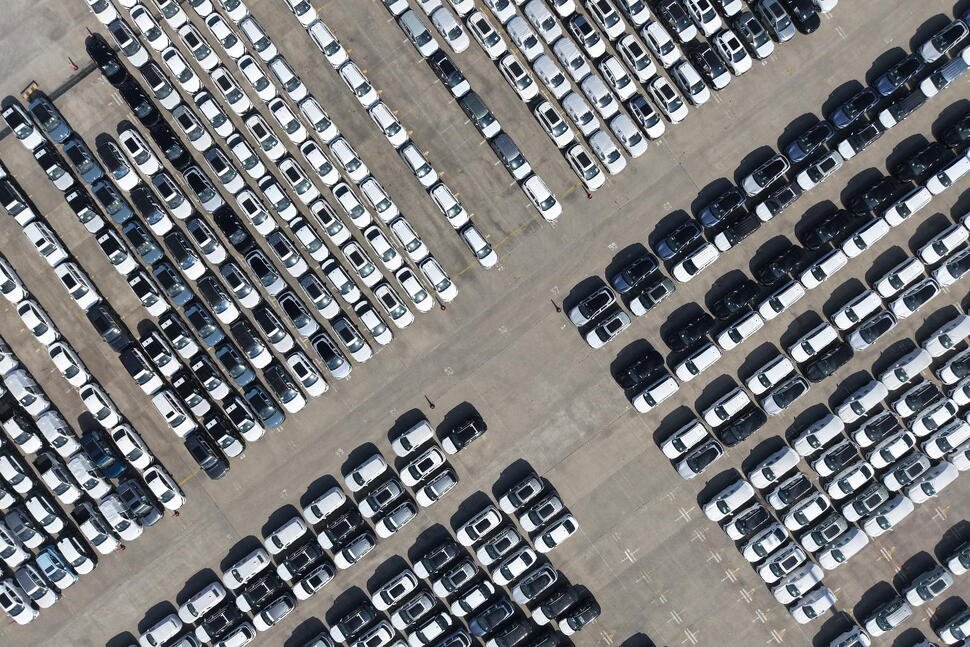
Chinese automakers are aggressively pivoting toward global markets as domestic demand remains mired in a slump. New data from the China Association of Automobile Manufacturers reveals a massive 64% surge in passenger car exports for September 2026 compared to the same period last year. As local consumers pull back due to cooling confidence and a reduction in government incentives, major manufacturers are leveraging their manufacturing prowess to dominate international roadways.
## A Strategic Shift Amid Domestic Stagnation
The decline of the Chinese domestic market has been stark, with passenger car sales plummeting 27% year-on-year in September, totaling roughly 1.6 million units. In contrast, China exported approximately 919,000 passenger vehicles in the same month, bolstered by insatiable international demand for electric vehicles (EVs) and plug-in hybrids. Analysts from S&P Global Ratings note that this export-heavy strategy has become the primary engine for profit and growth for firms struggling to find traction at home. Projections from consultancy AlixPartners suggest that Chinese brands could be on track to ship nearly 10 million vehicles globally by the end of 2026.
## The Technological and Cost Advantage
The competitive edge of Chinese manufacturers, such as industry leader BYD, is largely rooted in manufacturing efficiency and cost control. Modern automotive production in China has increasingly benefited from advanced automation, AI-driven supply chain optimization, and sophisticated manufacturing software.
Industry analysis indicates that a Chinese-branded EV can be produced for approximately $20,000, a significant undercut compared to the $31,000 average cost for an equivalent European-manufactured vehicle. This price gap has sent shockwaves through the European market, prompting regulators to consider trade rebalancing acts. While the European Union has already implemented elevated tariffs to protect its domestic industry, recent negotiations have even targeted the rapid influx of Chinese hybrid models, with an interim agreement potentially cutting these specific exports by half.
## Navigating Geopolitical Headwinds
While the export numbers are soaring, the road ahead is fraught with trade barriers and protectionist policies. Stella Li, executive vice president at BYD, recently admitted at the Milken Institute Asia Summit that geopolitics represents the single greatest hurdle to the company’s global expansion.
To circumvent the rising tide of tariffs, Chinese manufacturers are adopting a “localize or perish” strategy. Rather than relying solely on shipping vehicles across borders, firms are investing heavily in establishing manufacturing plants in Brazil, Hungary, Indonesia, and Thailand. This move toward local production serves two purposes: it lowers logistics costs and acts as a shield against potential trade sanctions.
The United States remains a largely closed market for Chinese EVs due to hefty tariffs and ongoing political friction. Following a high-profile state visit to Washington in September, where leaders from the U.S. and China failed to reach a consensus on vehicle trade, it appears that most Chinese automakers have deprioritized the American market.
As the global automotive landscape shifts, the reliance on AI-integrated production and localized manufacturing will define which companies survive the protectionist climate. Analysts at BofA Global Research anticipate that “more and more volume will be made locally,” suggesting that the future of the Chinese automotive surge will be defined by international footprint expansion rather than just export volume. As trade tensions simmer, the sector’s ability to navigate the complex web of global policy will be the ultimate test for China’s industrial giants.
Disclaimer: This content is auto-generated for informational purposes only.
Source: Read Original News