








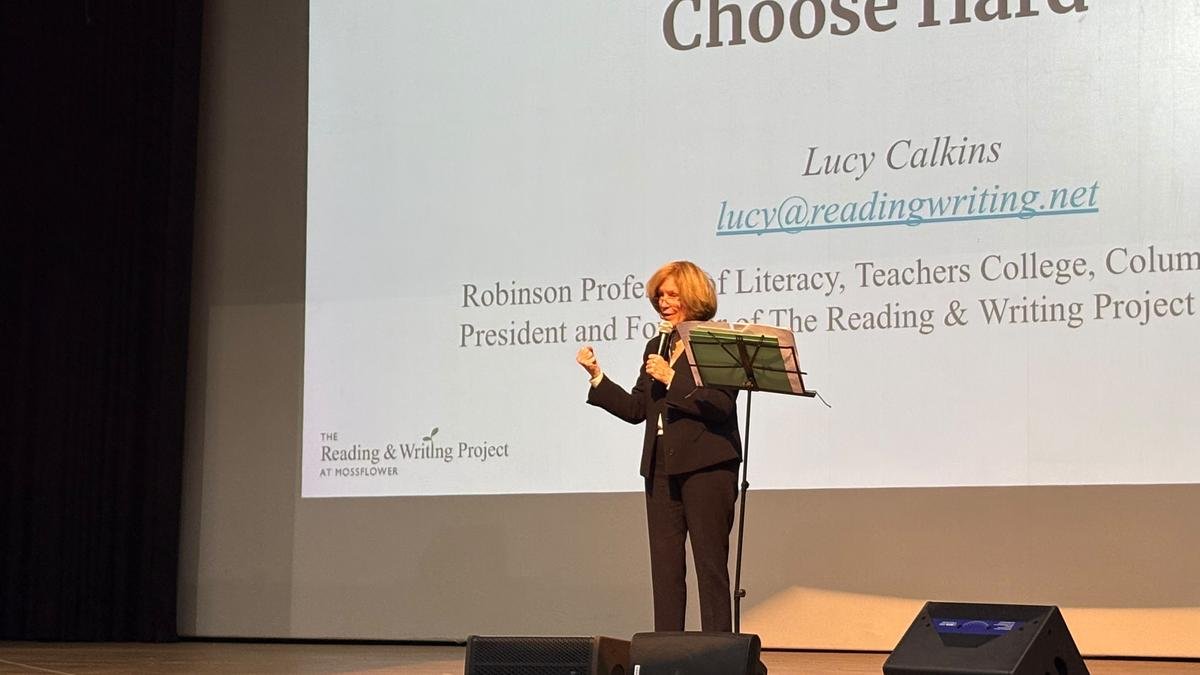
In an era defined by the rapid ascent of Generative AI, the fundamental act of putting pen to paper—or fingers to keyboard—is undergoing a profound existential crisis. However, for Lucy Calkins, a professor at Columbia University and the architect of the widely utilized Units of Study curriculum, the rise of artificial intelligence does not signal the end of writing. Instead, she argues, it makes the cultivation of deep literacy more critical than ever.
During a recent lecture at the Shiv Nadar School in Gurugram, Dr. Calkins addressed the intersection of pedagogy and technology, emphasizing that the human capacity for critical thinking, developed through rigorous writing, remains the ultimate safeguard against intellectual obsolescence.
Rethinking Literacy in the AI Age
As AI tools become increasingly capable of summarizing texts and generating essays, educators are facing an urgent question: Why should students learn to write when a machine can do it for them? Dr. Calkins posits that the value of writing has never been about the final product—the finished essay or report—but about the process of mental synthesis.
“Writing is not just a tool for communication; it is a tool for thinking,” Dr. Calkins noted. She argues that when students struggle to articulate an argument or refine a narrative, they are doing the hard, necessary work of organizing their thoughts and identifying logical gaps. When we outsource this process to AI, we risk losing the very cognitive discipline that distinguishes an informed thinker from a passive consumer of generated content. For schools, the policy shift must be away from rote output and toward the development of complex analytical skills that AI cannot yet replicate.
The Evolution of Classroom Assessment
The influence of AI is already forcing a structural change in how institutions approach exams and assessment. As take-home essays become vulnerable to AI-generated submissions, schools are being pushed to reconsider high-stakes testing models. Dr. Calkins suggests that assessments must pivot toward in-class, evidence-based discourse and creative application.
Rather than testing a student’s ability to recall facts or produce standard summaries, schools should prioritize “process-based assessment.” This involves evaluating a student’s drafts, their iterative revisions, and their ability to defend their work in real-time. By moving away from standardized templates, educators can foster a learning environment where academic integrity is maintained, and students are challenged to engage with the subject matter personally.
Policy Shifts and Institutional Responsibility
For educational institutions, the integration of AI is not merely a matter of banning or permitting technology; it is a matter of curricula design. Dr. Calkins suggests that policymakers and school administrators must prioritize “digital literacy” that teaches students how to use AI as a collaborator rather than a crutch. This involves rigorous fact-checking, understanding algorithmic bias, and mastering the art of prompt engineering to elicit higher-order thinking.
However, the core of the curriculum must remain rooted in human-centered activities: sustained reading and reflective writing. Dr. Calkins emphasizes that unless students are provided with the scaffolding to develop a unique voice, they will be unable to distinguish their own perspectives from the generic, homogenized outputs of large language models.
The Road Ahead for Learners
Ultimately, the future of education lies in balancing technological convenience with the endurance of foundational human skills. For students, this means that the “exam” of the future will look less like a memory test and more like a simulation of real-world problem-solving. Educators are tasked with the challenge of keeping the “human” in the loop, ensuring that as tools evolve, the capacity for original thought, empathy, and creative reasoning is not sidelined.
As Dr. Calkins concluded during her visit, the goal of education is to prepare students to navigate a world that is becoming increasingly automated. By fostering deep literacy, schools can ensure that the next generation remains the architects of their own ideas, rather than the subjects of an AI-led narrative.
Disclaimer: This content is auto-generated for informational purposes only.
Source: Read Original News