








Chloé Farand Tuesday 5 May 2026

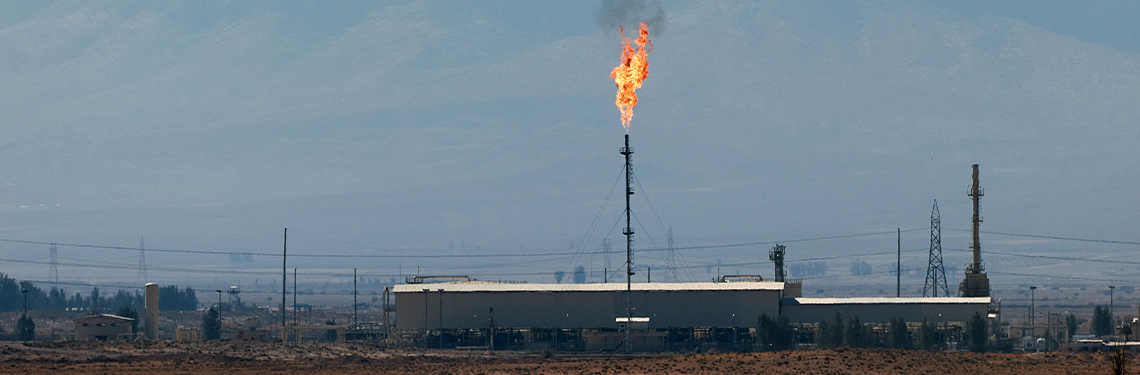
Iranian oil refinery. EvgeniyQW/Adobe Stock
War in the Middle East has caused significant environmental damage and led to, in the International Energy Agency’s words, the ‘largest supply disruption’ to oil markets in history. Attacks have also damaged energy and water facilities in numerous countries.
The US-Israeli conflict with Iran has exposed the vulnerability of countries dependent on oil and gas imports passing through the Strait of Hormuz, a key shipping route through which around 25 per cent of the world’s seaborne oil and 20 per cent of its liquefied natural gas (LNG) transits. The Strait is currently closed and subject to a US blockade.
‘In the short term, other than the economic impact caused by rising [energy] prices, there is also an environmental impact’ as countries turn to coal and other polluting energy sources to cope with the shock, says Ana Karina de Souza, an officer of the IBA Power Law Committee.
However, the crisis could also accelerate the transition to domestic renewable energy as governments seek alternative sources – such as solar and wind – to secure supplies. The conflict will bring discussion of the energy transition back to the table, says de Souza, an infrastructure and energy specialist and partner at Brazilian law firm Machado Meyer. Partly, this will be a result of the war’s environmental impact, but mostly it’ll be due to ‘energy security considerations,’ she believes.
The attacks on water infrastructure are being noticed particularly because of the major role desalination plays in the Middle East
Ana Schwab
Officer, IBA Water Law Committee
In the meantime, the conflict risks leaving a toxic legacy for people and the environment. ‘Black rain’ fell over Tehran after the US and Israel hit major fuel storage depots around the city, setting millions of litres of fuel ablaze and creating a haze that spread toxic pollutants, which affect respiratory health and contaminate groundwater and agricultural soils. The World Health Organization also raised concerns of ‘wider regional pollution exposure’ following reports of Iranian strikes on oil infrastructure in Bahrain and Saudi Arabia.
Early estimates from the Climate & Community Institute found that the first two weeks of the war alone led to total greenhouse gas emissions of more than five million tonnes of carbon dioxide.
Michael Showalter, an officer of the IBA Environment, Health and Safety Law Committee, meanwhile highlights how the vast amounts of energy, fuel and mineral resources powering the war could have been used to advance wellbeing and economic prosperity.
Attacks on desalination plants have also highlighted the Middle East’s vulnerability as one of the most water-stressed regions in the world. Iran was already on the edge of a water crisis when the conflict began and researchers say the war could worsen the challenges the country faces and amplify the risks to food security.
‘The attacks on water infrastructure are being noticed particularly because of the major role desalination plays in the Middle East,’ says Ana Schwab, an officer of the IBA Water Law Committee. In Kuwait, for example, where a water plant was damaged, desalination facilities treat 90 per cent of the nation’s drinking water. ‘The full impact and the response of those communities will develop in the coming weeks,’ says Schwab.
Access to water is recognised by the UN as a human right. Attacking drinking water installations, supplies and irrigation works for the ‘specific purpose of denying them for their sustenance value’ is prohibited under the Geneva Convention ‘whatever the motive.’ However, access to water often doesn’t get the attention that other utilities such as energy receive, says Schwab, a partner at US-based Best Best & Krieger.
Strikes on fossil fuel infrastructure – notably the attack on the Ras Laffan industrial complex in Qatar, which is home to the world’s largest LNG export plant – have upended energy production and will take years to repair.
Asia, which receives more than 80 per cent of the oil and gas exported through the Strait of Hormuz, has been affected most heavily. Many countries across the region are now leaning more heavily on coal – the most carbon-intensive fossil fuel burnt by humans – as they struggle to secure energy supplies. Coal producers such as China and India are tapping into stockpiles while governments from Bangladesh to Thailand are ramping up coal-fired power generation.
In March, US Energy Secretary Chris Wright issued an order allowing a company to restart an oil pipeline off the California coast, which state officials have kept offline since 2015. Wright argues that the project will strengthen America’s oil supplies and enhance the country’s defensive readiness.
Supporting America’s domestic energy infrastructure ‘to keep our market from being exposed to risks we can’t control’ is a national security consideration, says Showalter, a partner at ArentFox Schiff, based in Chicago. At the same time, energy price fluctuations make it harder to plan for oil and gas infrastructure in the long term as sustained high prices could lead to ‘people reconsidering their consumption patterns,’ he says.
President Donald Trump’s administration has urged the expansion of American fossil fuel production in the name of national security, given its use by US armed forces and the country’s industrial base, for example. The President has also sought to reassure American consumers that increased fuel prices are a temporary blip.
For Showalter, higher oil and gas prices and the falling costs of clean energy technologies will accelerate the transition to renewable energy systems. Electric vehicle (EV) demand has already spiked in Europe and Southeast Asia. Meanwhile, Chinese exports of lithium batteries, EVs and solar cells increased in March, driven by rising demand for alternative energy sources. ‘As you start to see cheaper EVs come onto the market, it’s going to cause people [buying] new cars to think a little bit harder [about their choices],’ says Showalter.