




“He was very well-spoken, very knowledgeable. It’s hard for me to think of him as a terrorist. He was shy, well-mannered and amusing.”
That’s what New York-based executive Fred Rossetti told India Today Magazine in 1985, describing a colleague who he often had lunch with. Khalistani terrorist Gurpratap Singh Birk, alias John Singh was just arrested. The software engineer earned up to $60,000 a year, held a doctorate and appeared every bit the ordinary techie. Rossetti told India Today Magazine Birk rarely wore a turban.
But, according to the FBI, Gurpratap Singh Birk was the ringmaster of a conspiracy to overthrow the Indian government through violence, bombing strategic targets across India and assassinating Prime Minister Rajiv Gandhi during his 1985 visit to the United States. Birk and his associates attended a terror camp, where Khalistani terror recruits were trained in explosives, automatic weapons, chemical warfare, urban guerrilla, assassination, and the sabotage of targets such as bridges, trains and the Bhabha Atomic Research Centre, India’s premier multi-disciplinary nuclear research facility.
The plot emerged barely months after Indira Gandhi’s assassination in October 1984.
Punjab was then witnessing a surge in militancy, Khalistani extremism and separatism. While the government moved to control things at home, the Khalistan demand found support among sections of the Sikh diaspora abroad.
Fortunately, Rajiv Gandhi escaped. That’s because Birk and his men, aided by some local private mercenary, who was actually an FBI agent, got distracted. They shifted their target to Haryana strongman Bhajan Lal, who was also visiting the US, first. The FBI, informed by its undercover agent, swooped in before the “Gandhi plot” sting could play out.
Forty-one years later, this aborted 1985 plot to assassinate PM Rajiv Gandhi deserves a second look. Thursday (May 21) marked the 35th anniversary of the assassination of Rajiv Gandhi. Rajiv was assassinated six years after the plot in the US was foiled.
“Tributes to former Prime Minister Shri Rajiv Gandhi Ji on his death anniversary,” Prime Minister Narendra Modi posted on X. Rajiv Gandhi’s son and Congress leader Rahul Gandhi wrote a tribute alongside an old photograph of himself with his father. “Papa, I will fully shoulder the responsibility of realising the dream of a skilled, prosperous and strong India that you envisioned,” Gandhi wrote on X.
In 1991, Rajiv Gandhi was assassinated by Sri Lanka-based terror outfit Liberation Tigers of Tamil Eelam (LTTE) in a suicide bombing at Sriperumbudur in Tamil Nadu. The LTTE targeted Rajiv for his decision to place Indian military as the Indian Peace-Keeping Forces (IPKF) in Sri Lanka in 1987.
The 46-year-old former PM was on the campaign trail, eyeing a comeback after the brief tenures of prime ministers VP Singh and Chandra Shekhar. The 1991 bombing that claimed Rajiv Gandhi’s life, is remembered as the conspiracy that succeeded. Less remembered are the numerous plots that failed before it. Among them was the FBI’s “Gandhi plot” investigation that unfolded in America over six years earlier.
Long before the LTTE bomber approached Rajiv Gandhi in Tamil Nadu, American investigators nabbed Khalistani terrorists trying to do the same thousands of kilometres away. And this wasn’t the only plot. According to the Jain Commission, “several attempts were made on the life of Shri Rajiv Gandhi and, in several instances, concrete steps were taken to make preparations to assassinate Shri Rajiv Gandhi” between October 1984 and May 1991, including the 1985 plot involving terrorists Gurpratap Singh Birk, Lal Singh and Ammand Singh.
At the centre of that conspiracy stood a software engineer from Brooklyn.
WHO WAS KHALISTANI TERRORIST GURPRATAP SINGH BIRK?
When FBI agents began tracking Gurpratap Singh Birk, they were not looking at a stereotypical extremist.
As India Today Magazine’s Inderjit Badhwar reported in June 1985, Birk worked as a software engineer for Automated Tools Company in New York. He held a doctorate in engineering from London and earned a good living in Brooklyn. His wife and children remained in Britain, and he travelled on a British passport.
To colleagues, he appeared courteous and intelligent, as Rossetti recalled. The only time he remembered seeing Birk wearing a turban was during a television appearance after Indira Gandhi’s assassination, when he made remarks that appeared to justify the killing.
According to Inderjit Badhwar’s report, that television appearance caught the attention of the FBI, who were already monitoring Sikh extremist activities after the assassination of Indira Gandhi. Soon afterwards, Birk allegedly approached a gunrunner (smuggler and dealer) seeking information about paramilitary training. The gunrunner turned out to be an FBI informant, and the trap began to close.
HOW DID THE FBI INFILTRATE THE RAJIV GANDHI ASSASSINATION PLOT IN 1985?
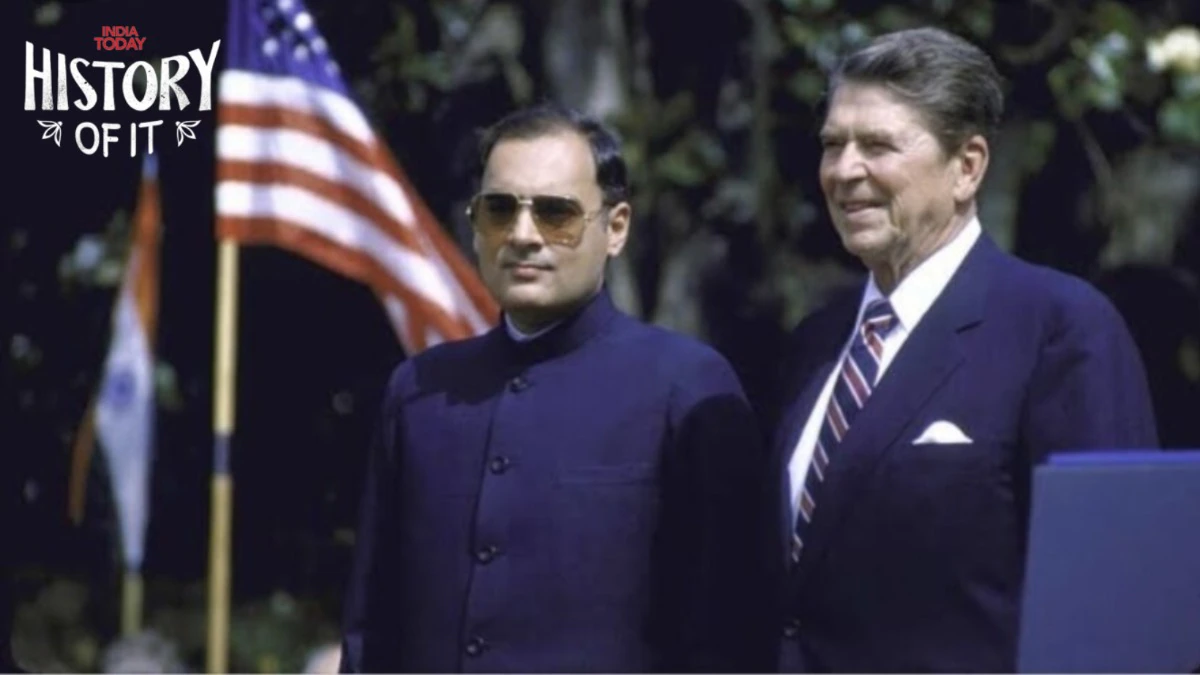
Barely seven months after he became prime minister following Indira Gandhi’s assassination in October 1984, Rajiv Gandhi was to visit the US in June 1985. The trip was designed to reset India-US relations under the young leader and included high-level talks with US President Ronald Reagan, who had met Indira Gandhi in 1982. An address to a joint session of the US Congress, and meetings with business and technology leaders, were also planned.
Despite being close to the USSR, New Delhi was cautiously seeking stronger cooperation in advanced technology, trade, science and defence-related sectors. Meanwhile, Rajiv was seeking to present himself internationally as the face of a modernising India.
The FBI, tracking Birk and his activities, was on an operation which was elaborate and patient.
Badhwar reported that undercover agents gradually gained the confidence of Gurpratap Singh Birk and his associates, Lal Singh and Ammand Singh.
KHALISTANI TERRORISTS SOUGHT TRAINING IN AUTOMATIC WEAPONS, CHEMICAL WARFARE, URBAN GUERRILLA TACTICS
A secret operative identified as “A” was introduced as the head of a mercenary organisation capable of providing weapons, explosives and military training to the Khalistani terrorists. Unknown to the suspects, every major meeting was secretly recorded on camera by the FBI.
At a January 26, 1985 meeting in New York, Birk and Lal Singh outlined their ambitions and handed the FBI agent its wishlist.
The Khalistani terrorists wanted to overthrow the Government of India through violence. They discussed bombing strategic targets, including a nuclear power plant, bridges, hotels and public buildings. They sought training in explosives, automatic weapons, chemical warfare and urban guerrilla tactics. They also asked for false passports and plastic explosives, reported India Today Magazine in June 1985.
The terrorists hadn’t revealed that they wanted to assassinate the Indian Prime Minister.
A parallel account published in The New York Times in March 1986 described how FBI undercover operative Thomas Norris, a decorated Vietnam War veteran, posed as an explosives expert and met Birk repeatedly as part of the investigation.
The FBI soon expanded its surveillance.
KHALISTANIS TRAINED TERRORISTS IN US, PLANNED STRIKES IN INDIA
The assassination plot surfaced during preparations for a Khalistani terrorist training camp in the US.
According to the FBI account, Gurpratap Singh Birk and his associates located a wooded site in Columbia, New Jersey, where terror recruits would be trained in weapons and explosives. The trainees would later travel to India and expand the network, planned Birk and his associates.
It was during a drive to inspect the terror-camp site in the woods that Birk made a bigger and more chilling request to “A”.
He asked the undercover operative to find someone capable of assassinating Rajiv Gandhi.
Initially, the group wanted the killing to take place in India. When Rajiv Gandhi’s June 1985 visit to the US was announced, they shifted focus to America. The FBI operative discussed several possible methods. Costs and logistics were weighed. Payment discussions were postponed for a later date, India Today Magazine reported.
The FBI’s inputs later found place in the Jain Commission’s examination of threats faced by Rajiv Gandhi. The commission recorded that the FBI had learnt in early 1985 of plans by New York-based Sikh extremists to assassinate the prime minister and bomb strategic Indian targets. It noted that Birk’s group was willing to pay $60,000 for the assassination, reported another India Today Magazine report from 1999.
The Jain Commission was a one-man inquiry headed by Justice MC Jain, set up by the PM PV Narasimha Rao government in August 1991 to investigate the conspiracy behind Rajiv Gandhi’s assassination, and the wider circumstances that enabled it. The Commission submitted its report in 1999.
The 1985 conspiracy against Rajiv Gandhi, however, was not the one that forced the FBI to act. Another target moved unexpectedly into the crosshairs of the Khalistani terrorists, led by Gurpratap Singh Birk. And that was then Haryana Chief Minister Bhajan Lal.
HOW KHALISTANI TERRORISTS TRAINED AT A TRAINING CAMP IN US
The FBI operation was originally intended to nab a much larger network of Khalistani terrorists in the US, and keep an eye out on the extremists.
According to Badhwar’s report, the FBI agents planned to allow nearly two dozen extremists to assemble at the New Jersey Khalistani training camp. The site was to be secretly wired with cameras and recording equipment before a coordinated raid.
In another India Today Magazine report (July 1985), journalist Ramesh Chandran quoted former US commando Frank Camper, whose Alabama training facility had been attended by some members of the group. Camper said the Khalistani terror recruits openly sought training in assassination techniques, explosives and attacks on infrastructure. “They wanted to learn assassination techniques, and they wanted to learn how to blow up trains,” he said.
According to Chandran’s report, “four Sikhs, including Lal Singh and Ammand Singh, took courses there in November [1984], along with their ringleader Gurpratap Singh Birk”.
According a report in The Indian Express, the terrorists “planned to select and train 100 commandos and send five of them to each Indian state to cause widespread sabotage and create panic”. The possible targets of these commandos included the Bhabha Atomic Research Centre.
TERRORISTS WANTED TO KILL RAJIV GANDHI BUT MOVED TO KILL BHAJAN LAL FIRST
But another high-profile Indian target, soon to land in the United States, distracted the terrorists.
While Haryana Chief Minister Bhajan Lal was in the US and receiving medical treatment in New Orleans, Birk and his terror aides decided to kill him as well. After discovering his location, they sought help obtaining a hitman and purchased a .45-calibre pistol through contacts they believed were criminal associates.
Sadly for Birk, they were linked to the FBI operation as well. But the threat to the Haryana CM forced FBI investigators to act early.
Police surveillance around Bhajan Lal’s hotel intensified. On May 4, 1985, officers arrested Gurpratap Singh Birk and four Khalistani terrorists outside the hotel Lal was recovering in. Searches later recovered firearms, knives, maps and newspaper photographs of Haryana CM Bhajan Lal from Birk’s car.
The arrests protected Bhajan Lal but came at a cost. Ronald Depetris, the US prosecutor overseeing the case, told India Today Magazine in 1985 that the New Orleans arrests effectively blew the cover of the larger FBI operation. “We could have nabbed them all. But then Mr Bhajan Lal’s life was in danger. We had no choice,” he said.
HOW RAJIV GANDHI’S 1985 VISIT WAS IMPORTANT TO INDIA-US TIES
Meanwhile, a month after Birk’s arrest, Rajiv Gandhi landed in Washington on June 11, 1985. He held talks with President Ronald Reagan whose administration had hoped Rajiv Gandhi would adopt ”a more balanced posture” in relations with the United States and the Soviet Union, according to another 1985 report in The New York Times.
Reagan, welcoming Rajiv and Sonia Gandhi to the White House, said the United States was “steadfastly dedicated to India’s unity” and “firmly opposes those who would undermine it”.
The arrests of Birk and other Khalistani terrorists in the United States triggered a scramble among investigators. Birk was sentenced to seven years. Two of his aides, Lal Singh and Ammand Singh, escaped. Years later, Ammand Singh died while on the run in a 1988 Seattle car crash. Lal Singh evaded capture for years before being arrested in Bombay (now Mumbai) in 1992 after moving through Canada and Pakistan, noted the Jain Commission.
Before we wrap up, was the 1985 Khalistani conspiracy the only assassination plot against Rajiv Gandhi? Far from it. He faced repeated assassination threats between 1984 and 1991. The Jain Commission specifically recorded the FBI case involving Birk. It also documented a conspiracy from the same year, where Leicester-based Khalistaini extremists attempted to hire supposed IRA gunmen to kill Rajiv Gandhi during his London visit. There were more threats after that. Khalistani terrorists, lone attackers, all targetted Rajiv Gandhi, until the LTTE assassinated him in 1991.
– Ends