






Wakefield Council has agreed to scrap its target to become a carbon neutral authority by 2030 and cut its climate change budget by £170,000.
The Reform-led administration voted in June in favour of overturning climate change and biodiversity declarations made in 2019.
Under Labour, the council had declared a climate emergency, pledging to become a carbon-neutral authority by 2030 and a net zero district by 2038.
At a meeting on Tuesday (July 21), cabinet members voted in favour of a recommendation to “agree a practical approach to end some of this council’s climate-related activity.”


A report to senior councillors said the decision could have “workforce implications” which would “be subject to formal trade union consultation.”
Wakefield Council leader Karl Johnson told the meeting: “It is not about denying the science of climate change.
“It is about focussing council resources on practical actions that can be delivered locally and benefit residents.
“The council will abandon the net zero targets of becoming carbon neutral by 2030 and achieving district-wide net zero by 2038, recognising these targets as unachievable and unnecessary.”

Coun Johnson said the council would also “unpublish” the council’s climate change action plan and scrap the role of “climate change elected member champion”.
Cabinet members also agreed to end support for the Wakefield Net Zero Partnership, an organisation which connects local organisations, businesses, and community groups to share sustainability best practices.
The council will now withdraw from the Yorkshire and Humber Climate Commission’s climate action pledge, a public commitment for businesses and organisations to act on the climate and ecological emergency.
The meeting was told the council’s climate change newsletter and associated social media channels would be be “retired” under the changes.
According to the report, the council’s remaining revenue budget for the current financial year (2026/27) is around £170,000.
It said: “Subject to the council’s organisational change processes, cabinet is asked to agree to re-purpose this spending to contribute to the 2027-28 budget setting process.
“This proposal may have workforce implications, which would be subject to formal consultation in line with the council’s HR (human resources) policies and procedures.”
Coun Johnson said the authority’s new policy included making the council’s property portfolio, which contains more than 1,600 assets including civic buildings, offices and commercial property, more efficient.
Further improvements include upgrading the council’s ageing fleet of vehicles, 72% of which are “beyond their economic life.”
Other plans include supporting residents and businesses to become more energy efficient, as well as improving recycling rates and maintaining over 600 green spaces across the district.
The report added: “Local government decides how best to serve communities and is best placed to integrate activity on the ground so that action on climate change also delivers wider benefits – for fuel poor households, for the local economy, for the environment and biodiversity, as well as the provision of green jobs and skills.”
After the meeting, Rosa Foster, director of Yorkshire and Humber Climate Commission, said: “People in Wakefield, like all of us in Yorkshire and around the UK, are feeling the effects of our changing climate in real time with back-to-back heatwaves that are impacting people’s health, our schools and workplaces.
“We agree that practical, locally led solutions are needed to help people and businesses adapt and thrive.
“We also believe that place-based leadership is going to be critical to successfully reducing, preparing and adapting to the impacts of climate change.
“We work closely with local leaders around the region and have always had a productive relationship with Wakefield Council.
“We would welcome the opportunity to meet with the new administration to discuss how we can continue to support them in their ambitions to make Wakefield more resilient, prosperous, and a great place to live now and in the future.”
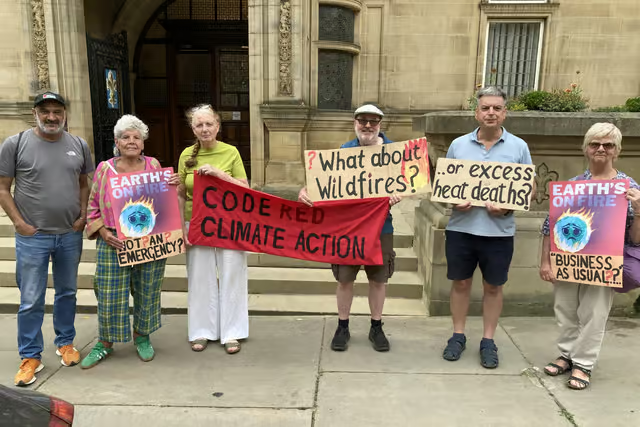
Members of environmental group Just Transition Wakefield gathered outside Wakefield Town Hall ahead of the meeting.
Group spokesperson Catherine Porritt said: “This is neither practical nor climate action.
“In this report they aim to remove all expertise on climate change from the council and bury all aspects of their business-as-usual policy in departments which will have neither the time nor the knowledge to continue them.
“Climate action is not continuing, it is being hidden to slowly wither and die.”