









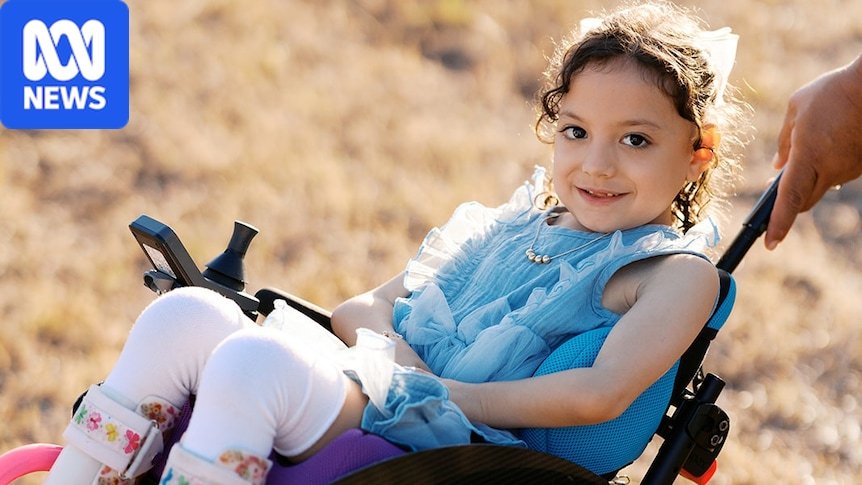
A six-year-old girl living with a rare genetic bone disorder was left stranded at an airport after her $33,000 specialist wheelchair was severely damaged by an airline during a flight from Townsville to Brisbane.
Adelaide Tuimalealiifano, one of only about 60 people globally diagnosed with multicentric carpotarsal osteolysis syndrome (MCTO)—a condition causing the loss of wrist and ankle bones—relies on her custom wheelchair for mobility. While she can walk short distances, the chair serves as her primary means of independence.
Upon arriving at Brisbane Airport this week, the family discovered a critical bracket on the wheelchair had been twisted, rendering the device unusable. Adelaide’s mother, Amanda, said the nature of the break suggested a “significant force” had been applied during transit. Because the chair was broken, Adelaide’s father, Jaster, was forced to carry his daughter through the Queensland Children’s Hospital to ensure she could reach her medical appointments.
While Jaster was eventually able to perform a makeshift repair using hardware tools, Ms. Tuimalealiifano emphasized that the situation could have been catastrophic for a less supported passenger.
“Someone’s wheelchair is essentially their legs, and breaking a wheelchair is like breaking someone’s legs,” she said. “If our daughter was an adult and she was travelling solo and she couldn’t walk anymore… she wouldn’t be able to leave the airport and she would be stranded.”
The incident has sparked fresh outrage, with a video documenting the ordeal reaching nearly 100,000 views on social media. Many in the disability community have responded by sharing similar stories, highlighting a recurring pattern of mistreatment of mobility aids by major carriers.
Virgin Australia has issued apologies to the family and stated it is committed to improving accessibility and inclusive travel. However, the airline has faced repeated scrutiny in recent years, with multiple documented incidents involving broken chairs, poor handling, and accessibility failures.
Megan Spindler-Smith, chief executive of People With Disability Australia (PWDA), called the damage to personal mobility equipment a “long-standing issue” that continues to occur despite frequent complaints.
“How are airlines not sorting this out?” they asked. “When equipment is actually damaged, passengers need more than just a ‘sorry, we’ll try and do this better’.”
Advocates are now calling for mandatory reporting for all airlines regarding incidents of damaged or missing mobility equipment to better quantify the scale of the problem. As the federal government reviews proposed new aviation disability standards, organizations like PWDA are pushing for these to be transformed into “practical, enforceable requirements.”
“Airlines and ground staff need to be properly trained on how to handle wheelchairs, because they are not the same as luggage,” Spindler-Smith said. “We need to ensure people with disability can travel with confidence, just like everyone else.”
Disclaimer: This content is auto-generated for informational purposes only.
Source: Read Original News