







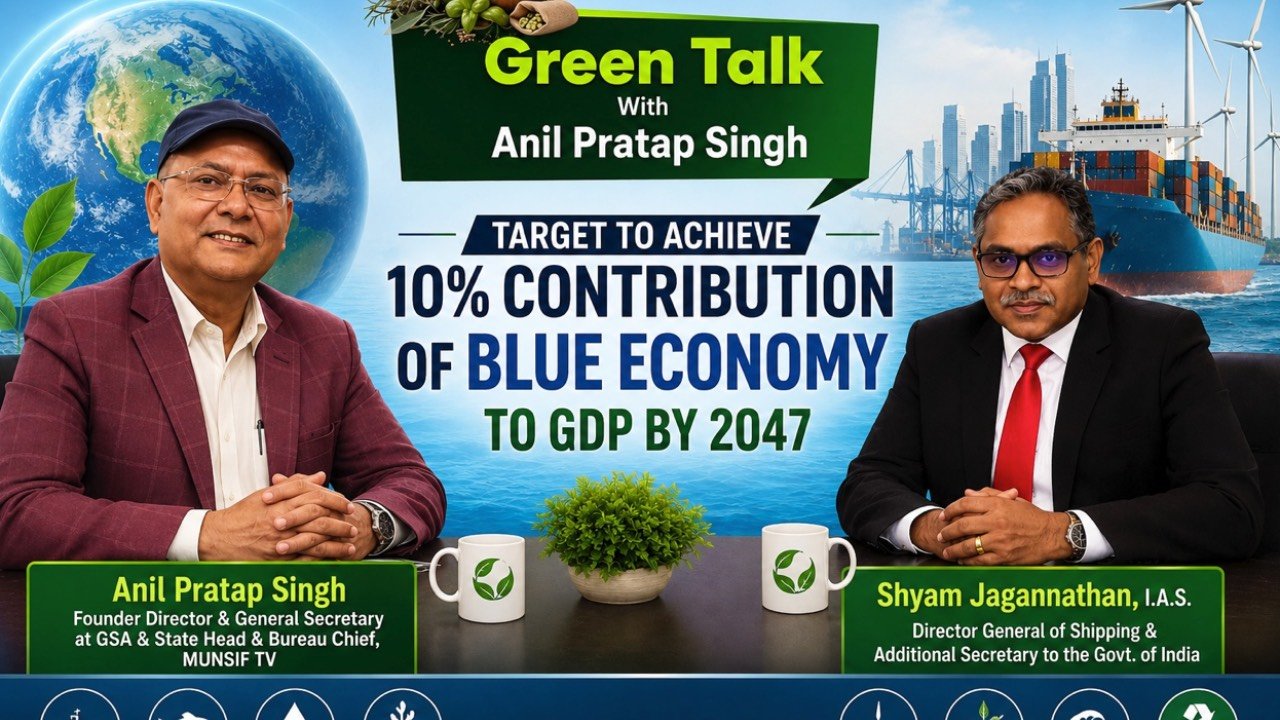
Highlighting India’s aggressive march toward net-zero carbon emissions and sustainable ocean governance, Shri Shyam Jagannathan , Director General of Shipping and Secretary to the Government of India, has presented a comprehensive vision for the nation’s maritime future. Speaking in an exclusive high-level conversation on the special World Ocean Day edition of Munsif TV’s flagship program ‘Green Talk with Anil Pratap Singh’, the DG Shipping detailed how the maritime sector is being strategically positioned to power a ‘Viksit Bharat’ by 2047 and scale up the Blue Economy’s contribution to 10% of the national GDP.
The crucial discussion, hosted and anchored by renowned scientist and environmental author Dr. Anil Pratap Singh, brought forward definitive policy roadmaps, pioneering legislative milestones, and structural frameworks guiding India’s maritime green transition.
- The Eight Pillars of the National Maritime Decarbonization Policy Framework
During the broadcast, the Director General of Shipping revealed that under the strategic direction of the Ministry of Ports, Shipping and Waterways (MoPSW), India is actively executing a robust ‘National Maritime Decarbonization Policy Framework’ built on eight core pillars designed to drive a deep structural transition:
- Pillar 1: Green Shipping – Focuses on achieving higher energy efficiencies on existing vessels and converting conventional internal combustion engines to alternate net-zero fuel propulsion.
- Pillar 2: Green Ports – Ecosystem greening across major ports to drastically scale down operational emissions in line with the Harit Sagar Guidelines and Maritime India Vision.
- Pillar 3: Green Ship Recycling – Firmly aligning with the Hong Kong Convention to position India as the foremost global destination for sustainable ship recycling.
- Pillar 4: National Green Finance – Creating targeted financial mechanisms and pooling capital resources to enable high-investment green technologies.
- Pillar 5: Green Skill Development (Just Transition) – Equipping and training India’s massive seafaring workforce to confidently handle next-generation green tech.
- Pillar 6: Green Alternative Fuels – Leveraging India’s low-cost solar production to move from hydrocarbon dependency to a green energy surplus via the downstream production of Green Ammonia, Green Hydrogen, and Green Methanol.
- Pillar 7: Green Technology & Digitalization – Promoting incubation, regulatory sandboxes, and startup investments in maritime single-window systems to ensure smarter, energy-efficient logistics.
- Pillar 8: Waste Management and Pollution Prevention – Strengthening compliance frameworks to check ambient waste and safeguard fragile marine ecosystems.
- Human Capital and Just Transition: ‘Sagar Mein Yoga’ & ‘Sagar Samman’
A primary focus for the DG Shipping is scaling up India’s global seafaring presence from 16.5% to over 20%. To ensure an equitable ‘Just Transition’ for this massive workforce, the Directorate has introduced ‘Sagar Mein Yoga’, a unique program embedded with 10 foundational pillars of wellness—covering emotional, intellectual, and financial security for seafarers transitioning back to shore.
Furthermore, to champion gender inclusion and secure equality at sea, the ‘Sagar Samman’ initiative has been enacted alongside a 24/7 dedicated grievance helpline, ensuring a highly respectful, secure workspace for female maritime professionals.
- The ‘Surface-to-Sea’ Pipeline: The Crucial Role of Inland States
Addressing a critical geographical misconception, the DG Shipping threw light on the direct surface-to-sea connection. He emphasized that inland states like Uttar Pradesh, through which sacred river systems flow, play a decisive role in marine conservation. Untreated municipal sewage and industrial microplastics discharged into inland river systems ultimately reach fragile oceanic zones like the Bay of Bengal, severely impairing marine biodiversity and the biological carbon pump (marine carbon sequestration).
He appealed to citizens to guard river ecosystems with the same devotion as maternal entities, complementing Prime Minister Narendra Modi’s ‘Ek Ped Maa Ke Naam’ tree plantation drive to reinforce critical carbon sinks.
- Landmark Legislative Reforms and Ocean Law 2026
The DG Shipping marked the current period as a watershed era for Indian maritime legislation, where outdated laws have been heavily upgraded to international standards to support the salvage economy, streamlined vessel registration, and swift wreck removal.
The historic Coastal Shipping Act 2025 now gives a niche focus to coastal trade, leveraging strategic transshipment hubs like Vizhinjam, Galathea, and Vadhavan. On the global stage, India’s active alignment with the BBNJ (Biodiversity Beyond National Jurisdiction) Agreement, widely hailed as ‘Ocean Law 2026’, reinforces the nation’s steadfast commitment to safeguarding marine biodiversity in international waters.
Conclusion
Concluding the broadcast, host Dr. Anil Pratap Singh reinforced the structural cognitive links between SDG-13 (Climate Action) and SDG-14 (Life Below Water), reminding global viewers that oceans act as our planet’s primary ‘Blue Lungs,’ stabilizing global temperatures and generating vital oxygen through marine phytoplankton.
Media Reference Link (Full Video Interview): https://youtu.be/rwJjEZeq4iQ